


Welcome to this week’s Brief, our analysis of the most consequential developments in unmanned systems and drone warfare. Each week we track battlefield innovation, emerging doctrine, and the technologies reshaping how states and non-state actors deploy unmanned systems.
Have intelligence requirements, developments we should investigate, or perspectives to share? Contact us at info@dronesense.ai.
Deep Dive: Can high interception rates be sustained without skilled pilots?
On the surface, the procurement logic of interceptor drones favors volume. Ukrainian President Zelensky revealed in January that Ukraine produced up to 1,500 interceptors per day, with the capacity reaching 2,000 with adequate funding. The increase in production was reflected in how Ukraine efficiently countered Russian threats. By February 2026, interceptors accounted for 30% of all aerial targets destroyed, exceeding 70% of Shahed downings over Kyiv alone.
But volume alone never ensured a sure-kill. The success of interceptors depended on operators' skills, even with autonomous navigation assistance. Maria Berlinska of Ukraine's Victory Drones project argued that as high as 90% of success in drone warfare currently depends on team training, not technology. Operators' skills become a crucial determinant of high kill-rates as the difference in drone quality gets narrower.
The biggest challenge currently lies in ensuring that the pipeline of trained pilots matches the procurement timelines. The Achilles regiment, one of five elite units in Ukraine's Drone Line, said that a minimum of three months is required to produce a mission-ready interceptor operator. The widespread campaign by the Russian military encouraging youngsters to become drone pilots signals how crucial yet in shortage the operators are in the current system.
Related:
- South Korean military pursues plans for mass 3d printing of drones and training over 500,000 pilots. (News PIM)
- Russia is luring students with large financial packages to join drone units. (SCMP)
The US military has launched several courses and certifications for interested candidates, but the number of capable operators is far below that in Ukraine and Russia. In fact, the US is disproportionately dependent on Ukrainian combat data and soldiers for its capability-building. Those who argue that AI-driven piloting can offset this deficit fail to acknowledge that in the majority of Shahed interceptions over Ukraine, pilots took control at the last minute to ensure interception against adversarial maneuvers.
This holds for lower-resource environments as well, where drone technologies are not relatively mature. In Sudan and across the Sahel, operator proficiency has consistently determined whether drone hardware delivers tactical results or sits idle. Colombian and West African contractors entered Sudan specifically to address the training gaps that hardware acquisition alone created.
The arms race that determines interceptor effectiveness runs through the pilot pipeline, not the production line. The first force to scale human capital at the same rate as hardware will hold the asymmetric advantage.
China Watch: Material Science and Hybrid Propulsion
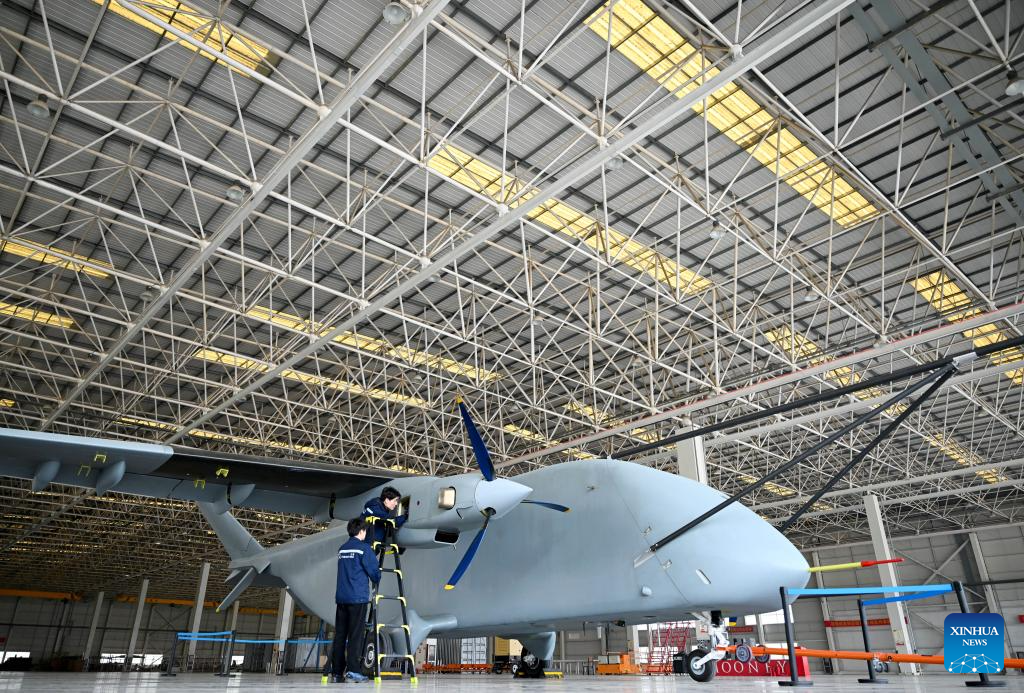
The world’s heaviest cargo drone, CY-8, built by China North Industries Group Corporation Limited (Norinco), completed its maiden flight this week. The drone has dual-use capabilities and weighs 3.5 tonnes with a matching payload capacity. CY-8 is highly adaptable to its environment, particularly suited for high-altitude operations and island terrains.
The Chinese Academy of Sciences has proposed a new composite material manufacturing method that can increase performance gains and reliability of structures used in drones, aircraft and spacecraft by 27%. The new approach involves stacking up fibre layers symmetrically and at opposing angles to minimise internal stresses to improve design flexibility, particularly in high-precision components such as fuselage, wings and load-bearing panels. The method also improves joint strength by 13%, indicating durability under complex stress conditions.
China’s 60-kilowatt hybrid propulsion system developed by Sichuan Tianfu Light Power Technology, passed its flight tests and is ready to make small drones stealthier. The system’s motor combines fuel and powered electricity, meshing two distinct propulsion pathways found in uncrewed vehicles. The leverage lies in the system’s ability to generate electricity from fuel during flight and switch to quiet electric mode when required. This would reduce the thermal and acoustic signatures of small drones, enabling them to fly longer distances.
On Our Radar:
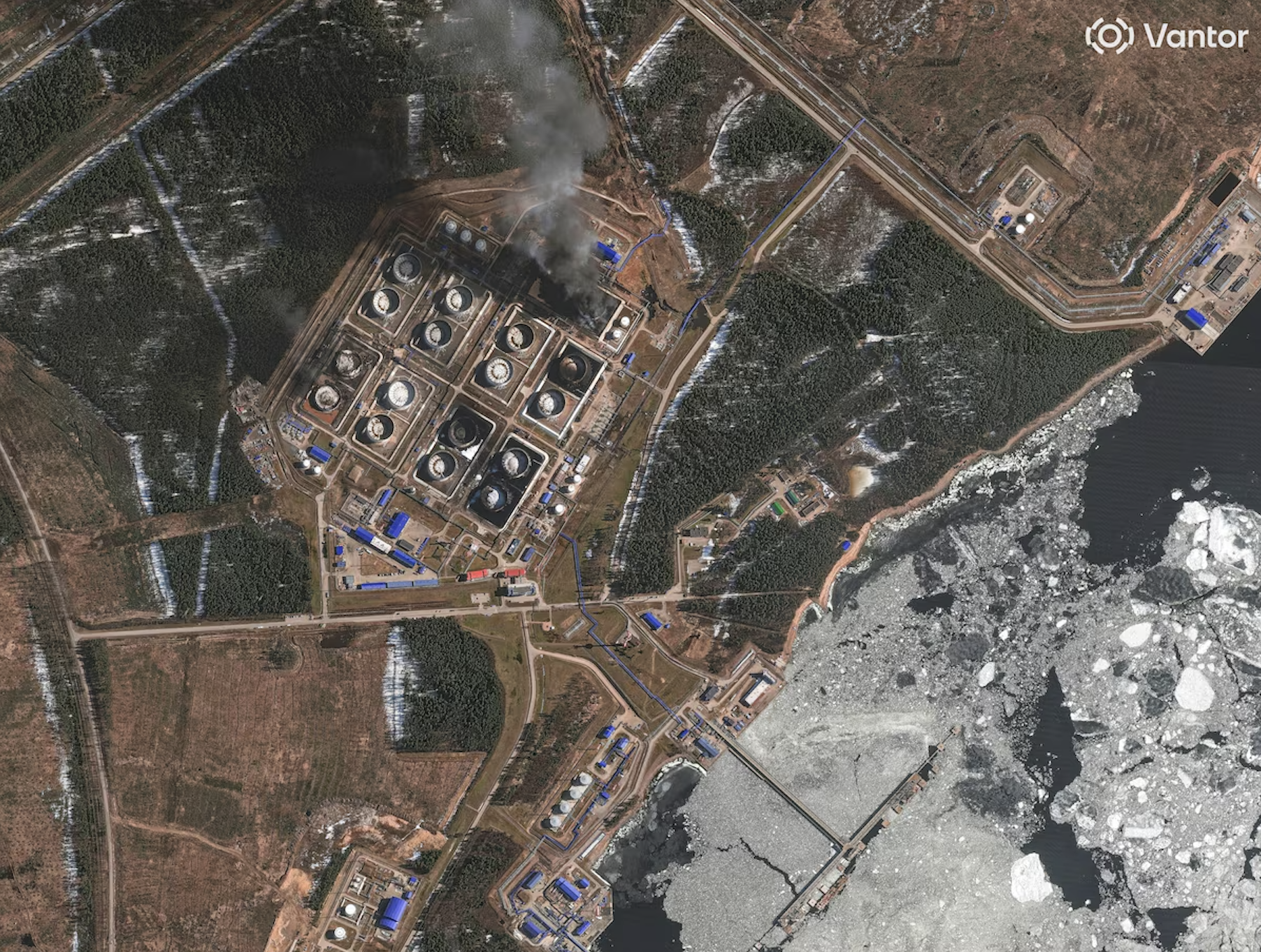
Russian oil output cuts are unavoidable as drone attacks shrink exports
Ukraine's strikes on Baltic port infrastructure, pipelines and refineries have knocked out roughly 1 million barrels per day of Russian export capacity, forcing oilfields to curtail output as Transneft's pipeline system fills up with crude that cannot reach market. At least 20% of total export capacity is expected to remain offline, costing the state billions, keeping millions of barrels off of global oil markets, and offering a stark reminder that Russian C-UAS systems have not solved refinery vulnerabilities for three years. A similar situation in the Gulf could lead to long term risk premiums for oil after the direct conflict. (Reuters)
Hezbollah uses fibre-optic drones with anti-tank warheads for the first time
Fiber-optic drone footage released by Hezbollah shows a series of attacks against Israeli armor in Al-Bayada, Lebanon. The supplier of the fiber-optic capable FPV drones is unconfirmed, but the dominant source of such systems in the Russo-Ukraine war is China, making Chinese-origin spools the most probable explanation. If confirmed, it would mark a further economic entanglement of China in the broader conflict. (Funker530)
Ukraine claims near-90% air-defense success in March
Ukraine's air defense interception rate climbed to 89.9% in March, up from 85.6% in February and 80.2% in December, even as Russian attack volumes rose to 6,600 sorties from 5,345 the prior month. The simultaneous improvement in kill rate and increase in incoming volume makes March the most demanding month Ukraine has successfully defended since the war began. (Defense News)
Red Cat Buys Apium Swarm Robotics Amid Growth Spree
Red Cat Holdings is acquiring new capabilities quickly, purchasing Apium Swarm Robotics, adding distributed control software that enables multiple drones or unmanned surface vessels to coordinate autonomously in GPS-degraded and comms-contested environments. Apium will operate as an independent subsidiary and its architecture is expected to be integrated across Red Cat's rapidly growing family of systems, including the Black Widow ISR drone currently fielded by the US Army. (The Defense Post)
Infrared FPV Interceptor Drones Set for Mass Use
Russia is testing night-time interceptor drones operating on a "fire and forget" principle in the Ukrainian theater, designed to complement the Yolka-type daytime interceptors already in active use. Ukraine is developing a parallel capability: Brave1's UAV division is working on infrared seeker heads that would allow interceptor drones to engage targets autonomously, removing the operator from the terminal phase of interception. (TASS)
Government C-UAS spending hits $29 billion in Q1 2026
Publicly announced C-UAS contracts topped $29 billion in the first quarter of 2026, led by the US Army's $20 billion ten-year award to Anduril Industries and Poland's $4.2 billion SAN program. Major new programmes have also been announced in Colombia, Nigeria, Saudi Arabia, Qatar and the UAE, reflecting a global procurement surge driven by the Iran conflict and the lessons of Ukraine. (Unmanned Airspace)
Hardware Innovations and Tactical Adaptations
- Spiked IEDs: Russian soldiers have found unidentified, drone-delivered IEDs (81/82mm) based on mortar bombs on the frontlines. The devices have spiked tails intended for embedding in asphalt when dropped from a height. It remains unclear whether these devices have the explosive capacity to damage armored vehicles. The most likely target based on available design features is Russian motorcycle/ATV-mounted soldiers.
- Drone with Skewers: Videos on Telegram show another low-cost interception solution employed by Russia this week. Russian FPV drones were retrofitted with metal rods to skewer Ukrainian drones mid-air during active operations. Structural damage without using explosives reduces interception costs while preserving the interceptor's reusability for multiple rounds.
- Anti-radiation capability: Russian Geran-2 drones are now mounted with radar-homing sensors that enable them to detect radar emissions and guide them towards the emitting antenna. The innovation is most likely a countermeasure against the extensive Ukrainian radar network, which plays a key role in improving the interception of Russian drones. Solutions that Ukraine could employ range from emission control and decoy signaling to frequency hopping.
What We're Reading
- Vietnam Pushes to Climb the Drone Value Chain: Vietnam is moving from drone assembly to indigenous design, positioning itself as a mid-tier supplier in the Indo-Pacific defense market. (VietnamNet)
- Russia Establishing Long-Range Drone Bases in Belarus: The bases extend Russia's strike radius into central Europe and give Moscow a second launch axis against Ukraine that bypasses existing Ukrainian air defense coverage. (Forbes)
- Drone Ship Builder Saronic Valuation More Than Doubles to $9 Billion: The funding round reflects investor conviction that autonomous surface vessels are the next major procurement category, following the Red Sea and Gulf conflicts. (Reuters)
- Anti-Aircraft Drones More Effective at Shooting Down Shaheds on Front Lines Than Over Cities: The finding points to a fundamental tension in interceptor deployment, where urban airspace constraints reduce the engagement window that makes drone-on-drone interception viable. (Militarnyi)
- FPV Drones Hunt Russian Forces in Mali as Anti-Moscow Opposition Spreads Across the Sahel: The use of FPV drones against Wagner-affiliated forces in Mali marks the first confirmed application of Ukraine-style drone tactics in sub-Saharan Africa. (United24)
- 6,000 NATO Soldiers Were Routed by a Few Ukrainian Drone Pilots: A NATO exercise showed that conventional armored formations remain acutely vulnerable to small drone teams operating with current-generation FPV hardware. (Daily Mail)
- Iran War Supercharges Marine Drone Revolution: The combination of Red Sea and Gulf operations has accelerated naval drone procurement timelines across at least a dozen navies that had previously treated the capability as experimental. (Reuters)
- Iran's Drone War Exposes Deep Cracks in Air Defenses: Gulf states are burning through interceptor stockpiles at a rate that existing production lines cannot replenish, a structural vulnerability that Iran's operators have clearly identified. Even so, US Embassy Riyadh was badly damage in attacks which were unable to be repelled. (Business Insider)
- New Laser System Neutralizes Drones for Less Than $5 per Shot: At that cost per engagement, the Locust X3 is the first US-made directed energy system that meaningfully inverts the cost asymmetry that has defined the drone threat since 2022. (InfoDrons)
- Militaries Rush to Build Portable Interceptor Factories: Mobile production units that can be deployed close to the front are emerging as the answer to the supply chain lag that has repeatedly left air defense units short of interceptors during peak attack periods. (Defense News)


