


Welcome to this week’s Brief, our analysis of the most consequential developments in unmanned systems and drone warfare. Each week we track rapidly accelerating battlefield innovations, emerging doctrine, and the technologies reshaping how states and non-state actors deploy unmanned systems.
Have intelligence requirements, developments we should investigate, or perspectives to share? Contact us at info@dronesense.ai.

Deep Dive: Russian Decoy Drones are Changing Roles
Moscow now wants more from its decoy drones. So far, their primary job has been to confuse Ukrainian crews and draw interceptors away from strike drones. But Ukrainian crews are getting better at identifying decoys. The problem is tracking and verifying them still takes time, and operators are less likely to spend an interceptor once they recognize a drone as a decoy.
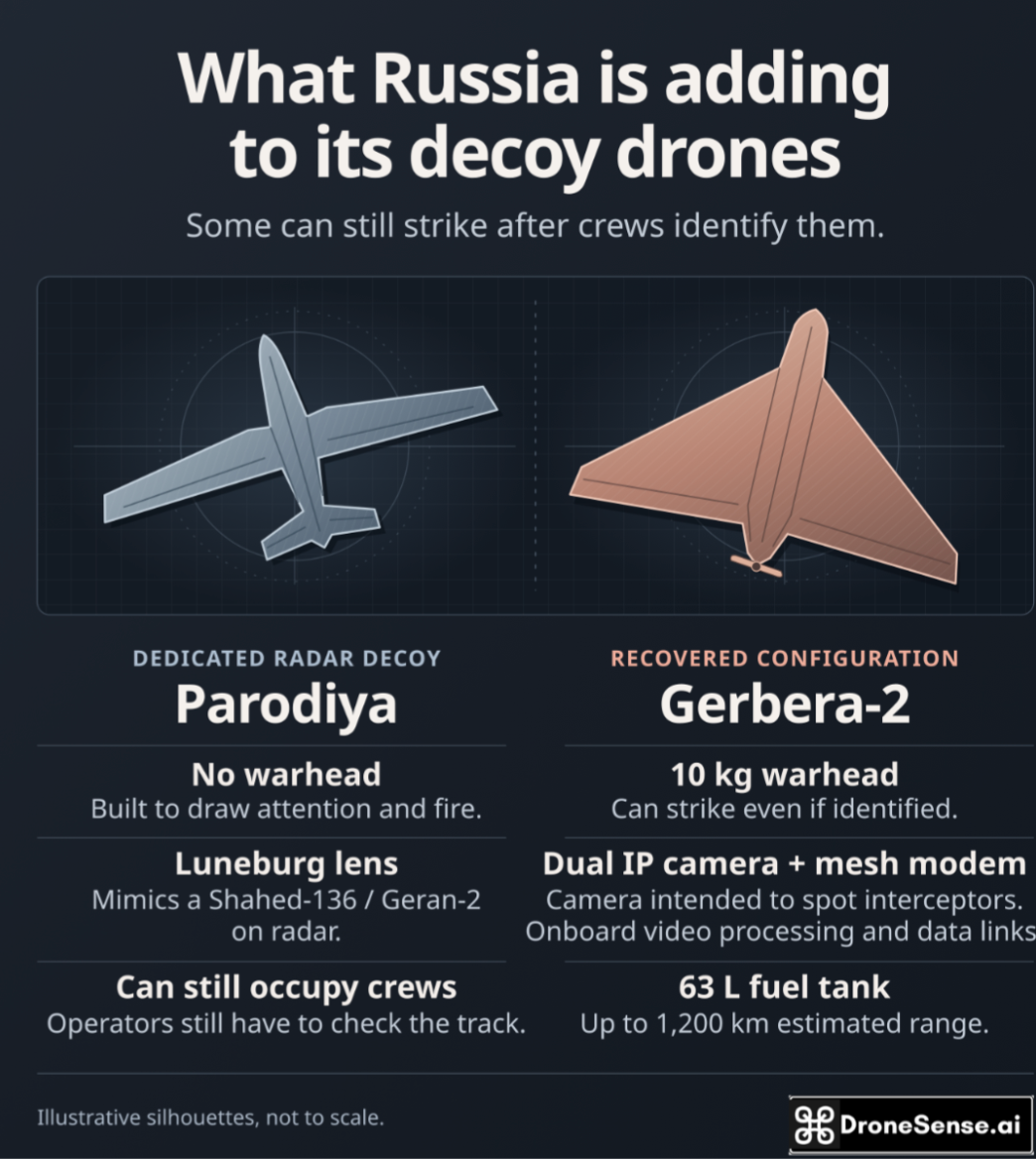
Decoys are undergoing a transformation which gives them a wider capability set per platform. Moscow likely wants some of these drones to deliver an effect even when they fail to deceive.
Russia’s low-cost Gerbera drone family already had strike and reconnaissance variants in 2024, but they were scarcely used. The enlarged Gerbera-2 shows how much more Russia is putting on a single drone. The recovered version carried a 10 kg warhead, cameras and a mesh modem. It also had a 63 L fuel tank. Ukrainian intelligence estimated a range of up to 1,200 km and cited a Russian claim of up to 25 kg of warhead capacity. Those figures do not establish that the drone can achieve both on the same flight.
Recognizing a Gerbera does not necessarily tell a Ukrainian crew what it carries. If crews can identify the family without distinguishing an armed version from an unarmed one, they still have to weigh the risk of letting it through. That could limit how many interceptors Ukraine saves through better identification. And if crews do recognize an armed Gerbera and it gets through, Moscow can still gain from the launch even though the drone failed to deceive them.
We examine why Russia is changing tactics now, what new decoys can deliver, and why some decoys like Parodiya have stayed the same even as Gerberas keep changing.
China Watch: China's stealth GJ-11 UAV onboard targeting | Compulsory CUAS | Germany ban & Language-guided drones
- China is giving the GJ-11 a clearer role in opening defended airspace for its wider air force. Latest disclosure links the tailless stealth drone with air strikes and suppression of enemy air defenses, while new close-ups show how its weapons, propulsion and sensing are incorporated into a low-observable design.
- Two internal weapons bays, with serrated door edges, allow weapons carriage without exposed pylons and stores disrupting the drone’s external shape. This strengthens the case for treating GJ-11 as a platform built around carrying weapons into defended airspace.
If its onboard sensor supports target identification, GJ-11 could potentially complete part of the work that otherwise requires another aircraft to approach or maintain observation.
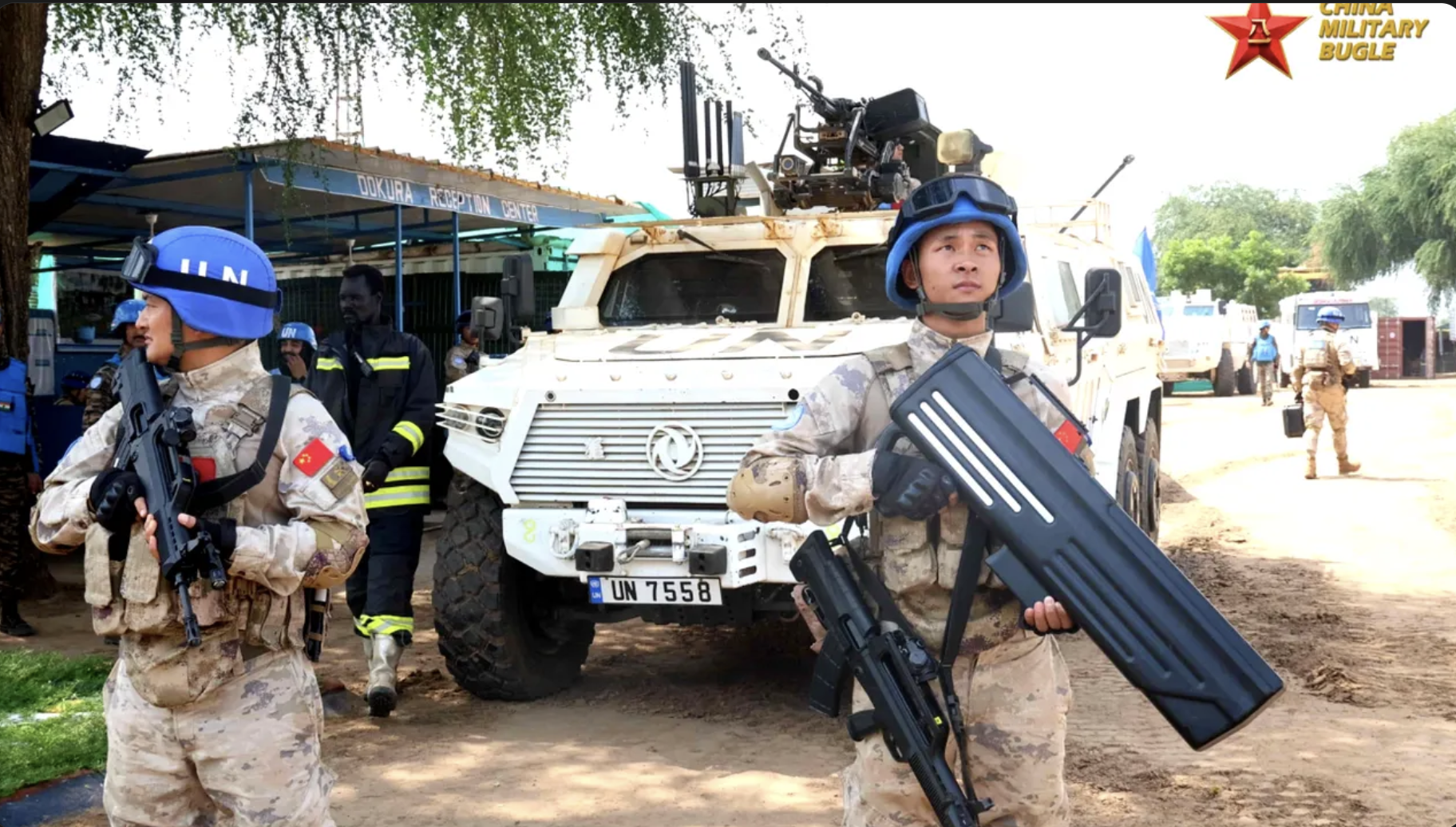
- A brigade of the 75th Group Army is extending counter-drone (CUAS) responsibility across infantry specialities. A recent account reports a formation continuing its approach after a soldier applied signal interference. Another soldier then used a counter-drone gun against the lead drone as the squad coordinated its response. PLA's training requirement is clear: personnel must keep acting when the first countermeasure does not stop the threat, in this case, the drone.
- Elsewhere, language-guided drones still need reliable movement near the target. Beihang University and its partners developed UAV-Flow++ to translate short instructions into maneuvers near objects. After additional training, the model achieved 93.16% success across 273 held-out simulator episodes.
On Our Radar:
Will Submarines Go the Way of the Tank?
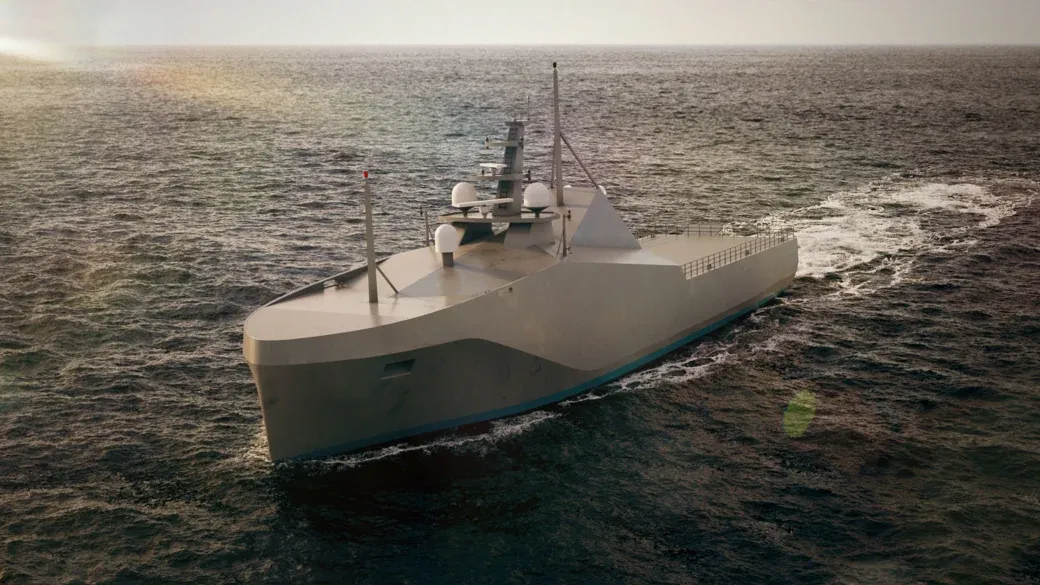
Several new submarine surveillance programs announced over the past few weeks point to a sub-sea domain contested by more numerous, persistent unmanned platforms. The buildout, even in its early stages, raises questions about the future of sub-marine warfare, just as early drone usage in the Caucuses did for the tank. Distributed unmanned systems can place serious strategic pressure on an expensive platform’s freedom of movement. While underwater contacts remain difficult to maintain and turn into engagements, a submarine need not be sunk for surveillance to constrain its usefulness. More frequent detection could force route changes, complicate access to operating areas, and consume time evading pursuit.
Drone Production Ramps Up on Both Sides of the Atlantic, but Spending Ambitions Faces Funding Squeeze
Neros secured a $450 million conditional Pentagon loan for U.S. component manufacturing, while Germany’s TYTAN opened a factory with planned capacity of 3,000 interceptors monthly. Factory expansion is advancing faster than agreement on the broader spending ambition though as the Pentagon seeks roughly $50 billion for autonomy and robotics within a $350 billion defense reconciliation request; congressional proposals assessed by CSIS provided only $60 billion for defense overall. That leaves drone priorities competing with other demands for a much smaller envelope.
Ukraine’s Growing Ground-Robot Fleet Faces Winter Weather Test
Ukraine’s ground robots are entering winter with more missions and more units depending on them. The 7th Air Assault Corps alone reports over 8,000 missions this year, including more than 600 evacuations. Mud and snow threaten mobility, while reduced foliage makes vehicles easier to spot from above. Those problems become operationally consequential when a stranded machine carries supplies needed at a position or a patient awaiting treatment: recovery can put personnel back onto the exposed route the robot was meant to spare them. Yet winter also makes those journeys more dangerous for soldiers. We'll be watching whether robots can continue completing enough essential missions to still reduce human exposure, and of course how the Ukrainians innovate (covered in the section below).
Drone Attack Halts Production at Iraq’s Khor Mor Gas Field
A suspected drone attack halted production at Khor Mor on November 8, with the Kurdistan Regional Government warning of a 2,800-megawatt reduction in electricity generation. The reported impact was on an LPG storage tank, but the consequences spread through the facility’s shutdown into gas-dependent power stations and their customers. A company can avoid direct drone damages and still lose production because its electricity supplier depends on a facility it neither controls nor protects. Assessing drone exposure narrowly by risk of being targeted misses a wider risk that is a second order feature of the falling cost of disruption.
Where Do Drones End and Robotics Begin?
From negations over humanoid robots patrolling tunnels in Gaza to robot dogs with the Ukrainian national guard, "robotics" is appearing more frequently alongside drone programs, raising a question about a field moving faster than its terminology: where do drones end and robotics begin? The categories describe different things. “Uncrewed” concerns who is aboard, “autonomous” concerns who controls a function, and “robot” can encompass machines with either characteristic. Robotics could therefore absorb drones as a subcategory while remaining a separate industry in procurement and investment. However in practice "robot" is being used more in non-combat roles like maintenance, explosive disposal, and some patrolling efforts. The divide isn't clean though, which stands to complicate how we assess both markets: "new" competitors may be applying familiar capabilities in another physical form, while shared labels can conceal substantial differences in what systems actually do.
Technical Intel:

Dummy Mobile Air-Defense Groups: Russia is positioning mock mobile air-defense teams along roads in occupied territory, using imitation weapons, vehicles and mannequins to resemble operational firing positions. The decoys are likely intended to draw Ukrainian drones away from genuine defensive assets and complicate visual target identification. They could also force operators to spend more time checking whether a suspected firing group is real before committing a drone. But static imitations are less likely to withstand prolonged observation, particularly when their activity does not match that of an operating air-defense crew.
Aerial Deployment of Ground Robots: Ukraine's 426th Separate Unmanned Systems Regiment has used a Perun aerial drone to transport a ground robot across the Dnipro, after which the robot continued its mission on the opposite bank with communications intact. The operation adds an airborne delivery method to ground systems that would otherwise have to cross exposed or inaccessible terrain. This could allow existing UGVs to operate beyond obstacles that limit their routes without exposing personnel during the crossing.
Tree-Cover FPV Ambushes: Ukraine is using FPV drones with suspended supports that allow them to remain in tree canopies during stationary ambushes. The observed configuration also includes a movable camera and digital video transmission, letting operators watch the surrounding area without repositioning the whole drone. Staying elevated could extend the observation area while conserving battery power, and foliage is likely to make the drone harder to notice from ground level. But branches can obstruct the camera and complicate departure.
Autonomous Recovery on UGVs: Ukraine has tested an AI KIT autonomy module on ground robots that can continue a pre-programmed mission when communications and positioning signals are lost. More than 20 kits have reached combat units. Instead of stopping when an operator loses control, the UGV can continue along a defined route, potentially reducing abandoned vehicles and the need to send personnel into exposed areas for recovery. This also shifts more responsibility to onboard navigation, which could struggle with unexpected obstacles, damaged routes or terrain that differs from the robot's reference data.
Enemy FPV Video Used to Protect UGVs: Ukraine's 14th National Guard Brigade has used intercepted video from Russian FPVs to guide a logistics UGV away from 2 attacks during a frontline mission. Viewing the approaching drone's camera feed gave operators a way to assess the immediate threat and change the robot's movement before impact. This gives existing video-interception equipment a second role beyond warning personnel of nearby drones, potentially protecting unmanned logistics without adding a separate defensive weapon. The method, however, depends on acquiring a usable video feed early enough to react.
Medical & Anti-Drone Retrofit on UGV: Ukraine has equipped its Triton amphibious UGV with a casualty platform mounted on 4 spring dampers and a folding overhead frame for passive protection against drone-dropped munitions. The dampers are intended to reduce shocks transferred to wounded personnel over rough terrain, while the frame addresses the exposure of patients and cargo to attacks from above. These additions could make existing ground robots more suitable for evacuations along FPV-exposed routes without sending crews forward. But the protection adds bulk.
What We're Reading:
- Containerized Air Defense Solution Targets Commercial Shipping: BAE Systems’ Sea Tridon C packages a 40mm gun and fire-control system in a shipping container, offering merchant vessels a temporary defensive installation against drones and other threats. (Naval News)
- Ukraine Reportedly Uses Alternative Satellite Terminals for Strike Drones: Russian sources claim recovered Ukrainian drones carry Israeli HiSKY terminals, suggesting another route to satellite-guided operations, although their operational use remains independently unconfirmed. (DefPulse)
- UFORCE Raises $700 Million at a $6 Billion Valuation: The Ukrainian-founded manufacturer will expand production across allied countries, scaling its air, ground, and maritime systems while distributing manufacturing beyond facilities exposed to Russian attacks. (UFORCE)
- Spain Places Large Orders for Tactical Drones and Microdrones: Contracts covering 147 Tarsis aircraft and 456 Skydio X10D microdrones will expand reconnaissance from small-unit operations to longer-duration tactical missions, with initial Tarsis deliveries scheduled for 2028. (La Razón)
- Ten European Countries Seek Interoperable Sea Drones: Britain and nine partners want unmanned vessels to operate interchangeably with allied warships, including transferring control between countries’ ships. (The Guardian)
- U.S. Air Force Seeks Autonomy for Cislunar Spacecraft: The service is seeking flight-ready software for navigation, hazard avoidance, and mission planning beyond near-Earth space, where communications delays complicate timely control from the ground. (DefenseScoop)
- Turkey Begins Developing Water-Dropping Firefighting Drones: Turkey’s agriculture ministry is working with its defense industry to develop drones that drop water on forest fires, extending unmanned aviation from fire detection into direct suppression. (Hürriyet)
- Drone Carries Weapons Across Pakistan–India Border: Indian police recovered two pistols and magazines with a crashed drone reportedly flown approximately one kilometer across the border into Fazilka, illustrating the use of unmanned aircraft to bypass border fencing for arms deliveries. (ABP Live)


