


Welcome to this week’s Brief, our analysis of the most consequential developments in unmanned systems and drone warfare. Each week we track battlefield innovation, emerging doctrine, and the technologies reshaping how states and non-state actors deploy unmanned systems.
Have intelligence requirements, developments we should investigate, or perspectives to share? Contact us at info@dronesense.ai.
Deep Dive: Who’s learning from Russia-Ukraine drone warfare faster, Iran or the US?
For every $20,000 Shahed-136 that Iran or its proxies launch, a defending nation may expend up to $2 million on a Patriot intercept. That 100:1 cost ratio is the structural problem driving everything else in the drone war. Both sides are now racing to close it, but through fundamentally different learning systems: a closed Russo-Iranian technology-for-tactics exchange, and an open, data-driven Western network with Ukraine at its center.
The Russo-Iranian loop works through direct reciprocity with the advantage of months of close coordination. Iran supplied Russia with Shahed designs and production knowledge, enabling Russia to develop domestic variants that are routinely stress-tested against NATO-supplied air defenses in Ukraine. Russia is now returning the favor by sharing electronic warfare and swarm coordination expertise. The training pipeline between the two countries has become increasingly structured.
UK Defence Secretary John Healey described the relationship this week as ‘circular' with British intelligence has identifying "definitive" tactical signatures of Russian influence in Iranian drone operations in the Gulf. The wreckage of a drone that struck RAF Akrotiri in Cyprus is now being forensically examined for Russian components. If confirmed, it would constitute hard evidence of co-development, not just doctrinal imitation.
The output of this loop is already visible in the evolving navigation stack of newer Shahed variants: a 16-element CRPA antenna that can block up to 15 GPS spoofers simultaneously, dual GPS/GLONASS reception, cellular-based RTK positioning through local LTE networks, and an inertial backup. An estimated 80% of the drone's electronic components are estimated to originate from Western manufacturers, an irony that underscores the ongoing porousness of export controls.
The American response is beginning to materialize in two concrete programs. Task Force Scorpion Strike, the Pentagon's first dedicated one-way attack drone unit, deployed the LUCAS during Operation Epic Fury. Built by SpektreWorks in Phoenix, the LUCAS is a reverse-engineered Shahed-136 carrying an 18kg warhead over 400 nautical miles on a 215cc combustion engine, at $35,000 per unit.
On the defensive side, the Pentagon is deploying the Merops counter-drone system from Ukraine to the Middle East. Merops fires a $15,000 delta-winged interceptor at 280 km/h, using AI-powered visual odometry to engage targets autonomously in GPS-denied environments. It has reportedly logged over 1,900 intercepts in Ukraine at a 95% success rate against Shahed-type drones.
New DroneSense Report: Iran's Data Center Targeting Logic
Three AWS data centers were operationally disrupted in the last two weeks. Two by direct hits and one by taking out its power grid. Iran precisely selected and validated the dual-use mature of its targets with open-source records, commercial satellite imagery, and a decade of publicly documented military contracts.
Read the full report to know why Microsoft Azure's UAE sovereign cloud carries the same dual identity that put AWS in the crosshairs.
The real challenge lies in how quickly Ukrainian expertise can be translated into operational capability to protect Gulf and American assets in the Middle East. Some estimates suggest a 90-day timeline, even as Gulf countries fly in Ukrainian commanders to train their militaries in countering swarms of Shaheds. In the meantime, the only cost-effective option for the Gulf states is to deploy anti-drone helicopters.
Alternatively, Russo-Iranian collaboration displays a faster tempo with agile, decentralized learning channels.
A compressed fielding timeline for Ukrainian interceptor drones may prevent further cost bleed in the Middle East. However, success will depend on the effective integration with the existing radar and sensor systems in the Gulf. What is sensed will only be intercepted; others may still slip past traditional detection methods.
Although interceptors now account for over 70% of Shahed intercepts in Kyiv, flying 6,300 sorties in February alone and destroying over 1,500 Russian UAVs, their performance is a result of Ukraine’s years-long efforts to build unconventional detection methods including acoustic detection networks and cellular signal analysis.
The deeper strategic advantage lies in data. Ukraine has built a NIST-compliant AI platform that gives allied developers access to millions of annotated frames from tens of thousands of combat missions, without exposing raw military databases. This is the asset that the Russo-Iranian intelligence-sharing model cannot easily replicate: a structured, scalable mechanism for converting that experience into next-generation autonomous capability.
On Our Radar
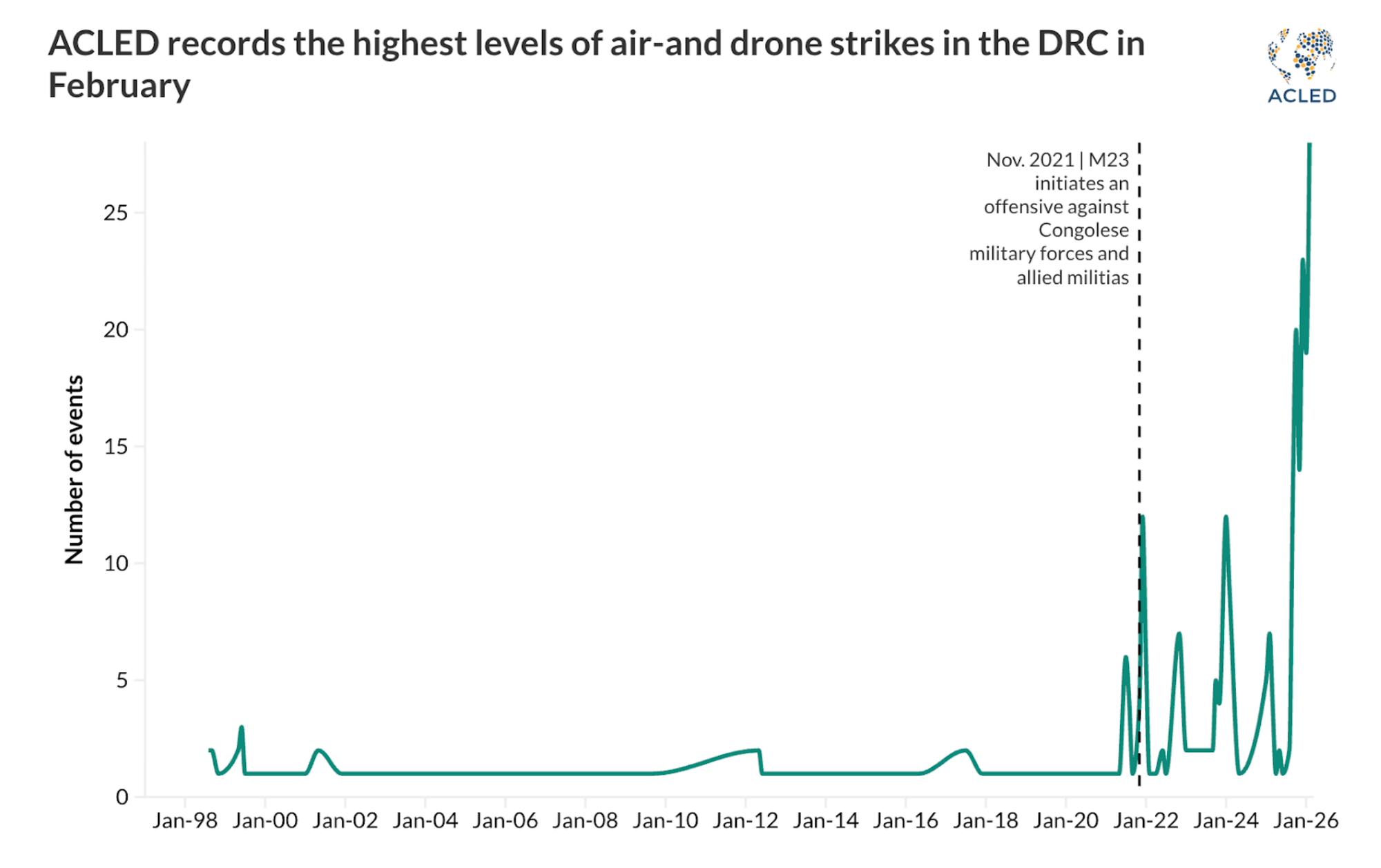
DRC Records the Highest Number of Drone Strikes in February 2026
Armed Conflict Location & Event Data Project (ACLED) recorded over 30 air and drone strikes in the Democratic Republic of Congo (DRC) in February 2026, the highest monthly total on record. The spike reflects the widening use of weaponized drones in aerial attacks by the Congolese security forces (FARDC) and rebel militia M23. Deployment of more advanced and lethal Chinese (CH-4) and Turkish (TAI Anka) drones underscores the role of smuggling networks in funnelling drones to conflict areas while signalling a deepening interest of third countries in this resource-rich nation. (ACLED)
Iraqi Militia Uses FPV Drones to Breach US Military Base
Open-source footage shows the first confirmed use of a FPV drone for a kinetic operation in the current conflict in the Middle East. Iran-based Kataib Hezbollah reportedly fielded an FPV drone tethered with a fibre-optic cable to infiltrate and surveil the US military site, Victory Base Complex, in Baghdad, Iraq. The video shows how easily the FPV drone breached military defenses undetected and manoeuvred around structures without being intercepted. This raises serious questions about the US’s C-UAS capabilities in the region, and signals bolstering drone capabilities of local militias. (Al-Jazeera)
Haiti's Domestic Drone War: 1,243 Dead, Zero Gang Leaders Killed
A Human Rights Watch investigation into Haiti's use of kamikaze drones for internal security documents 1,243 deaths, including 17 children, across 10 months of offensives that failed to kill or capture a single targeted gang leader. The campaign, conducted with private military contractors, exposes the lethal consequences of deploying military-grade loitering munitions in dense urban environments without adequate intelligence or targeting protocols. (HRW)
Turkey's Aksungur Becomes a Drone Mothership
Turkish Aerospace Industries has modified its Aksungur combat drone to carry and air-launch smaller, jet-powered Super Simsek UAVs capable of Mach 0.85 speeds and a 900km range. The configuration transforms the high-endurance Aksungur into a standoff platform for deploying expendable drones into contested airspace for electronic warfare, deception, or kinetic strikes. (The Defense Post)
Russia Fields New Drone Arsenal and Improvised Tank Defenses
Russia has introduced a wave of new drones to the front, including the 100km-range Kub-10ME kamikaze drone and air-launched models for the Su-57 fighter, while frontline units are improvising anti-drone defenses. T-80BV tanks of the 4th Guards Tank Division are now being fitted with the "Yozh" (Hedgehog), a cage of 1,300 unraveled metal cable "brooms" designed to entangle FPV drones and disrupt shaped-charge jets. (RIA) (IZ)
Merops Drone Killer Moves from Ukraine to the Middle East
The Pentagon is deploying the Merops counter-drone system, backed by former Google CEO Eric Schmidt's Perennial Autonomy, from Ukraine to the Middle East after the system logged over 1,900 intercepts against Russian-operated drones. The truck-mounted platform fires a $15,000 AI-guided interceptor at speeds over 280 km/h, using visual odometry and thermal signatures to engage targets autonomously in GPS-denied environments. (Business Insider) (Al Jazeera)
Innovation Corner: Infrared Counter-Interceptor Systems
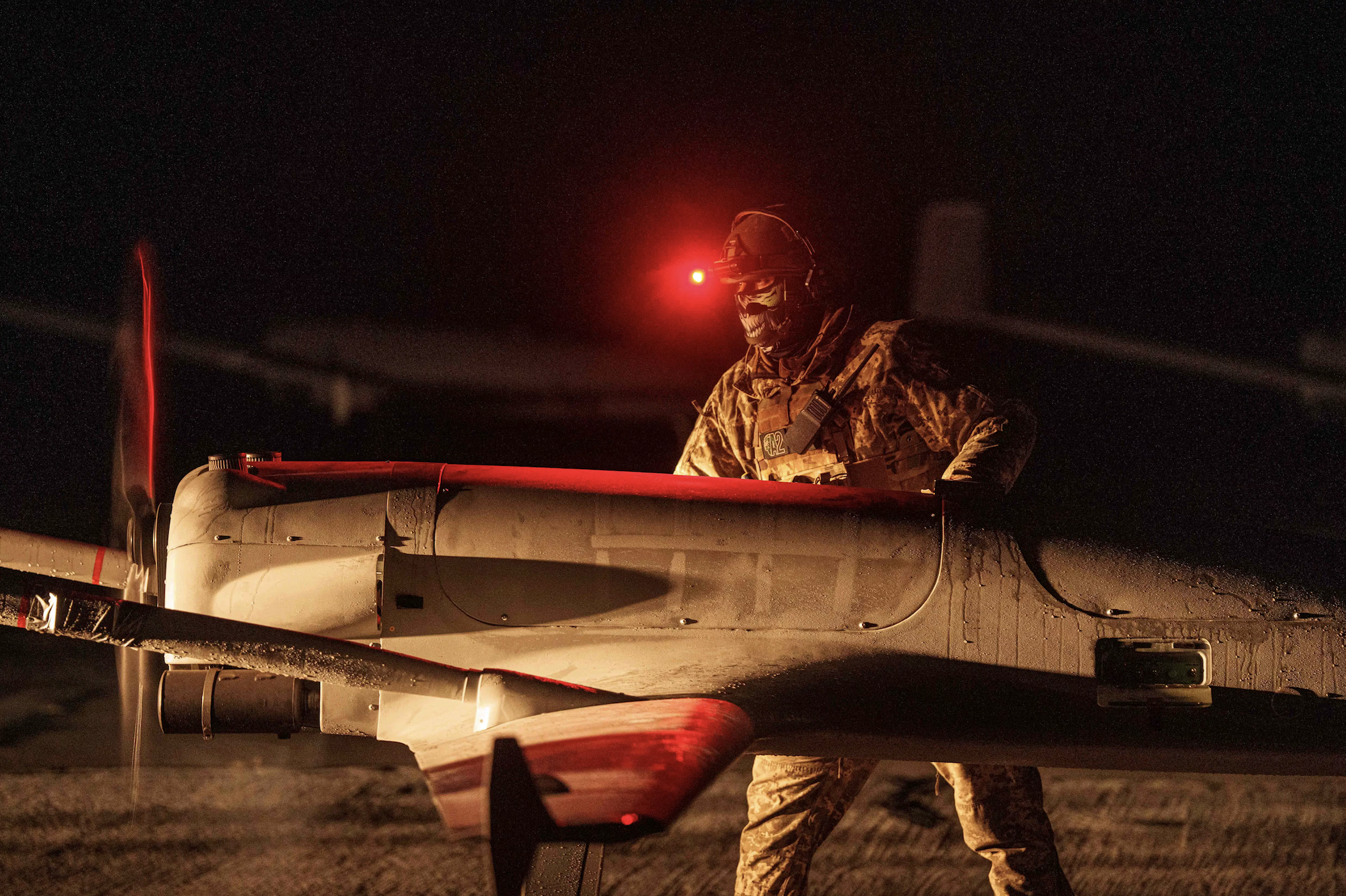
Russia is retrofitting its Molniya strike drones with infrared lighting systems designed to disrupt the visual targeting used by Ukrainian interceptor drones. The modification aims to obscure the drone’s visual signature, complicating the AI-assisted detection and cueing methods increasingly used by interceptor UAVs.
What We're Reading
- Yolka drone being integrated into Russia's critical facilities anti-UAV defense system. (TASS)
- Poland to build EU’s first anti-drone shield: System dubbed San is being developed by Polish-Norwegian consortium, with some technology battle-tested in Ukraine. (Financial Times)
- Iran challenges the powerful United States Navy in an asymmetric naval battle in the Gulf. (El Pais)
- Taiwan should create drone swarm ‘asymmetric hellscape’ to blunt Chinese invasion: Report. (BreakingDefense)
- Drone tech groups such as Quantum are winning investor support in Europe, boosting the region’s venture capital industry. (Financial Times)
- The Pentagon wants to buy 30,000 new drones. Here are the key questions. (Breaking Defense)
|
|||||||||
| Deal Flow | |||||||||
|
|||||||||
| Ukraine Theatre | |||||||||
|
|||||||||
| Iran Theatre | |||||||||
|
|||||||||
| Policy Pulse | |||||||||
|
|||||||||
| Sources: ISW (Mar 15), Ukrainian Air Force, JINSA Epic Fury Update (Mar 14-15), IranIntl, Bahrain MoD, DefenseScoop, BusinessWire, The Recursive. Updated weekly. |