


Top Headlines:
- China’s reconnaissance and strike drones are expanding its surveillance network into the western Pacific, potentially supporting carrier operations farther from home. Integrating that coverage with its carrier groups would likely give Beijing a broader picture of surrounding naval activity.
- Recent Guangjian laser trials are testing performance against successive groups of drones, while a separate procurement award bundles lasers with detection and electronic countermeasures. Chinese buyers are seeking integrated protection, giving suppliers with reliable equipment and integration capacity an advantage.
- Chinese cities are connecting drone deliveries with road transport and hospital logistics. Operators that complete the handoff after landing are expected to be better placed to turn approved routes into recurring delivery business.
- EHang’s firefighting aircraft and DJI’s expanded sensing capabilities broaden the work available to Chinese drones, suggesting that converting new applications into sustained deliveries could depend partly on suppliers’ ability to finance the work before customers pay.
- China is extending procurement beyond drone platforms into underwater launch-and-recovery equipment and yearlong flight services. This opens spending to handling-equipment suppliers and local operators, since buyers need aircraft and vessels available for repeated use after delivery.
- Emerging research and patents in the drone space this week focus on language-guided navigation, shared perception, changing airspace, etc.
Military Developments
China tests limits of anti-drone lasers
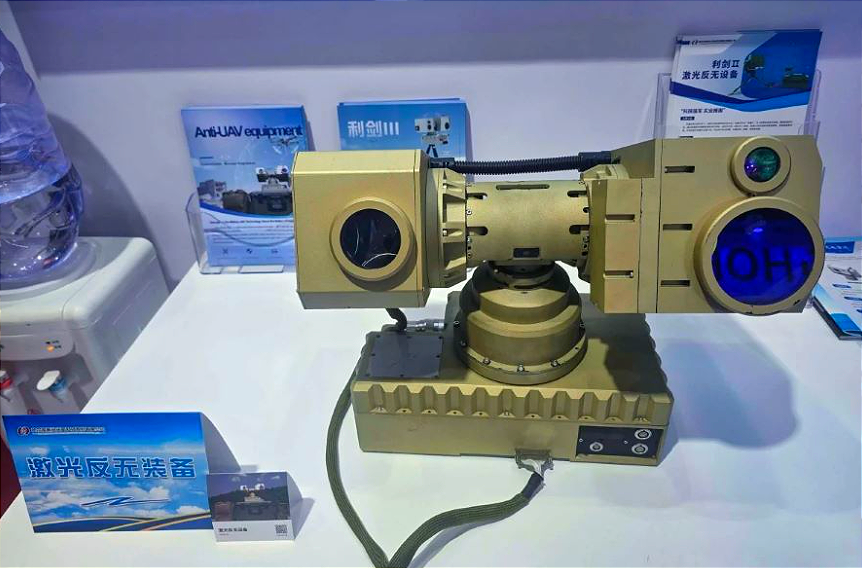
China’s Guangjian counter-drone laser has undergone desert trials against successive groups of drones, moving the development question beyond whether the system can complete an isolated interception.
The Aviation Industry Corporation of China’s manufacturing technology institute is testing whether that performance can be repeated as further aircraft arrive.
Repeated engagements are central to the case for laser protection, since a system that becomes unavailable after its first success leaves the protected site dependent on other equipment.
The trials put that continuity under scrutiny, although the available disclosure so far fails to establish sustained operational performance or deployment. But that appears to be the goal. Chinese buyers will need evidence of availability across a full test campaign to judge how much protection the equipment actually adds.
The separate Tashkurgan procurement award shows that demand in China already includes lasers within packages combining detection, electronic countermeasures, and site infrastructure.
This creates a market for the technology, but also makes its performance part of a wider system the buyer must accept and operate.
Chinese weapon suppliers able to demonstrate dependable integration are likely to have a stronger proposition than those relying on a successful interception alone.
China’s reconnaissance-strike drones bolster its carrier stack
Note: Subscription is free!


