


Key Takeaways
- Iran’s combination of drones and missiles placed different demands on Gulf defenses than Ukraine’s successive drone strikes across Yandex’s dispersed facilities. In the Gulf, defenders had to sustain protection against several threat classes, while Russia faced competing demands for coverage across widely distributed infrastructure.
- Yandex’s specialized computing tied its facilities to Russia’s domestic technology capacity, while AWS’s American identity created exposure beyond the principal belligerents’ borders. This suggests that moving infrastructure abroad can reduce geographic concentration without removing the geopolitical risk attached to its owner.
- Although geographic separation limited exposure to a single impact, overlapping losses at Yandex and AWS weakened the protection that dispersal offered.
- The strikes interrupted computing even where equipment survived, because emergency shutdowns and relocation kept usable hardware out of service. This helps explain why a drone’s destructive payload alone cannot predict its commercial impact. Operators also need to account for how long surviving capacity remains inaccessible and what it takes to bring that capacity back.
Iran and Ukraine brought different pressures to the defenses around data centers. Iran’s attacks came within a regional campaign involving several drone types and missiles. Ukraine’s strikes on Yandex extended its established long-range drone campaign to a group of facilities supporting one technology company.
Both settings allowed commercial computing to suffer, but neither can be explained simply by comparing drone speed or counting interceptors. The weapons, the wider demands on defenders and the operator’s dependence on the affected sites have to be considered together.
This difference drastically changes how operators should understand protection. In the Gulf, a substantial missile-defense capability coexisted with sustained drone exposure. In Russia, protecting infrastructure spread across a vast territory placed competing demands on finite defenses.
Read More:
 Drone Sense
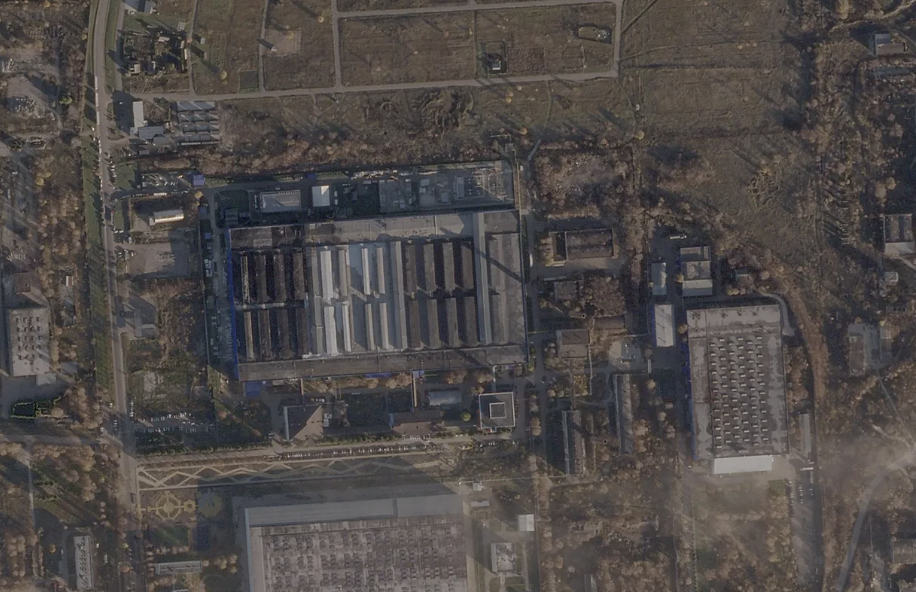
Were different drones responsible for different outcomes?
The evidence gives us stronger grounds for comparing the campaigns than for attributing their outcomes to a superior airframe. Ukraine’s FP-1 was identified by its manufacturer at Kaluga and Vladimir. Its published cruise speed of 140–180 km/h and payload of up to 60 kg describe a relatively slow strike platform. Yet its use coincided with substantial operational disruption. Speed alone plainly cannot explain whether this class of infrastructure remains available.
Iran’s likely platforms deserve the same examination. The UAE reported intercepting hundreds of Shahed-136s alongside Shahed-107s and Shahed-238s. Human Rights Watch also verified Shahed-136 use in Bahrain and a Shahed-238 strike in Dubai.
These observations make the Shahed-136 a well-grounded baseline hypothesis for the AWS incidents, while keeping other variants plausible.
That distinction changes the comparison. If a propeller-driven Shahed was responsible, the Gulf and Yandex cases concern broadly similar slow-drone threats operating in different defensive environments. If a jet-powered Shahed-238 was involved, the threat profile was different. Operators consequently need to account for both classes, without attributing the AWS losses to speed on the strength of damage alone.
More fundamentally, Iran had a substantial missile campaign alongside its drones. Ukraine’s repeated FP-1 attribution shows an existing drone capability being applied to another infrastructure category.
Neither case requires us to assume that drones were merely a substitute used when missiles were unavailable. An established drone fleet can sustain repeated missions without drawing on a missile inventory for every sortie. That is a plausible common reason for their use. The difference lies in how this repeated employment interacted with the wider campaign and the defenses available.
What protection could each side draw on?
The Gulf’s experience challenges the assumption that an advanced missile-defense network automatically supplies adequate drone protection. The UAE operated THAAD and Patriot, but those systems have different roles. THAAD addresses ballistic threats. Patriot can engage drones, and Bahrain confirmed its use against one on March 9.
This means the problem cannot be reduced to equipment being incapable of engagement. Repeated engagements also require ammunition, crews and sustained coverage. In fact, in the first week of the Iranian strikes, drones dominated assault packages against the UAE.
Calling this simply a mixed missile-and-drone campaign obscures how heavily its day-to-day demands depended on drones. For commercial operators, the relevant question is how national protection translates into sustained coverage of their facilities alongside other priorities.
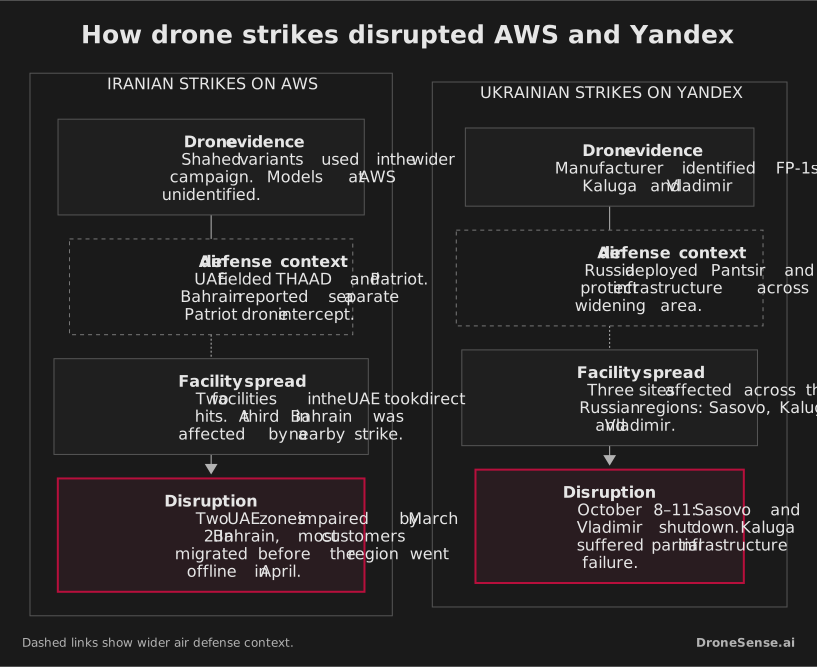
Russia faced a related allocation problem over a much larger territory. The pressure also mounted on Russia’s Pantsir and Tor systems as defenses were distributed deeper inside the country. This supports examining the Yandex strikes within a broader competition for protection. It does not tell us which battery, if any, defended each site.
In all, the Gulf drone strikes foreground the demands of a sudden, varied regional campaign, whereas Yandex ones provide a glimpse of the cumulative burden of protecting an expanding set of exposed assets - something the Gulf will most likely feel soon.
These pressures also overlap. Neither establishes that a particular AWS or Yandex defense was saturated, but both explain why a national inventory is an inadequate measure of site readiness.
Why did commercial computing become strategically valuable?
Those competing protection demands become more consequential when commercial infrastructure acquires strategic significance faster than its security arrangements change. Yandex and AWS illustrate two routes by which this can happen.
Yandex’s public disclosures placed three named supercomputers at Sasovo and Vladimir. Combined with Ukraine’s stated retaliation rationale, this supports interpreting the strikes as pressure on domestic technology capacity as well as a response to attacks on Ukrainian infrastructure. It does not require assuming these sites supplied a known majority of Russian computing.
AWS presents a different relationship. Our earlier Iran analysis examined exposure arising from corporate identity. Iran’s subsequent July statement invoking Amazon’s military associations reinforces that interpretation, although it cannot establish the March planners’ reasoning. Amazon’s defense business and the workloads inside a particular Gulf facility remain separate questions.
This difference must be accounted for by every single data center company and their investors. Yandex’s exposure followed its role inside Russia. AWS’s exposure crossed national borders through its parent company’s perceived affiliations. Selecting a host country outside the principal belligerents consequently does not remove every source of drone-related geopolitical risk.
Did repeated drone strikes change the equation?
Repetition connects the weapons to the computing losses, but the sequences were not identical. Yandex reported Sasovo’s shutdown on October 8, partial failure at Kaluga on October 9 and Vladimir’s shutdown on October 11. The resulting overlap meant the company was dealing with another affected location before resolving the first.
The UAE’s opening losses also overlapped quickly: 2 AWS zones were impaired by March this year. Bahrain unfolded differently. Most customers migrated after March’s initial damage and before another disruption made the region unavailable in April. The interval gave customers an opportunity as the opening UAE and Yandex sequences compressed.
These are patterns of cumulative disruption, not evidence of identical strike tactics. In particular, separate-site attacks should not be labeled “double taps.” Their analytical significance is that geographically distinct facilities can become unavailable within one recovery period. For an operator, dispersal needs to be assessed against that campaign-level exposure, alongside protection from any individual impact.
Greater destruction may not mean greater disruption
The damage reports undermine a simple ranking of drone effectiveness by physical destruction. At the first UAE facility, firefighters shut off normal and backup power after an impact caused a fire. Equipment could consequently become unavailable without being destroyed. Yandex later said its 3 supercomputers had survived and were being redeployed, despite the loss of normal operations at their sites.
In both cases, surviving hardware failed to guarantee immediately usable computing. This is why payload comparisons cannot, by themselves, explain the commercial consequences of a drone strike. The interruption also depends on whether equipment can operate safely and whether its services can run elsewhere.
Yandex’s recovery guidance still identified limited quotas and compatibility constraints after replacement capacity became available. Additional capacity had to be usable by the customers who needed it. The comparison brings operators back to the same practical problem from two directions: state defenses influence whether an incident reaches the site, while facility readiness and service architecture influence how far its consequences spread.
As drone threats evolve, operators will have to connect those decisions. A country’s advanced air defenses, a company’s dispersed facilities and an available backup each offer protection. Their value depends on whether they function together under the campaign the business actually faces.
This publication draws on open-source information and DroneSense’s proprietary strike and platform datasets. While reasonable care is taken in preparing this analysis, the accuracy, completeness and timeliness of underlying information cannot be guaranteed. Assessments represent DroneSense’s judgments at the time of publication and may change as additional evidence becomes available. Reported claims, platform identifications and strike attributions carry varying levels of confidence. This material is provided for informational purposes and should not serve as the sole basis for operational, security or investment decisions.
© 2026 DroneSense. All rights reserved. Reproduction or redistribution of this publication or its proprietary data requires prior written permission, except as permitted by applicable law.


