


Welcome to this week’s Brief, our analysis of the most consequential developments in unmanned systems and drone warfare. Each week we track rapidly accelerating battlefield innovations, emerging doctrine, and the technologies reshaping how states and non-state actors deploy unmanned systems.
Have intelligence requirements, developments we should investigate, or perspectives to share? Contact us at info@dronesense.ai.

Deep Dive: Houthi Drones Force Saudi Arabia to Leave More Targets Exposed
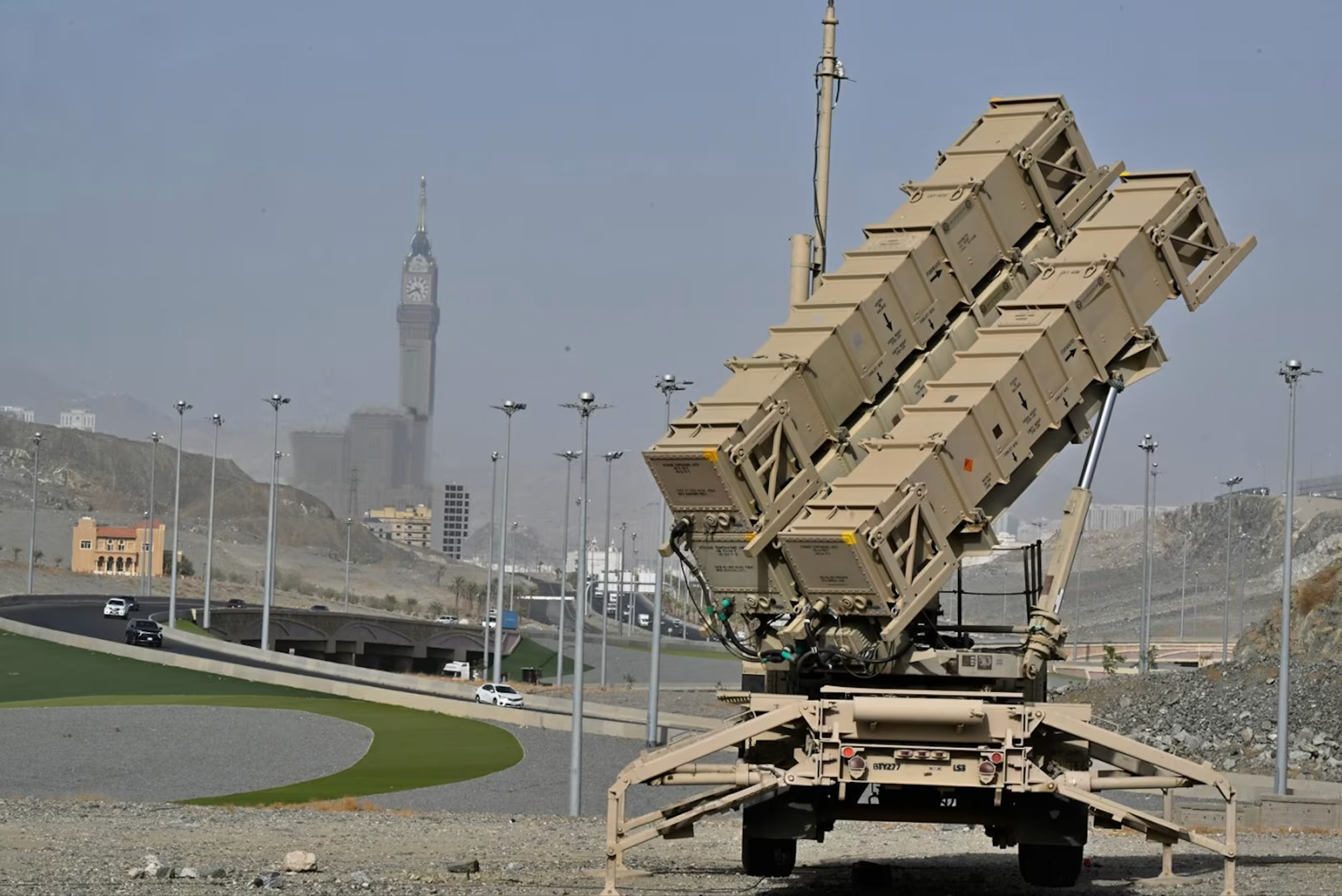
Saudi Arabia’s defenses recently intercepted 9 drones heading toward the Eastern Region, Riyadh and Madinah, followed by another 2 approaching the south the next day. Successful interceptions, certainly. But keeping defenses occupied across several regions is likely giving the Houthis something valuable even when their drones fail to reach their targets: more influence over where Saudi Arabia concentrates protection, and where it accepts greater exposure.
The Houthis have an immediate reason to build this pressure and sustain retaliation, as the Saudi-backed Yemeni forces conduct offensives around Bab al-Mandeb under the Kingdom’s air cover. The group’s declared “airport for airport” formula suggests they intend to make Saudi operations inside Yemen carry consequences at home. And, dispersed drone attacks in mixed strike packages support that calculation by keeping several Saudi facilities under threat all at once.
So far, Saudi defenses have intercepted over 90% of Houthi missiles & drones aimed at protected areas, yet over 50% of Houthi attacks have targeted undefended locations. The group likely seeks to drive one message home: no matter the expensive system, you cannot protect it all. Defensive gaps have persisted, and closing these gaps will require additional units. But recurring raids make commanders less willing to move defenses away from facilities that remain under threat.
Withdrawing protection risks exposing a facility again. Doubling down takes resources away from other sites. The Houthis can prolong this dilemma for the Saudis, despite unsuccessful raids.
At Riyadh airport, preliminary findings indicated that multiple Houthi drones preceded cruise and ballistic missiles, very similar to how Russia attacks Ukraine. Combining these weapons gives Houthi operators scope to impose successive demands on the defense because crews must identify and engage the opening drones while retaining capacity for the following missiles.
That sequencing aims to increase the defensive commitment required at each protected site, compounding the geographical demands of attacks across several regions.
Intelligence gathering is likely another objective, particularly given Iran’s assistance with targeting, and tactical guidance. Results from repeated engagements (whether offensive or defensive) is bound to give both actors feedback on how Saudi defenses handle different strike packages and whether reinforcement changes their effectiveness. For Tehran, the value goes beyond Yemen, experience against Western-supplied defenses can inform its assessment of the systems its own forces face. And through it, the assessment of its friends.
But provoking stronger Saudi defenses risks being an expensive gamble. Britain’s announced support includes defensive Typhoon missions and continued refueling assistance for Saudi operations, while Turkey and Pakistan are assessing air-defense, electronic-warfare (EW) and technical assistance under their pact. Additional fighters can expected to reinforce protection, but sustained coverage still needs the same things: timely detection, available crews and repeated sorties. Refueling support also risks helping Riyadh sustain offensive operations as its allies absorb more homeland-defense duties.
The Houthis are unlikely to keep sending the same drones into a strengthening Saudi defense. Tehran has requested newer Russian Gerans, whose jet propulsion and image-matching navigation offer a credible development path for Houthi strike packages through Iranian assistance.
Faster flight will shorten interception windows, and navigation using stored reference imagery would reduce dependence on satellite signals. Such transfers would likely increase the demands on detection and kinetic interception even more. Saudi reinforcements will then face drones that will leave their crews with fewer chances to stop them.
China Watch: PLA fixes drone-to-helicopter targeting, artillery-launched UAVs, LLM-driven multi-UAV planner
- A 71st Group Army aviation brigade recently resolved a data-format mismatch between reconnaissance drones and armed helicopters, allowing UAV observations to support strikes beyond the helicopter crew’s line of sight. The target information initially failed to work with the fire-control system, and tests at different heights and speeds traced intermittent communications to incompatible data encapsulation.
- The unit worked with the manufacturer to fix it, demonstrating Beijing's real-time feedback loop for improving platforms. As the PLA combines more drone types with conventional systems, compatible targeting messages and unit-manufacturer troubleshooting will determine how widely these methods travel beyond the brigade that made it work.
- Meanwhile, a new investigation has revealed that Russia’s SPLAV supplied Norinco with technical documentation for a reconnaissance rocket during 2014–15, with trade records indicating another likely transfer in 2022.
- The exchanges could have potentially given China access to engineering knowledge relevant to deploying drones from artillery systems, where surviving launch and transitioning into controlled flight are development problems in their own right.
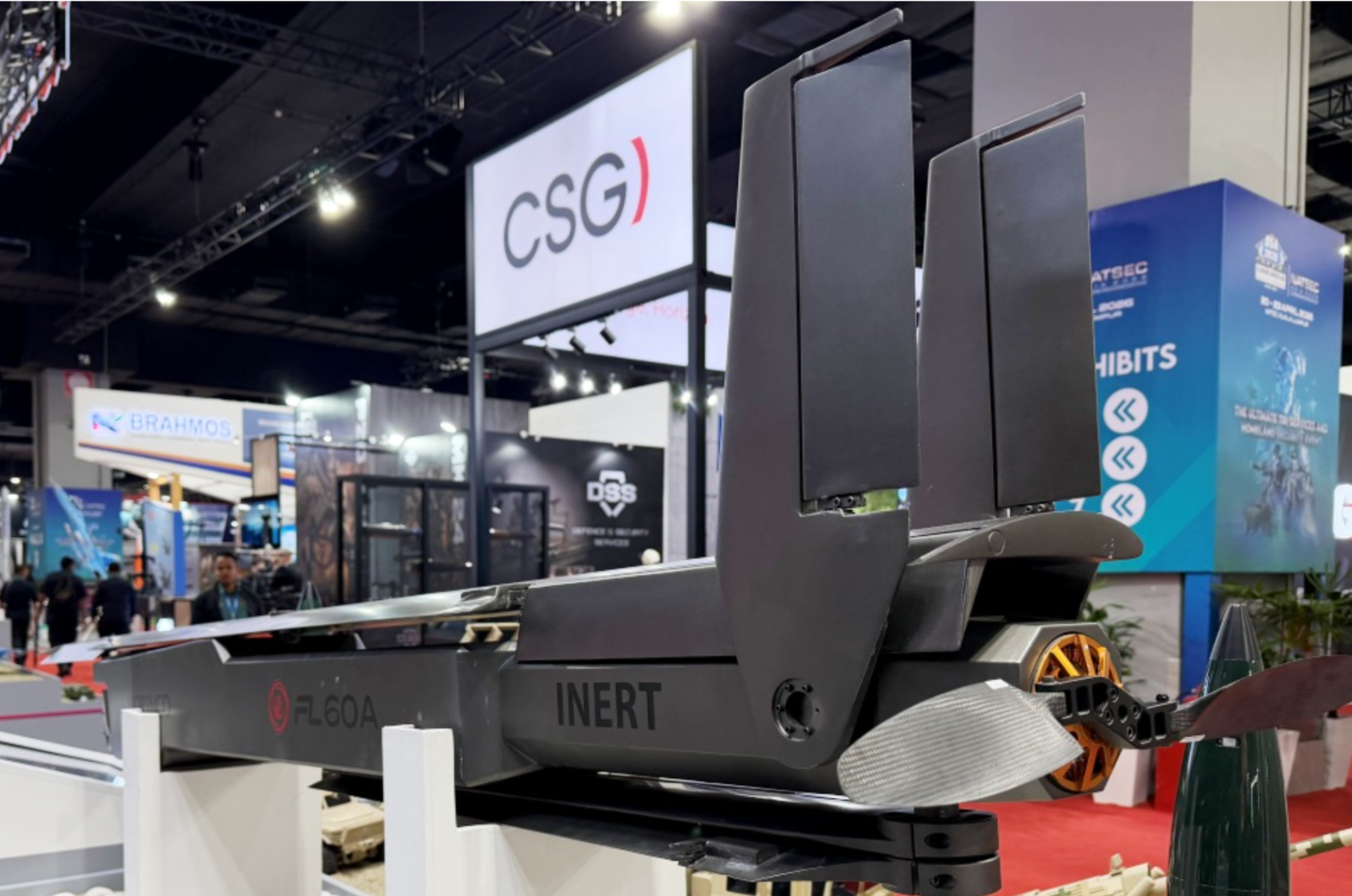
- China’s Feilong 60A now uses a disposable rocket booster to launch from the SR-5 multiple-launch rocket system before sustaining its own flight. For the PLA, integrating drones with artillery launchers could let a battery put reconnaissance closer to a target without waiting for a separately deployed UAV unit.
On Our Radar:
Australia Adds Mine and Drone Payloads to Ghost Shark Platform
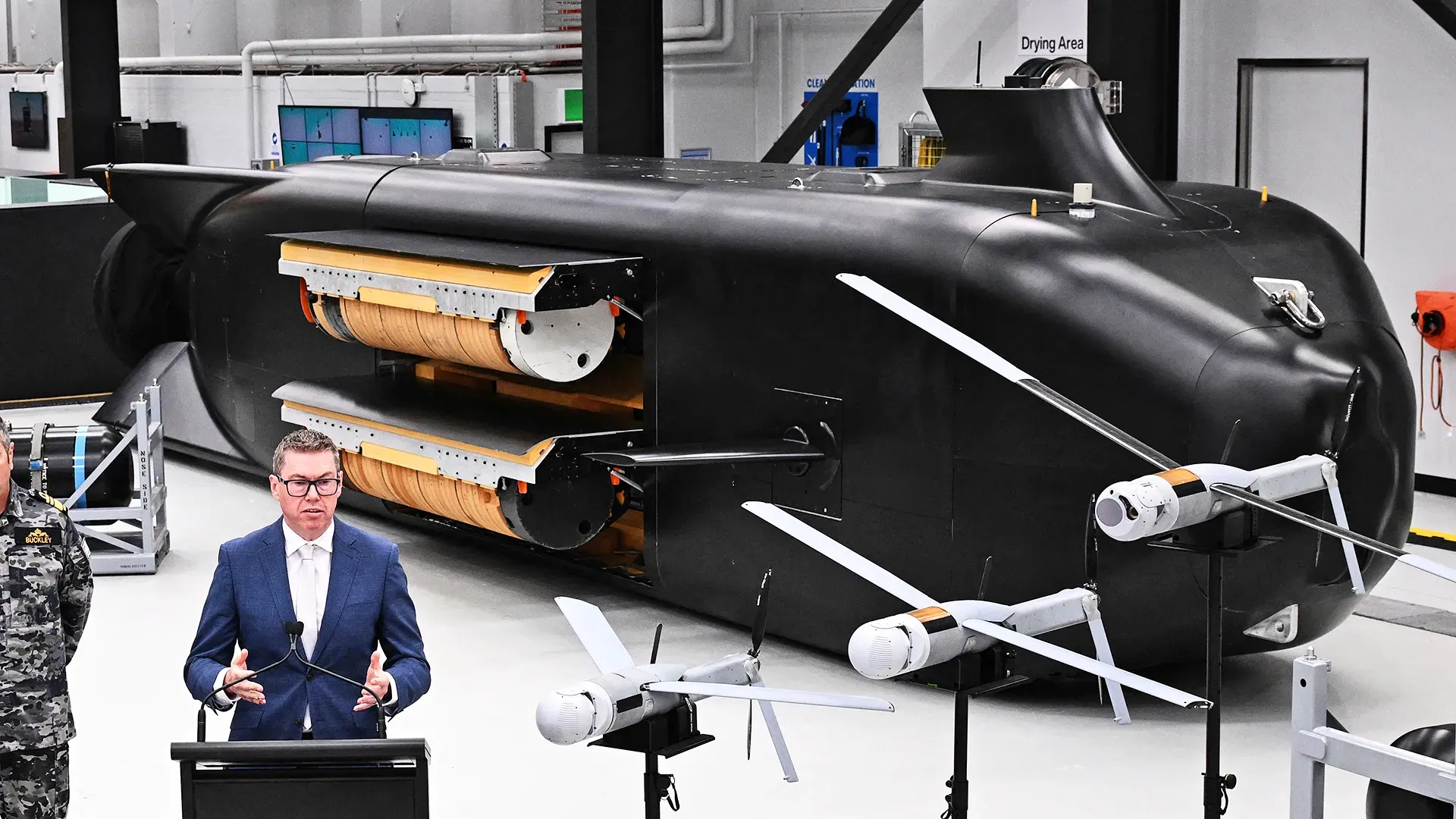
Australia has disclosed that its Ghost Shark extra-large autonomous underwater vehicle is being developed to carry sea mines, supply caches, and Altius aerial drones, with the Navy receiving its first platform this year under a A$1.7 billion program. Some payloads will enter an AUKUS exercise in San Diego, and Canberra says it is offering the common-payload work to the United States and Britain. Ghost Shark remains an autonomous submarine, yet the disclosure gives it a broader role as a vehicle for placing supplies, mines, and aerial drones inside contested waters, making payload configuration a central part of the AUKUS undersea competition. (Australian Department of Defence) (ABC News) (USNI News)
Drone Attacks Test NATO’s Black Sea Defenses
After drone attacks hit merchant shipping near Bulgaria and Romania, Romanian F-16s shot down two aircraft over the country’s territorial waters on October 17, which Bucharest assessed were Russian Geran-4s. NATO followed days later with additional maritime patrol aircraft, radar systems, drones, intelligence personnel, and explosive-forensics teams for the Black Sea, widening the response from national air policing to a shared surveillance and counter-drone posture. Russian responsibility for the full sequence remains unassigned, though the attacks have made commercial shipping, allied airspace, and attribution part of the same low-altitude defense problem. (Reuters) (Reuters) (Romanian Ministry of National Defence)
Data and Distribution Nodes Targeted in Ukraine War
Ukrainian drone attacks on the St. Petersburg and Leningrad region hit oil facilities, an Ozon logistics hub, and a VK data center, while debris and fires also affected power and residential infrastructure. The physical damage remains uneven and VK says its services stayed available, yet the target mix extends the air-defense problem past refineries and defense plants into the warehouse and data infrastructure behind Russia’s commercial economy. Such dispersed assets are difficult to protect through the concentrated point-defense model built for a smaller number of military and energy sites. (Reuters) (TASS) (The Record)
Fleet Deployment Begins Testing U.S. Navy Drone Boat Concepts
Acting Navy Secretary Hung Cao says the Theodore Roosevelt carrier strike group deployed on October 8 with an uncrewed surface vessel, though the Navy has not identified the boat. Leidos’s Sea Hunter and Seahawk have separately been delivered for real-world surface-fleet missions, while Bloomberg reports that further purchases of AEVEX Global Autonomous Reconnaissance Craft boats were paused over performance concerns, a claim AEVEX disputes. Field use is becoming the practical test that will determine which USV designs move from experimentation toward repeatable fleet roles. (DefenseScoop) (Bloomberg) (AEVEX)
India Moves Drone Capability Into Force Planning
India’s new Land Warfare Doctrine arrives as the Indo-Tibetan Border Police says every border battalion now has a drone platoon, giving its China-facing force a unit-level structure for persistent sensing and contested communications. The Army’s ₹770 crore radar contract will add systems able to detect mini and micro drones, while the Air Force has issued an unmanned-systems roadmap to industry and the defense secretary says emergency acquisition is accelerating drones, counter-drone equipment, and mobile radar. The architecture remains unfinished, though drones now appear across the doctrine, border-unit, procurement, and industrial layers that turn equipment into force structure. (Press Information Bureau) (The Times of India) (The Times of India) (The Tribune)
Hardware Innovations and Tactical Adaptations
- Gerbera-2 Incendiary Warhead: Russia has modified its Gerbera-2 drones to carry a 10 kg high-explosive fragmentation-incendiary warhead, with a separate flexible tank containing an incendiary mixture behind the main charge. The additional mixture is likely intended to ignite fires upon impact, potentially increasing damage to fuel storage facilities, warehouses, and other combustible infrastructure. This expands the Gerbera family's strike capabilities beyond its original decoy and reconnaissance roles, making it difficult to assess the threat posed by individual drones during mass attacks. But carrying both the warhead and incendiary mixture could reduce fuel capacity available for longer-range missions.
- Microphones on Fiber-Optic FPVs: Following Russian experiments, Ukraine has equipped its 10–50 km fiber-optic FPVs with microphones to improve target detection while operating in stationary ambush positions. With this, operators can hear conversations at 20–30m, light vehicles at 50–100m, and heavy vehicles at up to 200m. Microphones enable landed drones to detect approaching targets outside their camera's field of view without taking off and consuming additional battery power. The microphones could also warn operators of approaching enemy drones, allowing them to relocate their ambush position. The problem still rests with the fact that acoustic detection alone cannot reliably establish a target's identity or precise location, leaving operators dependent on visual confirmation before engagement.
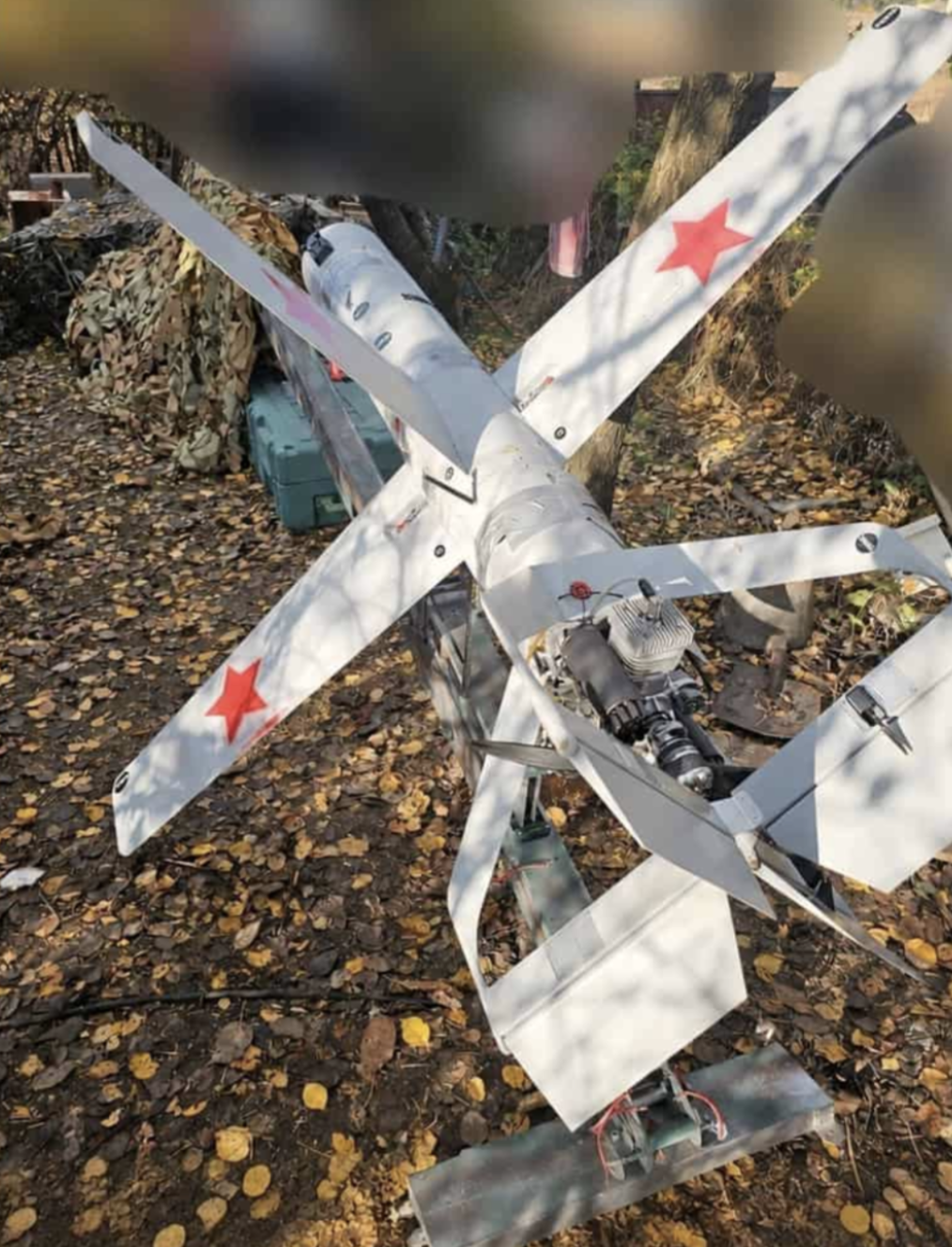
- Gasoline-Powered Lancet-Like UAV: Russian forces have reportedly begun using an unidentified fixed-wing drone resembling the Lancet loitering munition, but equipped with a gasoline-powered engine and rear-mounted pusher propeller. Unlike electrically powered Lancets, the use of liquid fuel could likely support longer flight endurance and potentially extend the distance from which operators can engage targets. This is expected to enable Russian forces to employ Lancet-like airframes against targets farther behind Ukrainian lines. The actual range and payload capacity remain unknown, but combustion engines often introduce greater acoustic and thermal signatures, potentially making the drone easier to detect than electrically powered alternatives.
- Sting Interceptor Launched from Naval Drone: Ukraine's Navy has launched Sting interceptors from a container-mounted system aboard its Sargan-3000 unmanned surface vessel (USV), destroying a Russian Geran UAV. The Sargan USV had previously intercepted aerial targets using its onboard 12.7 mm machine gun, but integrating an interceptor UAV broadened its options for engaging threats beyond the gun's effective range. Using USVs as mobile air-defense platforms will likely make Ukraine reposition and disperse interception assets across maritime approaches and engage drones before they reach coastal targets. The overall effectiveness will depend on timely target detection, guidance arrangements, and the number of interceptors each vessel can carry before requiring rearming
What We're Reading
- Jet-Drone Interception Depends on the Control Link: Zelenskyy said Starlink speed limits hindered interceptor drones against jet-powered Shaheds, while Ukraine later released video it says shows a ground-launched Bars interceptor destroying a Russian Geran-5. (Deutsche Welle) (The Defence Blog)
- UN Documents Sudan’s October Drone Toll: The UN says drone strikes killed at least 306 people in Sudan during October’s first three weeks; more than 80 died in the Abyei market attack, whose responsibility remains undetermined. (UN Human Rights Office) (UN News)
- Colombia Mounts a Three-Front Response to Criminal Drones: The Army says it detained an alleged ELN drone operator, explosive drones wounded six officers in Pelaya, and Bill 088/2026C is advancing through Congress. (Colombian Army) (Revista Semana) (Chamber of Representatives)
- Sierra Leone Tests Tear-Gas Drone for Public-Order Roles: Police tested a newly acquired tear-gas drone at several Freetown locations, describing the exercise as a readiness assessment subject to training, supervision, and legal safeguards before any deployment. (Sierra Leone Monitor)
- South Korea Pairs a Drone Carrier Concept With U.S. Autonomy Cooperation: The Navy has proposed a 30,000-plus-ton carrier for more than 20 unmanned systems, while Seoul and Washington are preparing an autonomy and interoperability framework for future manned-unmanned combat aircraft. (Yonhap News Agency) (Yonhap News Agency)
- Japan’s First OSA Counter-UAS Grant Targets Malaysia’s Maritime Approaches: Japan signed a ¥1.65 billion package for a Royal Malaysian Navy C-UAS system, with radar and camera equipment planned for Sepanggar and Labuan. (Japan Ministry of Foreign Affairs) (The Star)
- Small Drones Become an Army Testbed for Cyber and Electronic Effects: The Army is testing small drones carrying its Radiofrequency Delivery Effects Platform for tailored cyber and jamming effects, with configurations still experimental and production choices pending. (Breaking Defense)
- Coast Guard Orders MQ-9Bs for Long-Range Maritime Surveillance: The U.S. Coast Guard ordered four unarmed MQ-9B SeaGuardians for $247.8 million, with deliveries expected in 2028 and 2029 for surveillance and law-enforcement missions. (U.S. Coast Guard) (Stars and Stripes)
- Morocco Will Host U.S. Counter-Drone Trials Ahead of African Lion 2027: The Army plans a February-March demonstration in Tan-Tan before the exercise’s operational assessment, evaluating up to 15 solutions without an award yet announced. (U.S. Army)
- North Korea’s AI Torpedo Claim Remains at the Test Stage: KCNA says its Zam-2.0 torpedo uses AI for target detection and guidance and completed a successful October 15 underwater test, though operational capability remains unverified. (Reuters)
- AI Data Centers Become an Air-Defense Concern: An FT opinion argues that data centers need drone protection, citing AWS damage in the Gulf and Ukrainian strikes that disrupted Russian cloud services and exposed concentrated computing risks. (Financial Times) (Associated Press)
- Asylon Secures a Large Reported Critical-Infrastructure Robotics Contract: Asylon says a five-year, $17 million Securitas partnership will deploy 26 autonomous aerial and ground systems across facilities belonging to an unnamed major U.S. infrastructure operator. (Forbes)
- Uganda Tests a Medical-Drone Route for Lake Victoria Islands: Uganda’s Health Ministry tested a Butabika-Koome-Kalangala route to assess future transport of medical supplies and patient samples, ahead of a possible local deployment. (Daily Monitor)


