


Top Headlines:
- China’s 116-vehicle underwater swarm formation shows how small autonomous platforms could be operated at scale, while leaving open the harder question of performance outside a controlled pool.
- The WZ-7’s appearance near Scarborough Shoal adds another surveillance platform to China’s maritime presence, as the PLA reorganizes training around unmanned and intelligent systems.
- Heavy-lift demonstrations, postal supplier selection and emergency-response trials indicate that Chinese manufacturers are working on the operational arrangements needed to turn drones into services.
- Tianjin has designated its entire administrative territory as controlled drone airspace. Our policy tracker follows 6 national and local developments, from enforcement rules to holiday restrictions and heritage monitoring.
- Wuhan airport police are using fibre-optic FPV targets to test counter-drone preparations, bringing a different control architecture into the assessment of airport security.
- This brief examines 6 research papers, 8 patent publications and 2 external reports, covering swarm coordination, armored-vehicle protection, airborne computing, marine propulsion and the changing distribution of Chinese drone patents.
Military & Operational Developments
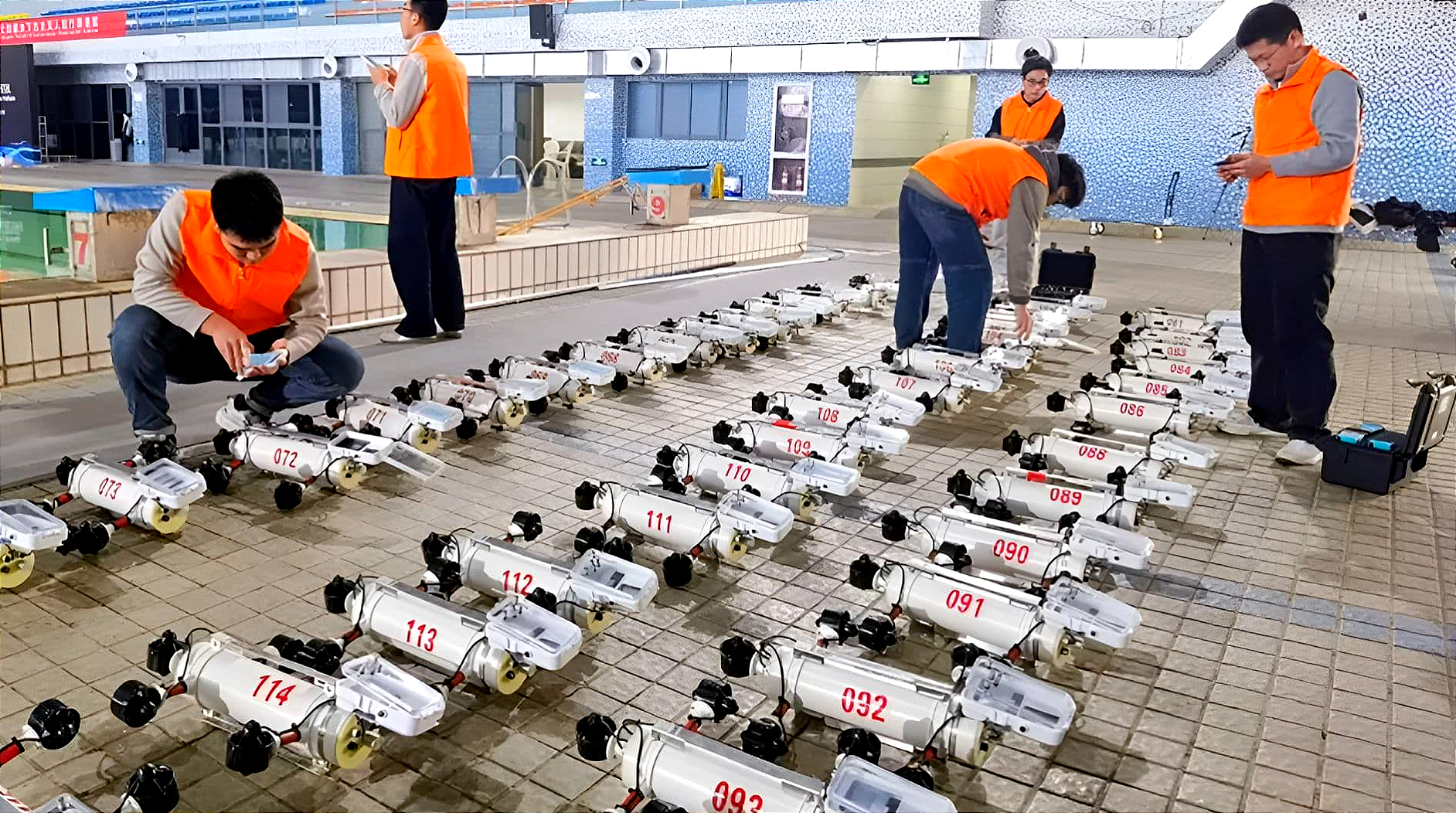
China’s underwater robotics work is moving toward larger groups of small autonomous vehicles, with 116 TH-618s completing a coordinated underwater run in a demonstration by Northwestern Polytechnical University (NPU) and Xi’an Tianhe Maritime Technologies.
The vehicles maintained formation for 34 minutes along a preset route exceeding 500 meters, using real-time visual perception to navigate without manual control.
At this scale, the main problem resides in the fact that each vehicle has to maintain useful spacing while responding to disturbances without disrupting the wider formation.
The TH-618 also indicates a relatively compact approach to underwater autonomy. NPU describes a 61.5 cm, 5.14 kg platform built around smartphone hardware for integrated perception and control. Its stated range of 30 km and endurance exceeding 8 hours are platform specifications, separate from the performance demonstrated during the record attempt.


