


Welcome to this week’s Brief, our analysis of the most consequential developments in unmanned systems and drone warfare. Each week we track rapidly accelerating battlefield innovations, emerging doctrine, and the technologies reshaping how states and non-state actors deploy unmanned systems.
Have intelligence requirements, developments we should investigate, or perspectives to share? Contact us at info@dronesense.ai.

Deep Dive: Russia’s ‘Drone Ports’ Have Put Ukraine in a Chokehold
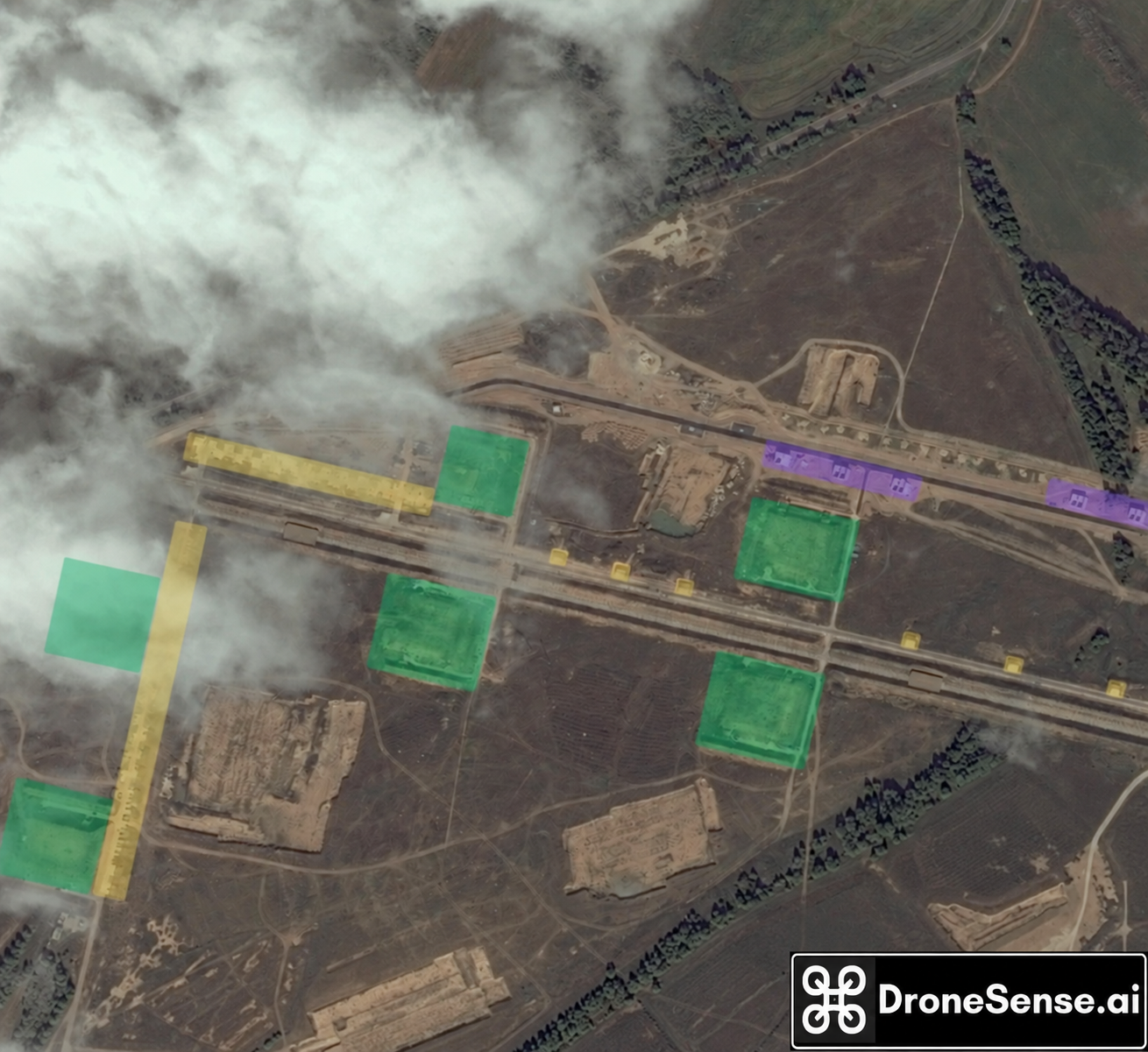
Two things were happening in August 2024: regular Ukrainian troops pushed into Kursk for the first time, and Russia laid the groundwork for a drone base that now has 23 launchers, 387 garages and 26 underground storage facilities. What few saw coming was how devastating the impact of these bases would be in 2026.
Drone ports are helping Russia turn growing inventories into sustained attacks. Most of these ports have auxiliary facilities built in by design, indicating that sustained production and quick turnaround times of iterative improvements as feedback comes back were a key priority. The base at Tsimbulova, in Russia’s Oryol region, forms part of an even wider network for storing, assembling, preparing and launching drones. Its expansion includes jet-drone launchers, coinciding with Russia’s use of 3,177 jet-powered UAVs against Ukraine by 29 September, against 2,850 throughout August.
Because the ports also handle decoys, their value extends to preparing mixed attack packages. Slower drones and decoys can occupy defensive attention while jets leave crews less time to engage. When their arrivals are coordinated with missiles, Ukrainian defenders are left to identify different threats and assign suitable weapons within overlapping engagement windows.
But with enough crews and prepared drones, additional Russian launch positions could narrow departure windows and concentrate arrivals.
Keeping successive waves ready also lets Russia revisit damaged infrastructure before repairs restore its function. The extended day-and-night attack cycles, in tandem with ‘double-tapping’ sequencing, create conditions for this pressure. Due to constant air raids, which, in the case of high-speed jet drones, do not anecdotally provide enough time to shelter, repair crews often have to suspend work during renewed attacks, prolonging disruption even when subsequent strikes cause limited additional damage.
The interval between attacks ultimately determines how long infrastructure remains unusable.
For Ukraine, destroying the fixed launch sites seems like a logical solution, until certain factors are considered. Russia has dispersed storage facilities and protected stocks beneath concrete and earth, reducing the chance of one strike destroying a large inventory.
Damaged facilities can also be rebuilt relatively cheaply, allowing launches to resume. In this case, keeping a port suppressed could require repeated attacks, competing with other missions for available strike weapons.
But drones inside protected storage still need crews and functioning equipment to prepare them and move them onto launchers. Interrupting that work can delay attacks even when stored drones survive. Ukraine reported damaging 5 jet-drone launchers at Tsimbulova on 21 September.
Delaying departures could separate parts of a coordinated attack, giving defenses more manageable engagement windows even if the drones eventually launch. Temporary disruption could carry tactical value without permanently disabling the base.
The ports’ lasting advantage will most likely depend on Russia’s ability to sustain coordinated attacks and restore launch tempo after strikes, while Ukraine tries to prolong those interruptions.
China Watch: 116 Underwater Drones Swarm, China-Russia Exercise, Wuhan Police Fiber-optic Target Practice & more
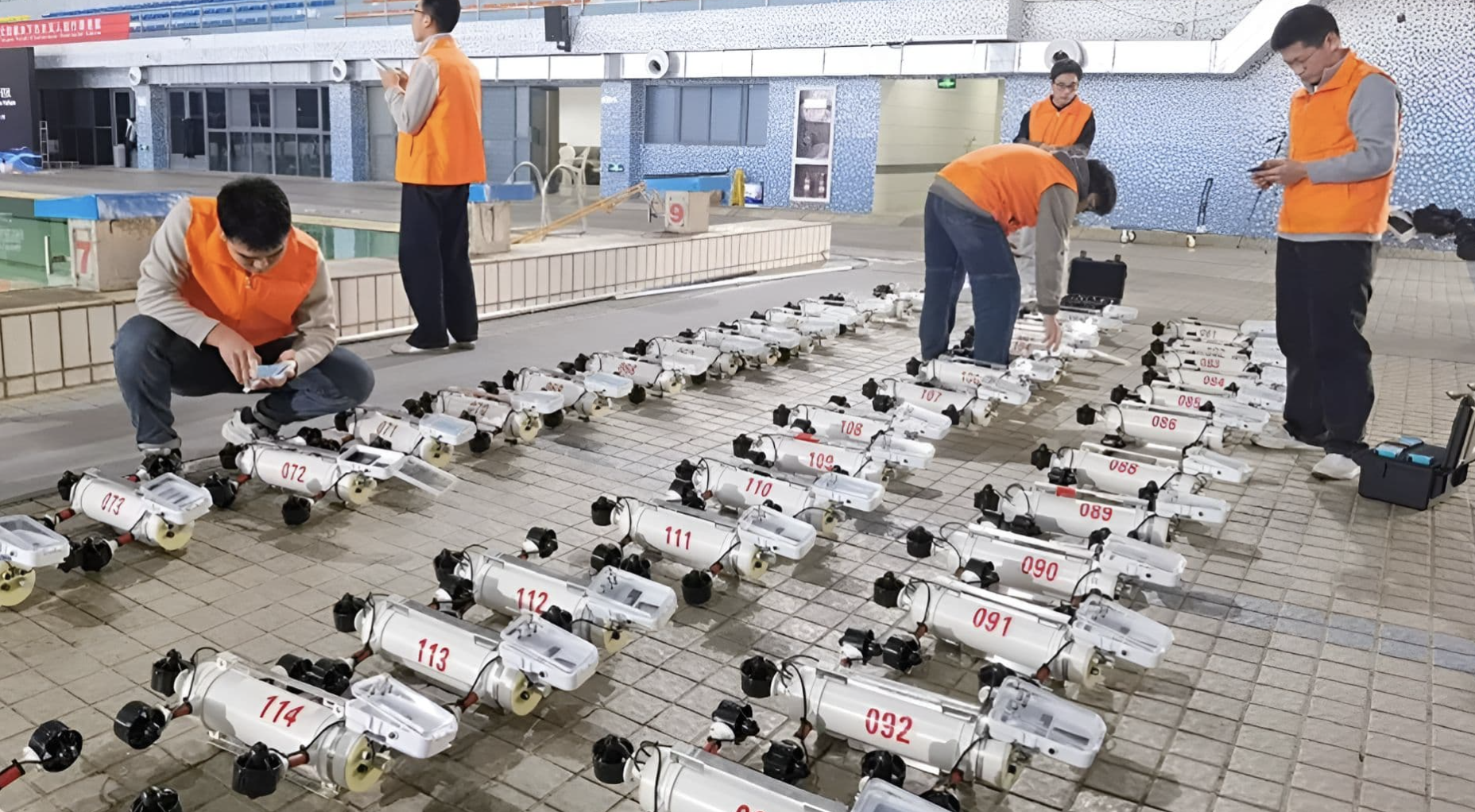
- China’s underwater robotics work is moving toward larger groups of small autonomous vehicles, with 116 TH-618s completing a coordinated underwater run in a demonstration by Northwestern Polytechnical University (NPU) and Xi’an Tianhe Maritime Technologies.
- The TH-618 also indicates a relatively compact approach to underwater autonomy. NPU describes a 61.5 cm, 5.14 kg platform built around smartphone hardware for integrated perception and control. Its stated range of 30 km and endurance exceeding 8 hours are platform specifications, separate from the performance demonstrated during the record attempt.
- This architecture could likely make distributed inspection more practical where operators currently depend on a smaller number of vehicles covering an area sequentially.
- Meanwhile, at Center-2026, the Russian-led multinational exercise involving Chinese troops, drone swarms supplied target information to ground units, while tactical UAVs, attack helicopters and unmanned ground vehicles coordinated attacks on simulated frontline positions.
On Our Radar:
JIATF-401 Builds the Buying System for a Larger Pentagon Autonomy Push
JIATF-401 and the U.S. Army awarded 10 counter-drone contracts spanning sensors, effectors and command systems, with announced ceilings totaling $4.15 billion and the wider vehicle valued at up to $7 billion. Echodyne alone received a $250 million ceiling as it expands radar production, while separate awards cover kinetic systems and training. The Pentagon is building a command layer alongside this procurement push through its proposed four-star Autonomous Warfare Command, linking larger buying capacity with an effort to shorten the path from autonomous-system development to fielding and operational feedback. (Breaking Defense) (CUAS Hub) (Echodyne)
Radar Availability Limits Ukraine’s Push Toward Autonomous Interception
Ukraine’s autonomous interceptor developers rely on ground radars and sensor software to supply the coordinates, altitude and speed needed to guide drones toward incoming targets. Radar availability remains limited, putting pressure on onboard alternatives to deliver enough detection performance within strict size, weight and power limits. Developers are now working on compact radar homing heads, including systems intended to cost below €500. Interceptor production can expand faster than autonomous interception if the sensing layer needed to find and update targets cannot grow with it. (The Defender)
 Drone Sense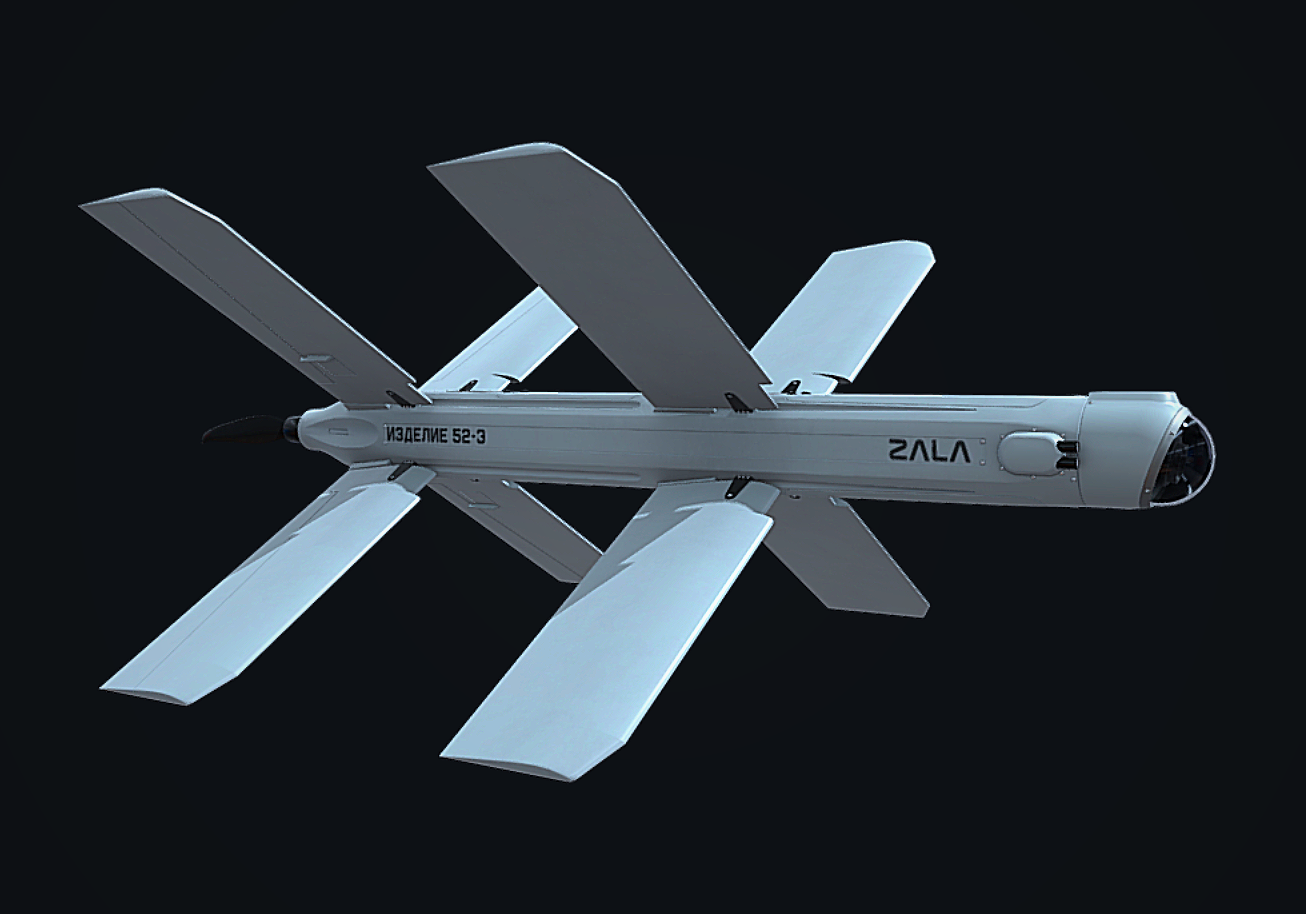
Ukraine Combines Electronic Warfare and Robots to Restore Battlefield Movement
Ukraine’s Operation Vivaldi combined electronic warfare, aerial drones and UGVs to reduce Russian observation and move robots more than 10 kilometers into the rear. The 3rd Army Corps says armed UGVs attacked positions while other ground robots handled demining, logistics and evacuation, contributing to an operation that regained 176 square kilometres. The system works through sequencing: electronic warfare suppresses reconnaissance, aerial drones move robots across exposed ground, strike drones pressure logistics, and UGVs create openings that infantry can exploit. (Atlantic Council) (The Defender)
Drone Strikes Reach More of Eastern Congo’s Battlefield Infrastructure
AFC/M23 was accused of launching drone strikes on Wazalendo positions in Masisi and a FARDC position at Pinga airfield in neighboring Walikale, with civil-society representatives also reporting civilian deaths during the fighting. The attacks put both frontline forces and an airfield used to support military movement inside the same drone threat envelope. Casualty and damage figures remain incomplete, but repeated strikes across separate locations suggest drones are becoming a more routine part of how armed groups pressure positions and supporting infrastructure in eastern Congo. (Radio Okapi) (Radio Okapi) (Digital Congo)
Houthi Training Could Give Al-Shabaab a Local Drone Support Base
Al-Shabaab has sought explosive drones and technical support from the Houthis, including training in drone modification, weapons maintenance and improvised explosives. One captured al-Shabaab liaison said he arranged travel for up to 400 Somalis to Houthi-controlled Yemen for military and ideological training, giving the relationship a personnel-transfer channel alongside weapons acquisition. Training in repair, modification and assembly could reduce dependence on finished imported drones, allowing al-Shabaab to keep systems operating longer and adapt them closer to where they are used. (Yonhap News Agency) (Africa Defense Forum)
Hardware Innovations and Tactical Adaptations
- ‘K5’ Geran-5 Variant: Russia is now deploying a new ‘K5’ variant of its jet-powered Geran-5 drone equipped with the “Susannin” autonomous optical navigation system (DSMAC), a revised fuselage and higher speed. The engine now rests inside the rear fuselage. The new navigation system enables the drone to fly without GPS or communication with an operator. Instead, the drone can navigate its path using images of the Earth’s surface by comparing what it sees with pre-loaded reference images. The changes will likely make interception and jamming more complicated for Ukraine. Russia is expected to use this variant for targeting strategic assets in Ukraine.
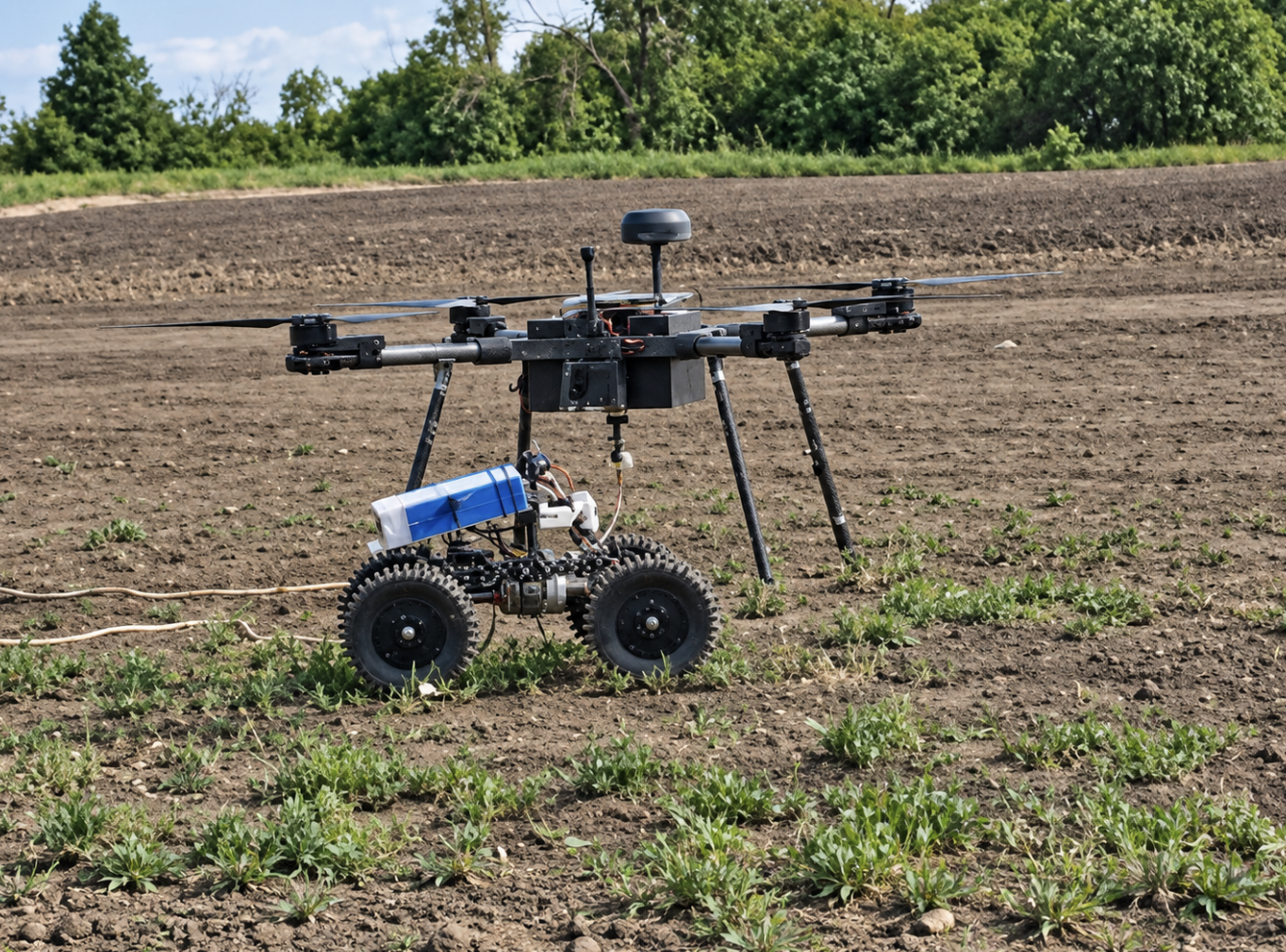
- Net-Launching UGVs: Ukrainian forces are testing UGVs with net launchers (often 2-3) against waiter FPV drones to reduce crew risk on frontline missions. The add-on mechanism enables UGVs to carry an independent last-layer solution to FPV-exposed routes. An automated net launcher gives logistics, evacuation, or strike UGVs a way to physically defeat an FPV inside the final 10–15 meters, including fiber-optic drones that cannot be stopped through link jamming. This could also turn the Russian ‘waiter’ tactic into a resource-exchange problem.
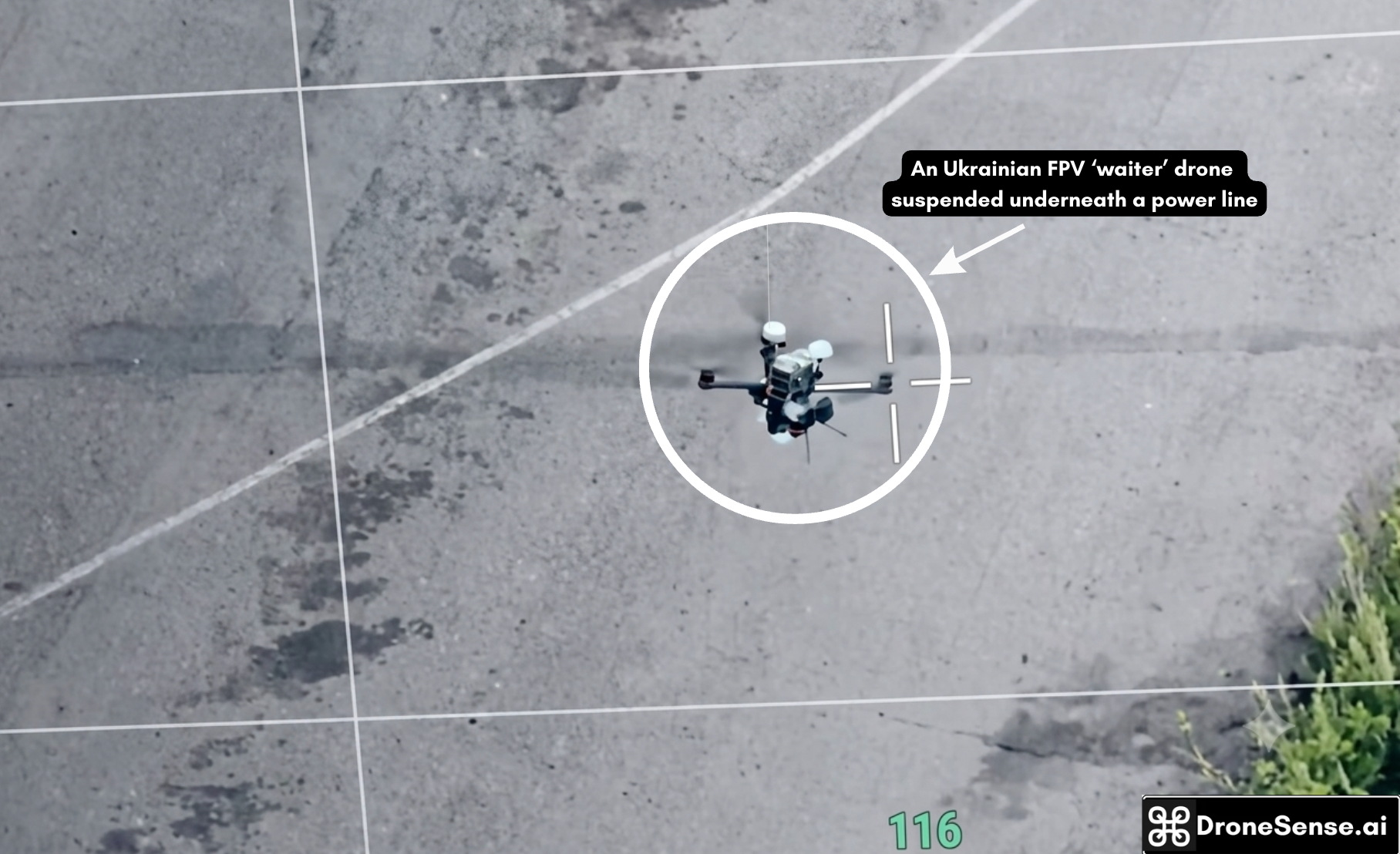
- FPVs on Power Lines: Ukraine is now using a new model of FPV drones that hang on power lines in ambush mode. The elevated position also gives the ‘waiter’ drone a broader view to spot targets farther away, giving it more time to prepare a response to enemy advances. The innovative method directly solves the problem of limited vision most ambush drones often face, and could potentially have long-term consequences for urban warfare that involves combat in an environment littered with power infrastructure.
What We're Reading
- EU Backs Joint Counter-Drone Development: The EU selected DECODER as 1 of 5 priority defense projects eligible for a combined €325 million funding pool. The project brings multiple European countries together to develop and procure counter-drone capabilities at a larger scale amidst rising cases of Russian drone threats.(Defense News)
- U.S. Marines Put Electronic Warfare Directly on Armored Vehicles: The Marine Corps is moving to equip more than 150 Amphibious Combat Vehicles with Anduril’s 11-kilogram Pulsar-L electronic-warfare system, pushing drone detection and jamming onto the vehicles that need protection rather than relying entirely on separate counter-UAS units. (Yonhap News Agency)
- South Korea Records 950 Drone Incursions Around Security Sites: South Korea recorded 950 unauthorized drone flights around national-security facilities between 2021 and June 2026, turning repeated small-drone incursions into a persistent site-protection problem rather than isolated airspace violations. (PoliNews)
- AI Pilots Compress the Reaction-Time Problem in High-Speed Drone Combat: Helsing says its Centaur AI pilot repeatedly defeated experienced human pilots in simulated air combat, an early result that matters as faster jet-powered drones shrink interception windows and make human detection, decision and response time a harder constraint on defensive engagements. (Handelsblatt)
- The U.S. Navy Moves Maritime Autonomy From Trials Toward a Fleet System: The Navy plans to buy 30 medium unmanned surface vessels after at-sea testing, is seeking platforms capable of 10-day autonomous missions with containerized payloads, and has created a dedicated warfare center to turn robotic systems into repeatable fleet tactics and training. (Breaking Defense)
- Terra Drone Buys Into Ukraine’s Interceptor-Drone Industry: Japan’s Terra Drone acquired 50% of Ukrainian manufacturer Kurin Technologies for $3.5 million, putting a foreign commercial-drone company directly into Ukraine’s wartime interceptor-drone industrial base while pairing its autonomous-control technology with Ukrainian systems. (The Defender)
- Russia-Linked Sabotage Reaches an Unmanned-Systems Manufacturer: Estonia says Russian security services commissioned the August arson attack on Milrem Robotics, extending the security problem around unmanned warfare from protecting systems and factories from cyberattack to physically securing the European companies supplying Ukraine. (Breaking Defense)
- Drone Delivery Runs Into an Environmental-Approval Fight: Fifteen U.S. states and Harris County are challenging an FAA framework that can approve new drone-delivery markets without separate environmental reviews, potentially making local noise and environmental assessment another constraint on scaling nationwide delivery networks. (Commercial UAV News)
- North Korea Practices Saturating Defenses With Mixed Drone and Missile Attacks: North Korea combined attack drones with cruise and ballistic missiles, multiple rocket launchers and artillery in an integrated strike exercise, practicing how different speeds and flight profiles can arrive together and complicate the defender’s detection and interceptor allocation. (The Wall Street Journal)
- Peru Moves Drones Upstream Into Disaster Prevention: The Peruvian Air Force is using drones to map El Niño flood and landslide risks around vulnerable ravines near Lima, shifting aircraft already used for search and rescue toward building 3D terrain information before a disaster occurs. (El Peruano)
- ELN Drone Attacks Expose a Countermeasure Gap in Colombia’s Chocó: Chocó’s governor says the ELN carried out 11 explosive-drone attacks against police and military positions in three days, with repeated strikes across Condoto, Nóvita and Río Iró exposing what she described as a lack of countermeasures at fixed security posts. (Caracol Radio)


