


Jet-powered one-way attack (OWA) drones are already shifting C-UAS economics. They are compressing the time available for detection, classification, target assignment, launch, and terminal guidance. This has narrowed the performance margin of systems designed around slow targets and raised the value of the sensors, C2, effectors, and sustainment capacity that keep the full kill chain working under time pressure.
Russia’s jet-powered (Geran-3, 4 and 5) campaign provides the clearest public evidence of this. Ukraine’s intelligence service has described a recovered series-U Geran-3 with a Telefly JT80 turbojet, a stated speed of 300–370 km/h, and maximum-speed use in air-defense, electronic-warfare (EW), interceptor-drone, and terminal-attack zones.
Ukrainian Air Force reporting cited by the Institute for the Study of War recorded more than 2,800 jet-powered drone launches in August 2026, with an approximately 60% interception rate against jet drones, compared with 90–95% for piston variants. The gap shows that the jet variants are substantially harder to defeat. It is consistent with the operational effect of greater speed and associated configuration changes, but it does not isolate speed from signature, altitude, terminal behaviour, navigation resilience, raid composition, or defensive adaptation.
Ukrainian Air Force reporting cited by the Institute for the Study of War recorded more than 2,800 jet-powered drone launches in August 2026, with an approximately 60% interception rate against jet drones, compared with 90–95% for piston variants.
DroneSense proprietary datasets and TTP forecasting suggest that Iran and its proxies (particularly the Houthis in Yemen) are most likely moving along the same path and will field more capable mixed-speed strike packages over the next 8–16 months.
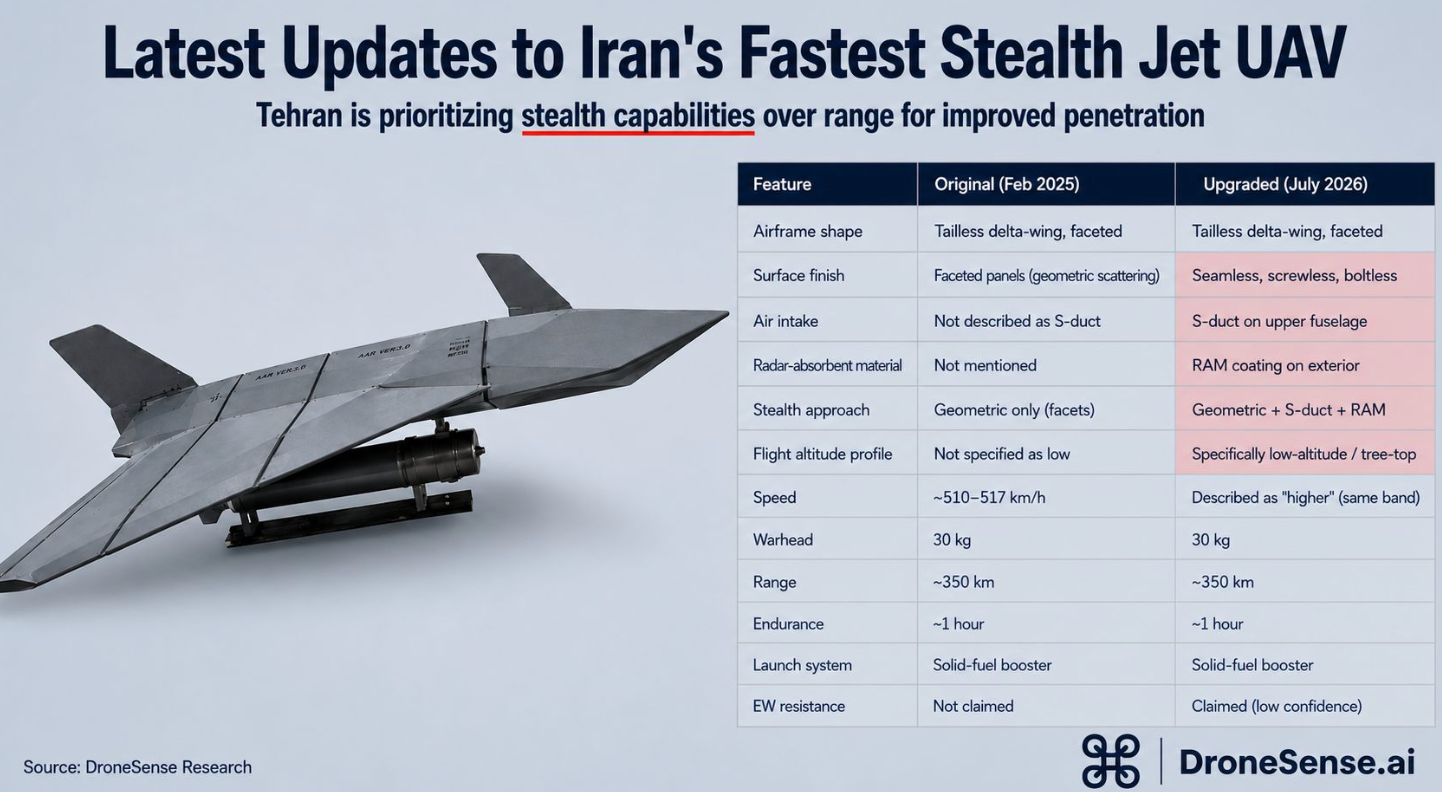
In parallel, lessons from Russian, Houthi, and Iraqi militia operations are expected to shorten the route to more capable mixed-speed packages.
Given the diffusion trajectory, drone strikes using mixed assault packages can be distributed, sequenced and even coordinated to overwhelm the best anti-drone systems and maximize the damage. The current evidence strongly points to massed, mixed-speed raids rather than a mature autonomous jet-drone swarm in the near term.
Speed Moves the Bottleneck Up the Kill Chain
Public reporting places the jet-threat envelope at roughly 300–600 km/h, depending on the configuration under discussion. At a fixed distance, that speed increase removes time from every stage of the defensive sequence. The key constraint then becomes whether the system can create a reliable engagement quickly enough.
Reaction time becomes a binding constraint alongside effector range. Range still matters because each additional kilometre of detection and engagement distance creates time for the defensive sequence. But a system with nominally adequate reach can still fail if it cannot generate, validate, and prosecute the engagement before a fast target passes through the usable envelope.
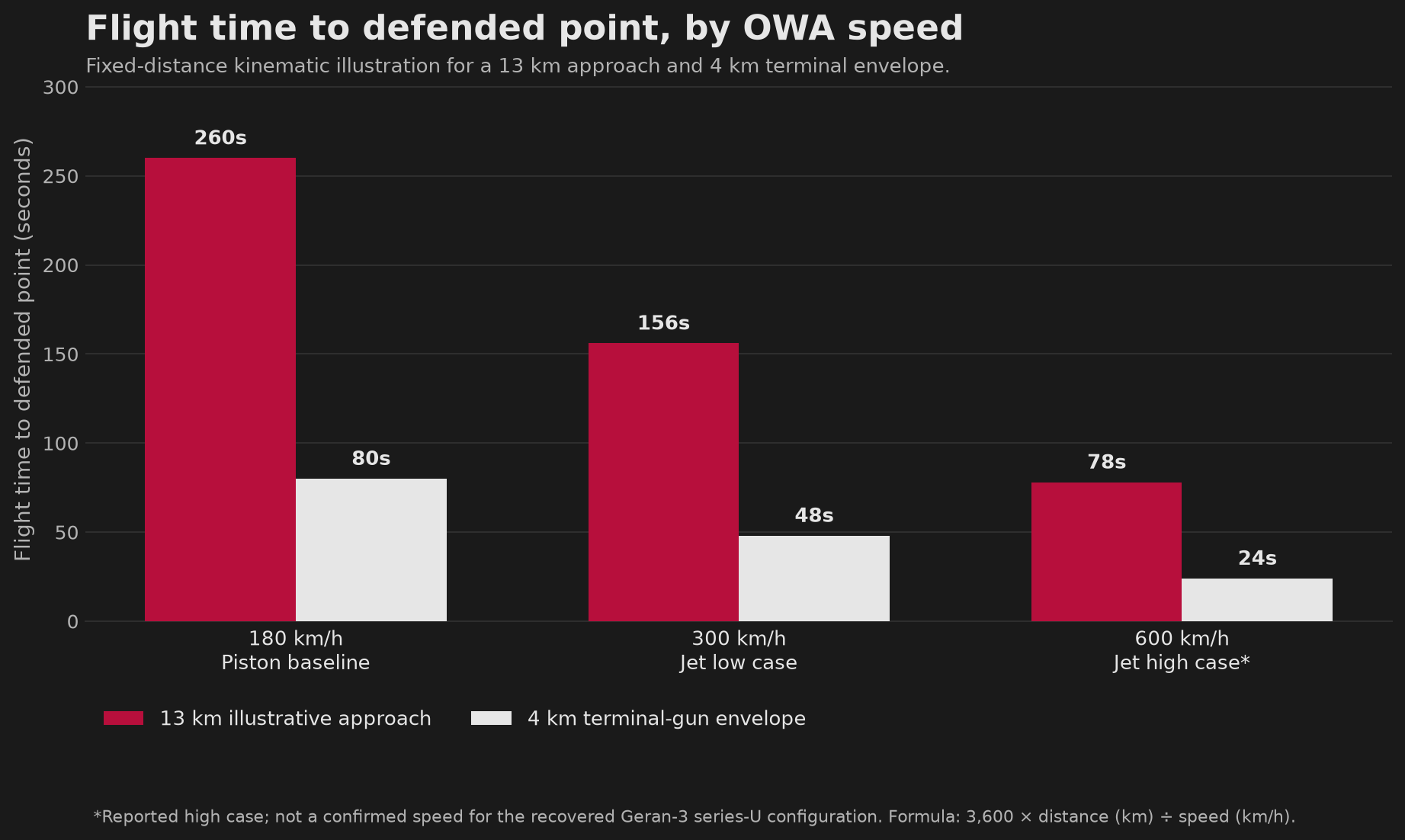
At 13 km, unadjusted flight time falls from 260 seconds at 180 km/h to 156 seconds at 300 km/h and 78 seconds at 600 km/h. At a 4 km terminal-gun boundary, the equivalent windows are 80, 48, and 24 seconds. A 24-second window leaves little margin for delayed detection, an imperfect track, operator decision time, or a failed first shot.
The result is a shift in the C-UAS stack. Faster targets reward the layers that preserve usable engagement time before the terminal phase; they also expose systems that rely on late visual cueing, manual hand-offs, or a single short-range effector.


