


Welcome to this week’s Brief, our analysis of the most consequential developments in unmanned systems and drone warfare. Each week we track rapidly accelerating battlefield innovations, emerging doctrine, and the technologies reshaping how states and non-state actors deploy unmanned systems.
Have intelligence requirements, developments we should investigate, or perspectives to share? Contact us at info@dronesense.ai.
Deep Dive: Multidomain Attacks Make Sequencing a Combative Edge
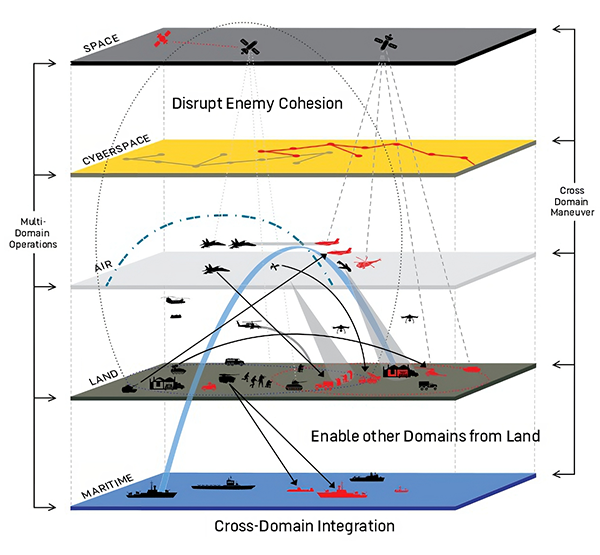
Ukraine's USV-launched UAV strike against a Russian target this week crossed a domain threshold mid-mission for the first time in unmanned warfare. As interception rates rise and EW technology advances, multi-domain attack strategies exploit loopholes in learned kinetic patterns to gain a combative edge.
The meshing of sea, land, and ground assets in an attack system enables positional deception or the relocation of threat origins during missions to disorient adversaries. Usually, fixed land-based launch infrastructure carries a predictable geographic signature, with defenders orienting radar geometry and intercept timelines around known origin points.
A USV in motion programmed to launch FPVs or UAVs flips this certainty. The idea is to reposition launch nodes continuously to make striking points impossible to pre-map. The inability to pinpoint attacks in this case does two things: it prolongs their operations and, creates mounting cognitive overload on defenders to figure out a solution within a tight response window.
Positional deception then sets out to create the conditions for coordination to matter. Once the defender cannot anticipate where the threat originates, the attacker can design the strike's sequencing — the precise order and timing in which assets cross into the target's detection envelope — to overwhelm response systems.
A single-domain attack gives defenders a linear response sequence. Multi-domain coordination converts that into a branching problem, where each branch must resolve faster than the intercept window allows. The USV-to-UAV transition forces separate command chains and detection systems to converge simultaneously. Sequencing then becomes an enabling instrument to dictate saturation in the decision cycles.
Despite tactical benefits, a multi-domain attack strategy using exclusively unmanned systems is largely target-dependent to sustain a cost asymmetry. Ukraine's combined USV-UAV strike costs between $100,000 - $300,000, which maintains a favorable cost-to-kill ratio if the defender uses a $3-4 million missile to counter the attack. But as countries move towards drone-on-drone combat, cost asymmetry will only hold when the target justifies combined platform investment.
If Ukraine uses a multi-domain attack strategy combining USVs and UAVs to target $30,000-$50,000 Russian drones, then a favorable ratio will likely be harder to sustain. Alternatively, Russia realizing this would likely resort to tactics that would incur higher operational costs for Ukraine.
There are logical reasons why multi-domain attacks using unmanned systems have been so rare, with the majority of experiments (such as ‘mothership’ carriers) focusing on one-domain superiority.
The first is communication resilience across electromagnetically contested domains. GPS spoofing and jamming target the timing architecture shared across all assets. Desynchronize the timing and the positional deception advantage immediately collapses.
The second is time-on-target synchronization across asymmetric kinematics. A USV at 40 knots and a UAV at 150 knots operate on fundamentally different timelines. Sea state, wind, and evasive routing continuously shift those calculations.
The third is autonomous decision authority under communications denial. When comms degrade, each asset falls back on onboard logic, which can produce collectively incoherent outcomes across domains. These constraints form a dependency chain between platforms. Whoever integrates all three layers into a coherent architecture will likely determine who controls the asymmetry in the decade ahead.
China Watch: Long-Range Combat Optimization
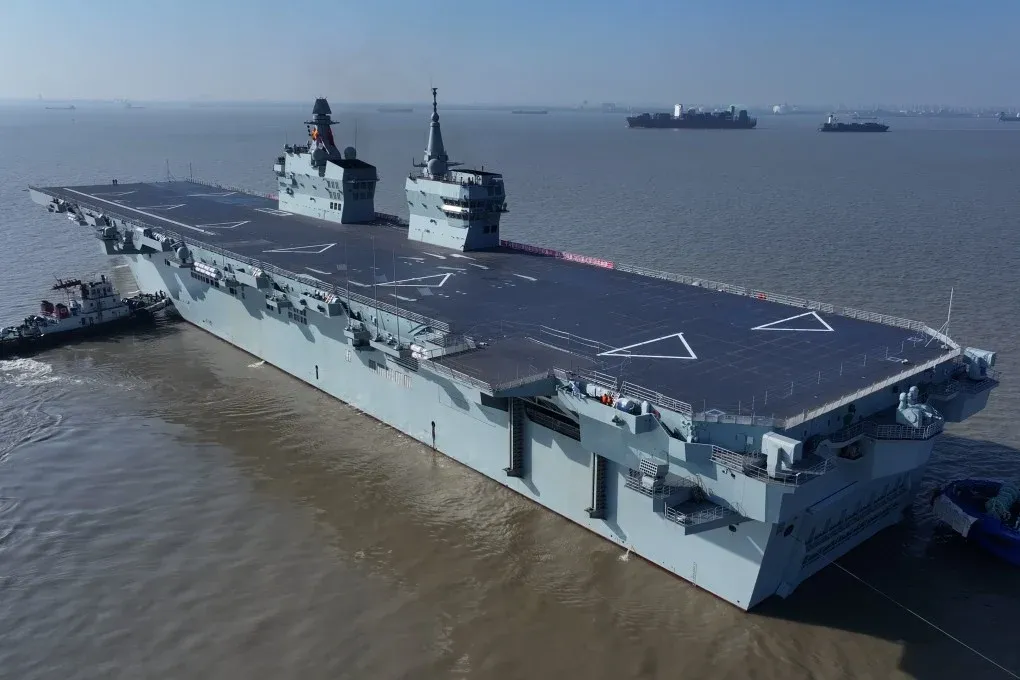
- China has deployed its first drone-carrier amphibious assault ship, Type 076, for scientific research trials and training missions in the South China Sea (SCS). These sea trials will test the performance of multiple on-board systems, including unmanned platforms, in the SCS maritime environment to refine technical and operational errors. A new class of carriers designed primarily for unmanned platforms signals a radical shift in how China intends to fight future conflicts and the role of interoperability in combat strategies.
- Chinese scientists have successfully tested an in-flight drone charging system using a wireless power transfer setup that beams energy from a mobile ground emitter to a drone using microwaves. The trials showed a vehicle-mounted system sustaining fixed-wing drones in flight for up to 3.1 hours at an altitude of 49 feet. The test achieved stable power transmission between units in motion by combining GPS-based positioning with onboard flight-control systems. For drones, this can enable persistent ISR and complex kinetic missions by reducing dependencies on landing cycles, extending operational range and replacing large onboard batteries for heavier payloads.
- Beijing has unveiled a new low-cost mobile laser system, NI-L3K, capable of countering small drones at a range of up to 4,300 ft at only $10 per shot in under 10 seconds. The laser also employs an electro-optical system to track targets at up to 1.4km for precision targeting. and has a field of fire with a full horizontal arc to engage low-altitude threats. Despite a long-range capability, the laser offers limited operational endurance and is susceptible to environmental conditions.
On Our Radar:
US-Made Comet USV Delivers Dual-Missile Punch
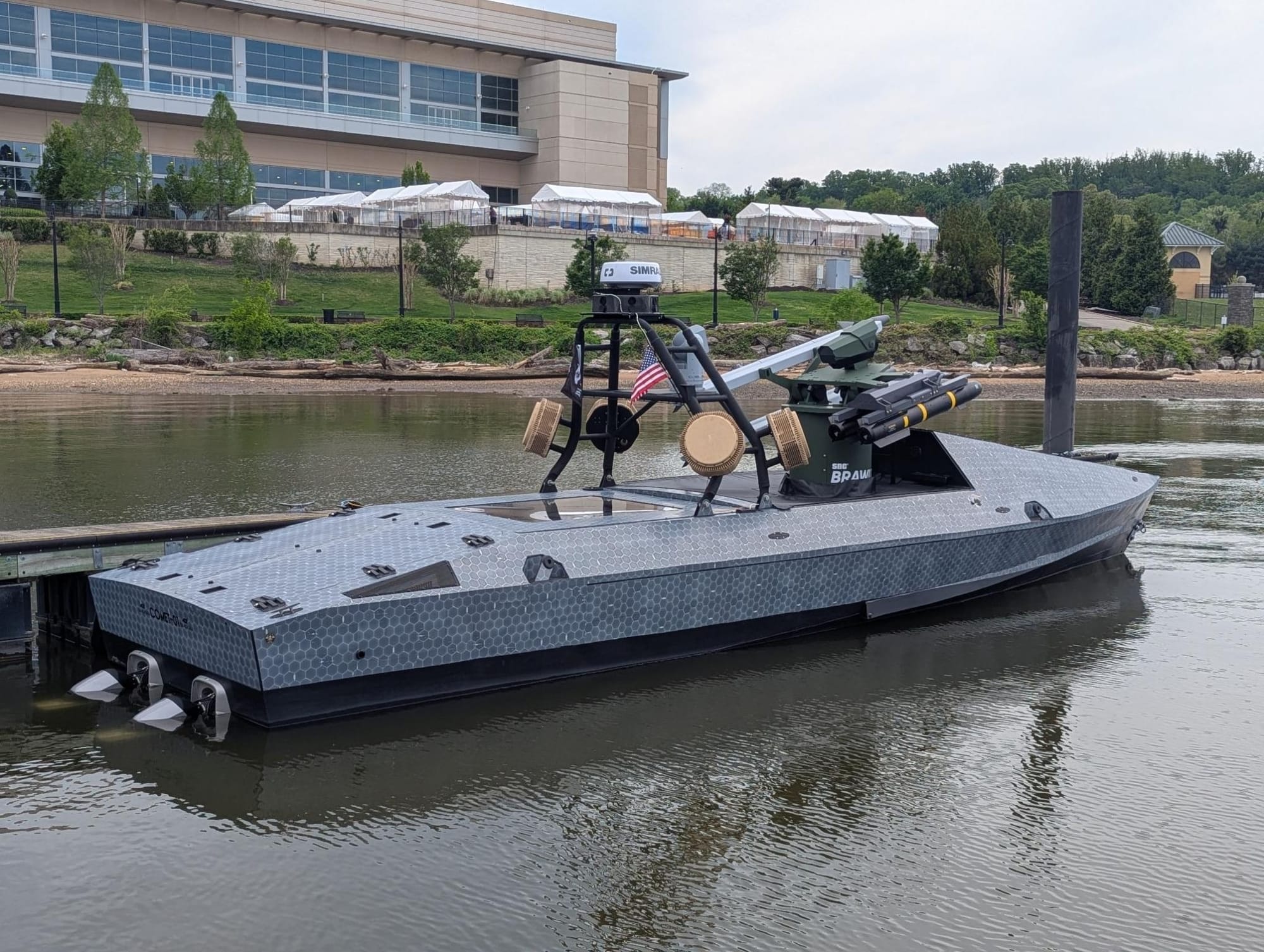
BlackSea Technologies developed the Comet unmanned surface vessel for naval air defense, featuring a dual-missile system that pushes interception capabilities offshore. Concurrently, Saildrone unveiled "Spectre," a 170-foot autonomous unmanned surface vessel designed for anti-submarine warfare and kinetic strike missions. The simultaneous rollout of heavily armed, multi-mission USVs by American defense contractors indicates that the naval drone market is moving past unarmed ISR platforms. The integration of kinetic strike capabilities onto autonomous vessels fundamentally alters the risk calculus for adversarial navies operating in contested waters. (The Defense Post)
Colombia Deploys AI Drones to Combat Gangs
Colombia is deploying 50 AI-equipped drones and expanding video surveillance to combat 11 criminal gangs vying for control in the Atlántico department. The deployment comes as drone attacks killed three Colombian soldiers this week, signaling that non-state actors in the region are rapidly acquiring and deploying lethal unmanned capabilities. Separately, Peru is ordering six TPS-77 MMR Radars from Lockheed Martin to bolster regional air defense. The simultaneous escalation of both offensive drone use by cartels and state-level radar procurement indicates that Latin America is entering a new phase of localized drone warfare. (AP) (Militaryni)
Southcom Creates New Autonomous Warfare Command
The US Southern Command has established a new Autonomous Warfare Command dedicated to integrating unmanned systems into regional operations. The structural reorganization reflects a broader strategic shift towards autonomous capabilities in the Southern Hemisphere, where vast maritime and jungle borders make traditional ISR prohibitively expensive. By elevating unmanned systems to a dedicated command level, Southcom is signaling that drone operations are no longer an experimental adjunct but a core component of its force posture against transnational criminal organizations and peer-adversary influence in the region. (DefenseScoop)
US deploys Ukrainian AI air defense against Iranian drones in Saudi Arabia
The U.S. military deployed Ukraine's AI-powered "Sky Map" command and control platform in Saudi Arabia to counter Iranian drone threats. The deployment highlights the growing reliance on combat-tested Ukrainian software to address complex air defense challenges in the Middle East. By exporting a system forged under constant Russian bombardment, Ukraine is proving that its defense-industrial base can produce software solutions that outpace traditional Western procurement cycles. The move also underscores the vulnerability of Gulf state infrastructure to Iranian drone swarms, necessitating immediate, proven countermeasures. (Yonhap News TV)
Ukrainian missile attacks damage Russian drone factories in Samara region
Ukrainian missile attacks damaged Russian drone factories, targeting industrial enterprises in Novokuibyshevsk and Syzran in Russia's Samara region. While the strikes caused no civilian casualties, they successfully disrupted critical supply chains for Russian unmanned systems deep within its own territory. The ability to strike production facilities hundreds of kilometers from the border forces Russia to disperse its manufacturing base and allocate scarce air defense assets to protect industrial hubs. This deep-strike capability is a critical component of Ukraine's strategy to degrade Russian drone saturation at the source rather than intercepting them at the front line. (DroneSense)
Nigerian drone maker aims to cut Africa's reliance on foreign defense suppliers
A Nigerian drone maker is aiming to cut Africa's reliance on foreign defense suppliers by developing indigenous unmanned systems tailored to the continent's specific operational environments. Meanwhile, Terra Industries is building Africa's largest drone factory in Ghana, signaling a significant push towards regional self-sufficiency in defense technology. The localization of drone manufacturing in West Africa reduces dependency on Chinese and Turkish imports while enabling states to rapidly scale fleets for counter-insurgency operations. (Africa Report) (TechPoint)
Hardware Innovations and Tactical Adaptations
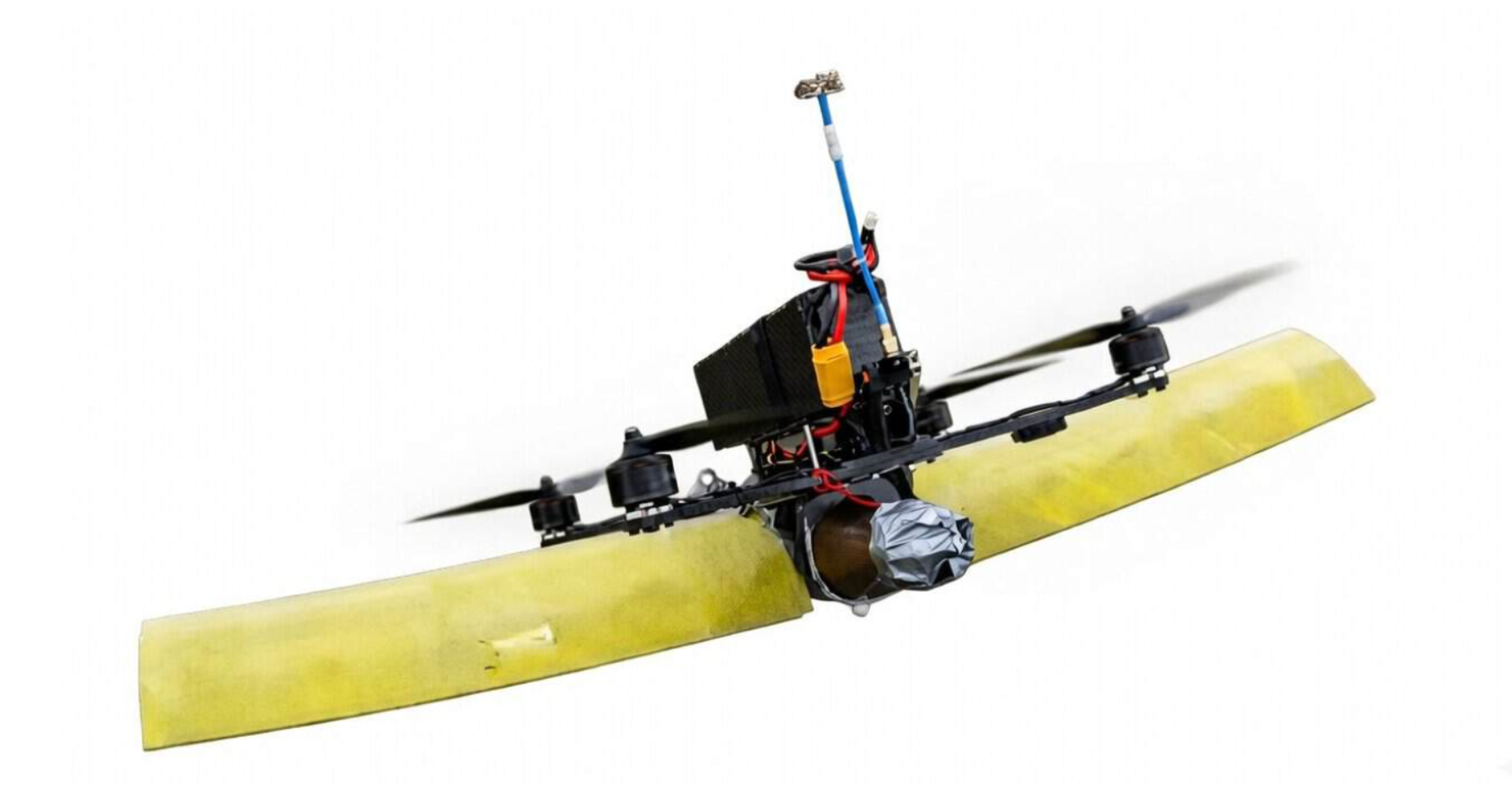
- Plastic Wing Retrofits: Ukraine has started retrofitting some of its FPV drones with plastic wings to increase their flight range. The trade-off for additional lift is likely the FPV's characteristic maneuvrability at high speed, which makes it difficult to neutralize at close range, higher visibility against adversarial countermeasures and a reduced payload capacity. This unusual capability swap signals that the innovation was most likely spun to meet immediate operational needs requiring a quick solution to an identified target.
- Mothership Carriers: The Russian forces reportedly configured their medium-range Orlan-10 reconnaissance drone into a mothership carrying small FPV quadcopters under its wings for long-range operations. Using fixed-wing drones as carrier and signal relays often enables drone pilots to increase the range of tactical quadcopters, which have a limited operational signature and can strike deeper into enemy territory without detection. This is likely at an experimental stage, with Russia testing FPV carrier tactics previously on its Gerbera, Geran, Shahid and Molniya drone variants.
- Darwin-Z Mesh Net: Reports indicate that Russia is fielding a new low-cost mesh net called 'Darwin-Z' to counter FPV drone attacks on key logistical lines, exposed positions and routes. The lightweight anti-drone net made from polypropylene mesh is designed to deform upon impact to prevent breaches for sustained protection. The net is easy and quick to install and is likely a response to Ukraine's growing attacks on Russian logistical lines over the past months.
What We're Reading
- Sentrycs Lands Major Counter-Drone Contracts Across World Cup Cities: The deployment of counter-UAS systems across 11 host cities highlights the growing prioritization of civilian infrastructure protection against asymmetric aerial threats during high-profile global events. (Dronelife)
- US Army Tests Drones, EW in Arctic Operations: The U.S. Army tested FPV drones, counter-UAS devices, and electronic warfare systems during cold-weather reconnaissance in Alaska, adapting tactical systems to extreme environments. (Defence Blog)
- Korean-US Partnership to Mass Produce AI Naval USVs: South Korean firms HD Hyundai and Hanwha partner with US defense to produce autonomous USVs, leveraging Korean shipbuilding capacity to offset American industrial base constraints. (Sedaily)
- Pakistan Deploys Indigenous 3D Stealth Tracking Long Range Radars: The deployment signals Pakistan's effort to reduce reliance on foreign defense imports while enhancing its ability to detect low-observable aerial threats along its borders. (ToI)
- DOD Plans Historic Drone Investment: The Trump administration proposes a $70 billion investment in drones, counter-drone systems, and autonomous tech for FY27, marking a massive structural shift in procurement priorities. (DefenseScoop)
- Australia Boosts Counter-Drone Defense with $7B: Australia commits $7 billion over a decade to boost counter-drone capabilities, funding high-powered laser and interceptor drone tech to secure its airspace. (Defense News)
- IDF Escalates Robotic Warfare Against Hezbollah: The IDF escalated deployment of autonomous robotic systems to dismantle Hezbollah's infrastructure, building on extensive drone and UGV use in complex urban environments. (JPost)
- Anduril, HD Hyundai Begin Autonomous Vessel Production: Anduril and HD Hyundai began constructing their first autonomous surface vessel, collaborating with Edison Chouest Offshore to use U.S. shipyards for production. (Military Times)
- India, Germany to develop AeroForce X long-endurance ISR drone: The joint development agreement highlights India's strategy of leveraging European technical expertise to build indigenous long-endurance surveillance capabilities. (AerospaceGlobalNews)
- Pentagon Seeks $54B for Drones and AI: The Pentagon requests over $50 billion for drone and counter-drone procurement, reflecting a major shift towards AI-enabled platforms across all branches. (Ars Technica)
- Deploys Maritime Drones for Mine Clearance: The U.S. military is deploying maritime drones in the Strait of Hormuz to detect and neutralize mines, mitigating risk to personnel from Iranian threats. (Yonhap News TV)
- China Proposes AI-Driven Crowd Control with Robots: Chinese researchers proposed an AI-driven crowd-control doctrine using drones and robot dogs to identify and neutralize agitators, replacing traditional security forces. (YNA)
- Northrop Demonstrates Modular AI for Aircraft Control: Northrop Grumman successfully demonstrated its Talon IQ modular AI architecture, "hot-swapping" AI agents mid-flight on a testbed aircraft for enhanced mission flexibility. (National Interest)
- Russia Enhances Su-57E Fighter AI Capabilities: Rosoboronexport continuously enhances Su-57E AI, providing pilots with automated tactical prompts for improved situational awareness and targeting. (TASS)


