


Welcome to this week’s Brief, our analysis of the most consequential developments in unmanned systems and drone warfare. Each week we track rapidly accelerating battlefield innovations, emerging doctrine, and the technologies reshaping how states and non-state actors deploy unmanned systems.
Have intelligence requirements, developments we should investigate, or perspectives to share? Contact us at info@dronesense.ai.

Deep Dive: Why Don’t Russia and Ukraine Use Direct Energy Weapons Much Against Drones?
The West is betting a lot on directed-energy weapons (DEWs) to protect its critical sites. Recently, the Pentagon awarded $86 million in initial contracts under a new laser programme, while its FY2027 budget proposal included more than $2 billion for DEW research, development and testing. Across the pond, the UK allocated £790 million over 4 years to a broader package for protecting its homeland and overseas bases from air, drone and missile threats, including new sensors, counter-drone systems, air-defence upgrades and DEW.
But surprisingly, evidence of the operational impact of DEWs remains quite thin in Ukraine, which has become a combat-testing environment for many emerging Western counter-drone technologies.
Logically, if lasers and radio frequency weapons can defeat drones for a fraction of the cost of missiles, the world’s most drone-intensive war should provide some of the strongest conditions for their adoption. But neither Russia nor Ukraine has shown sustained deployment, despite both sides having ongoing DEW programmes.
Russia conducted large-scale anti-drone laser tests in 2025, while Ukraine said in July 2026 that domestic lasers could intercept FPVs and were being adapted against Shaheds.
One reason behind this absence is that each drone type creates a different engagement problem.
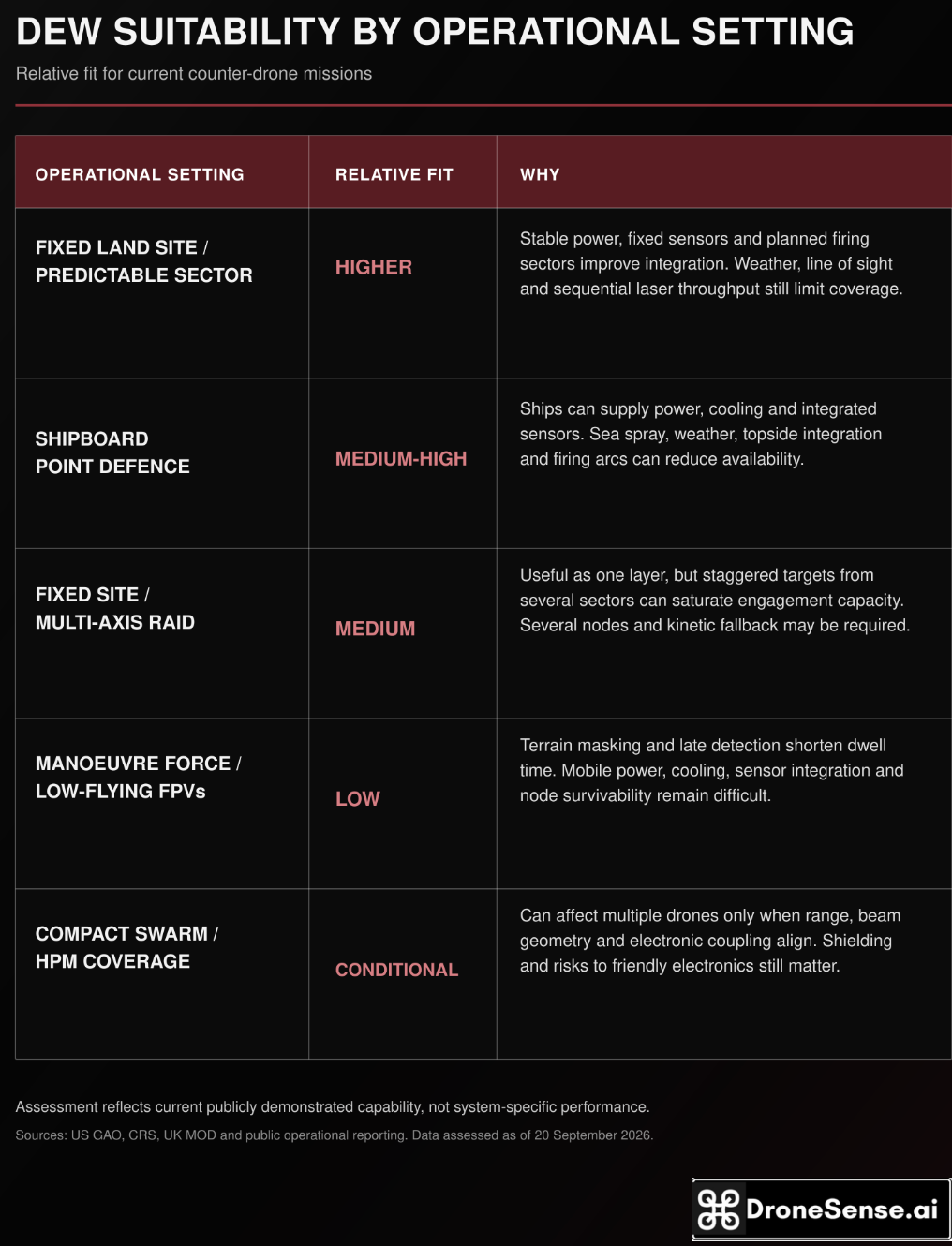
FPVs fly close to terrain and can remain outside line of sight until their final approach. This gives a laser only seconds to detect, track and hold its beam on a flight-critical component. Protecting moving units across a long frontline would also require many power- and sensor-dependent DEW nodes close to enemy fire.
Shaheds provide more warning, making them better candidates for laser defence around fixed sites. But Russia disperses them across different routes, altitudes and timings. Since a laser generally engages one target at a time, drones arriving from several directions can saturate its tracking and engagement capacity before every target can be defeated.
Then, there are radio frequency weapons, which can affect multiple drones but only when they enter the effective beam together. A mass attack involving hundreds of dispersed Shaheds does not necessarily create the compact swarm needed for this advantage to hold.
This distinction matters when trial performance is applied to Ukraine. A British radio frequency weapon defeated 2 swarms in one engagement and tracked, engaged and defeated more than 100 drones across the test programme. But its stated range was only 1 km. The trial showed that RF energy can defeat drones concentrated inside its coverage, while a multi-axis Shahed attack may spread targets across several engagement zones.
Maintaining each DEW node also requires sensors, power, cooling, clear firing sectors and conventional fallback systems. The effect must occur early enough to stop the mission. Damaging a sensor or temporarily disrupting electronics creates little defensive value if the aircraft or its warhead still reaches the protected site.
This also qualifies the idea of an “unlimited magazine.” Lasers do not carry conventional ammunition, but dwell time, retargeting and cooling still limit the number of targets they can defeat within one attack window. High-power microwave systems are similarly constrained by range, recharge time and thermal management.
Cost per shot creates another incomplete comparison. It captures the energy used during an engagement while excluding acquisition, sensors, power generation, maintenance, operators and the fallback weapons still required when DEW cannot engage.
Given these constraints, Ukraine has scaled systems that can be distributed faster. EW, mobile guns and interceptor drones can move as attack routes change, while interceptors can pursue targets beyond the firing radius of a ground-based weapon.
Russia faces a different calculation. Its airfields, refineries and military facilities provide more suitable locations for fixed DEW. However, Moscow said the results of its 2025 tests would be used to refine existing systems and move towards serial production and scaling. Its central problem lies in moving from a successful demonstration to producing enough complete defensive nodes to protect geographically dispersed assets.
So, if Western militaries expect to face the same dispersed FPVs, staggered drone waves and multi-directional attacks seen in Ukraine, why does it still make sense for them to invest so heavily in DEW?
The answer sits in what they expect to defend. Ships, airbases, ports, command centres and critical infrastructure all create bounded areas around which sensors, power, cooling and several defensive systems can be concentrated. Western investment is betting that enough threats can be detected and engaged inside these zones for DEW to reduce missile expenditure. Multi-axis attacks could still require several DEW nodes and kinetic fallback systems around the same site.
But securing mobility with DEW is still difficult. The US Army decided against fielding its 50 kW DE M-SHORAD after tactical testing exposed problems with heat dissipation, electronics and vehicle wear. Inevitably, the war in Ukraine is showing the West both where DEW could work and how an opponent could reduce its value through innovative tactics.
China Watch: Motherships, Swarm Mine Clearing, PLA Air Force Radar Site Defense, Drone Buybacks
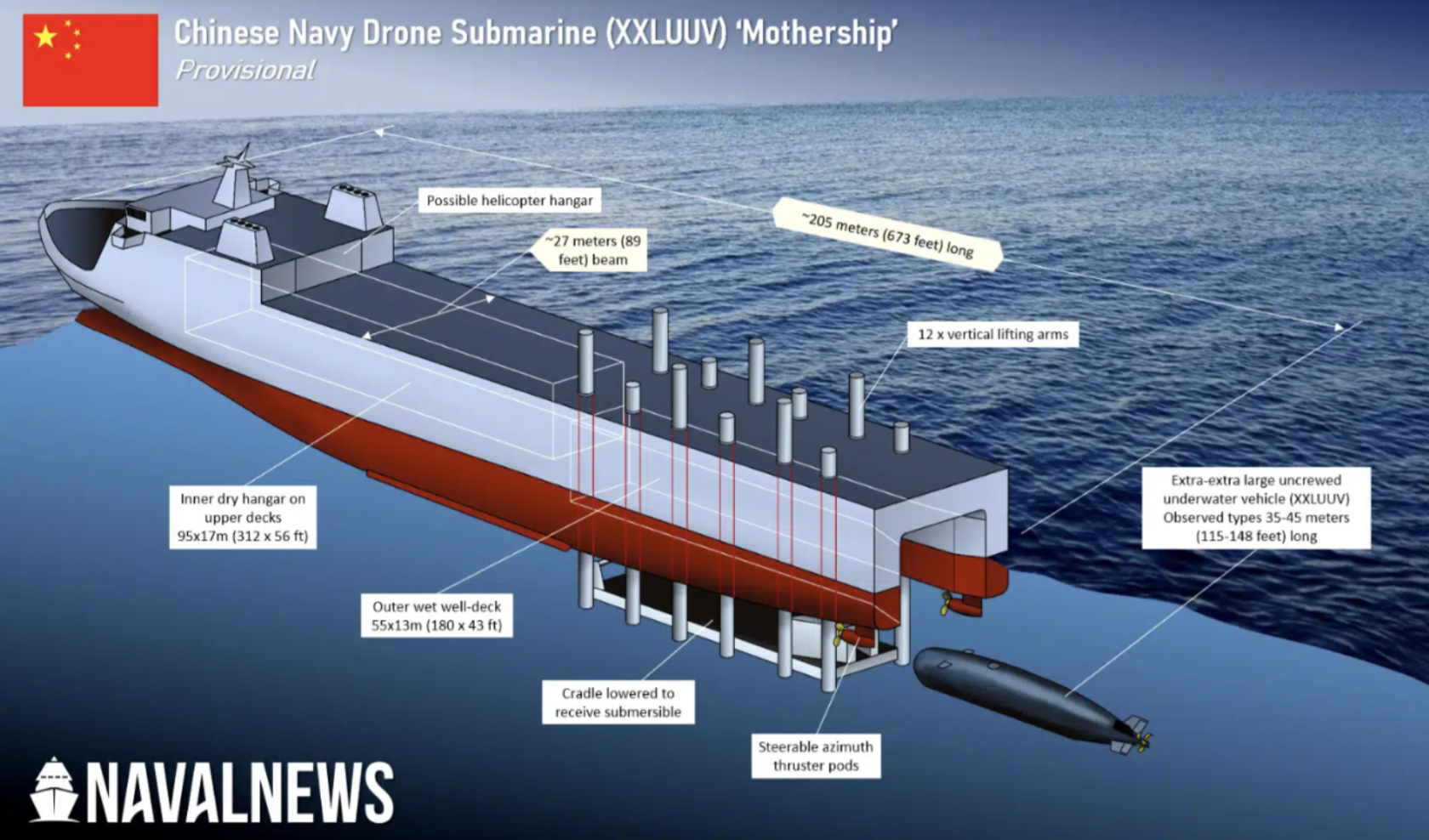
- China is building the world’s first mothership capable of carrying and recovering large submarine underwater drones. Imagery of a vessel under construction at Shanghai's Hudong-Zhonghua shipyard shows an internal hangar and a stern handling arrangement, with the structure interpreted as a lowering cradle supported by 12 vertical arms and possible accommodation for 4 extra-extra-large unmanned underwater vehicles.
- Usually, a large underwater drone can hold considerable range and still depend on a shore facility to prepare its next mission, which means a huge share of its endurance is consumed travelling to and from the point where it becomes useful.
- But a mobile support ship moves mission preparation closer to the operating area, allowing more of the vehicle's available energy to be spent on the assigned task. If the ship also provides servicing and payload replacement, it could support repeated deployments without each vehicle making a lengthy independent return to port.
- The 14th China International Defence Electronics Exhibition brought unmanned systems, counter-drone equipment and supporting electronics into a wider program covering components, information systems and intelligent logistics. Unlike China Electronics' account of the 2024 edition, what has changed this time is the specificity of the constraints the systems are built around.
On Our Radar:
Drone Damage Repair Timelines Become a Key Focus and Market Niche
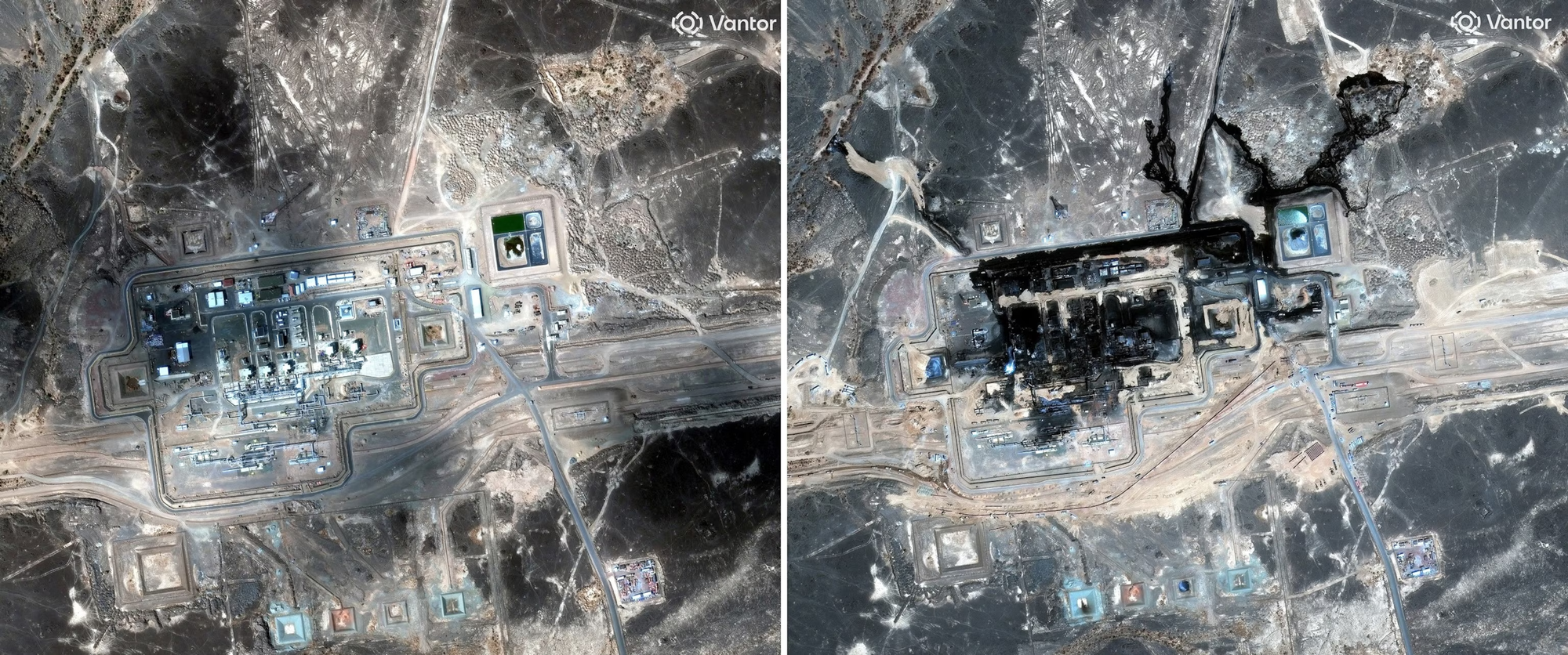
Damage to Saudi Arabia's East-West Pipeline could leave the line mostly out of service for three to six weeks, according to officials and industry sources, interrupting a route that had been moving between 2.6 million and 4 million barrels of crude a day to the Red Sea. That range puts an underexamined number at the center of every attack on energy infrastructure: the duration between visible damage and a repair that can actually return an asset to service. The quality of the initial inspection, access to specialized components, and the time needed to recommission damaged equipment now shape the commercial effect of a drone strike, while Russian refinery forecasts increasingly depend on estimates of when a damaged unit will resume production. (Associated Press) (Reuters) (EMOGCP)
Old Kit Gains New Life as Retired Vehicles Are Retrofitted for Autonomy
Textron Aviation and Merlin have built their Cessna SkyCourier UX concept around a familiar proposition for contested logistics: retain the useful airframe and remove the crew from the riskiest leg of the supply chain. The proposed aircraft would carry roughly 6,000 pounds, take off and land autonomously from austere fields, and use an FAA-certified platform already in production, though the program remains in engineering studies. On the ground, militaries are reaching for the same answer with old armored vehicles, adding remote-control and autonomy packages to equipment that can still haul supplies, evacuate casualties or enter exposed areas even after its original frontline role has passed. (Janes) (El Confidencial)
"Prepare to Be Constantly Hunted by Autonomous Drones"
Gen. Dan Caine, chairman of the Joint Chiefs of Staff, told U.S. forces to assume their formations will be hunted, jammed and tracked in real time by autonomous systems, a warning that makes communications denial an unreliable form of cover. He pointed to cheap Ukrainian FPV drones that use computer vision to continue toward targets after GPS is denied or the operator's link is cut, while the Pentagon's AI strategy directs the force to redesign its workflows around current AI capabilities. On Capitol Hill, witnesses were already asking whether an operator can exercise meaningful control when an AI-assisted targeting cycle has compressed past the point where a formal approval button leaves time to identify an error. (DefenseScoop) (Military Times)
Is a Smart Missile a Drone?
Rafael has begun integrating its SPICE 1000 guidance kit with Israeli F-35Is, a program that would give the fighter a 125-kilometre, GPS-denied weapon able to navigate, match a target scene and home after release. Ukraine's Brave1 says several companies are bringing AI into strike missiles, carrying the computer-vision experience of FPV warfare into weapons that have only seconds to correct their flight path. These systems do not have the persistence and retasking associated with many drones. Autonomy is moving deeper into the strike chain, placing more of the targeting decision inside the munition itself. (Defense News) (Business Insider)
Russia Tests Mothership Tactics for Swarm Deployment
Russia is putting a second aircraft behind its FPV penetration problem. Ukrainian units have reported Orlan and Molniya platforms carrying smaller FPV drones and signal relays, allowing the carrier to push an attack farther forward before releasing the systems that will make the final approach. The reported tactic turns one defensive problem into several: an interceptor must find the carrier early enough to prevent the release and then contend with the smaller drones and the extended control network it provides. This emerging layered delivery method can stretch the defended area around Ukrainian logistics routes and rear positions, though it remains unclear how broadly Russia has fielded the approach. (Ukrainska Pravda) (Institute for the Study of War)
Autonomy Suppliers Move Production Closer to the Customer
Rheinmetall Canada has broken ground on a 7,060-square-metre expansion in Quebec to produce, integrate, and sustain its Mission Master ground-robot family, turning a Canadian-developed autonomy stack into a domestic manufacturing and support line. Separately, Echodyne is considering European radar production after Kongsberg selected its MESA sensors for Protector remote weapon stations, pursuing the same proximity to a counter-drone market where local content increasingly determines who stays inside the procurement system. (Rheinmetall) (Defense News)
Hardware Innovations and Tactical Adaptations
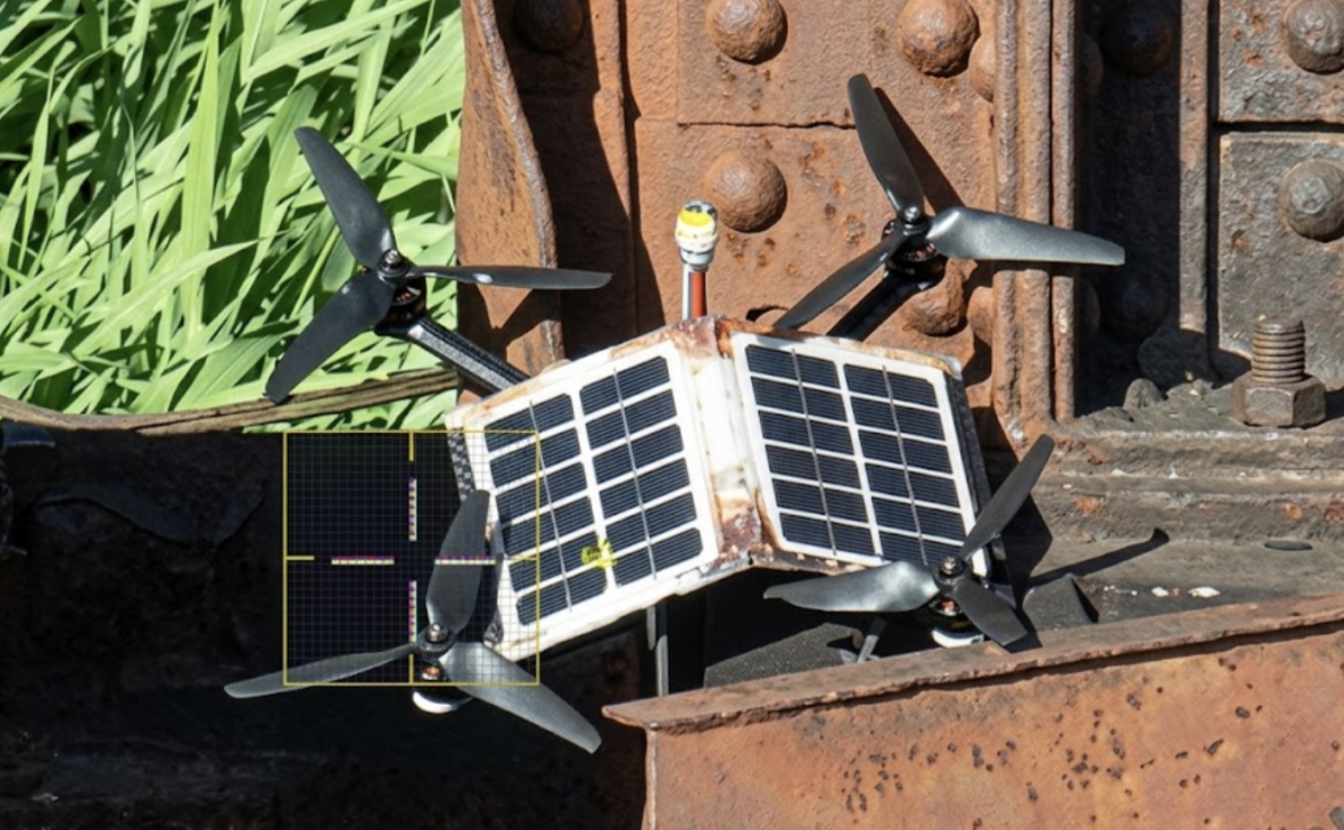
- Solar Panels on FPVs: More and more Russian FPVs were captured this week equipped with $50 solar panels. These panels, sized to sit on an FPV frame, put out roughly 5 watts. They are wired straight into the 5-volt bus that runs the camera and video transmitter, and produce 15-45 watt-hours a day depending on sunlight. While the panel cannot power the drone during flight, it lets operators run the drone from ambush, extending how long it can wait for a target. The aim is likely to preserve standby endurance, not continuous flight or deeper front-line penetration. This dormancy can stretch several weeks, with the drone electronically silent until reactivation.
- Positioning Remote IP Cameras & Comms Masts: Ukrainian soldiers are now using their hexacopters across the front lines to emplace small remote communication masts and IP cameras connected to starlink with large batteries, some of which appear heavily camouflaged by the surrounding nature. The tactic is a cheap way to ensure early warning, and removes the main exposure risk in current mast deployment: walking the unit into position under constant drone observation or fire. The camouflage will also likely improve survivability against visual drone reconnaissance. Further sensors, including acoustic and thermal, are very likely to appear on these devices.
- Timing Gerans with Rain: Russia has started timing the launching of its gasoline-powered Gerans with cloudy, rainy weather to make them harder to intercept. While this makes gasoline-powered Shaheds harder for interceptor drones to engage, it is less effective for some newer optical guidance modes. The jet-powered Geran “Seeker” variants usually struggle to hunt and lock targets from roughly 3–6 km in poor weather. In fact, these conditions make EW measures more effective against them. Similarly, AI-assisted optical terrain navigation on Molniya UAVs becomes less reliable when cloud and rain degrade the imagery. This tactic can likely push more of the burden back toward EW, guns, and MANPADS.
What We're Reading
- Border Laser Cuts Drone Activity: U.S. officials say the Army’s high energy laser destroyed 11 cartel linked drones in 10 days along the Rio Grande Valley, after which suspected incursions fell roughly 75%, supplying a permanent kill layer to complement electronic warfare despite an undisclosed baseline. (The Defense Post)
- IEA Says Drone Campaign Is Eroding Russian Refining Resilience: The IEA cut its Russian refinery throughput forecast to about 4 million barrels a day for late 2026 and 2027, citing accumulated strike damage and sanctions constrained repairs as repeat attacks turn temporary outages into a fuel supply reliability problem. (Oil & Gas Journal)
- Russia Hunts Ukraine’s Locomotives: Ukrainian Railways says Russia is destroying or damaging 37 to 40 locomotives a month, exposing a replacement gap that is difficult to close because Ukraine’s 1,520 millimetre gauge cannot quickly draw from Europe’s standard gauge fleets. (POLITICO)
- Russia Speeds Cheap Smart Weapons Production: The Wall Street Journal reports Russia has moved jet-powered Geran drones and Banderol missiles into mass production within a few years, using low-cost designs and Chinese electronics to translate battlefield feedback into fielded weapons faster. (The Wall Street Journal)
- U.S. Army Seeks Drones for Field Blood Transport: The U.S. Army wants two semi autonomous UAVs able to carry 20 units of blood over a 30 kilometre radius, testing whether commercial systems can close an urgent delivery gap under operator supervision. (Defense News)
- France Breaks Tank Platoons Into Smaller Drone Targets: France’s 7th Armored Brigade is testing two tank, two VBL teams after its one tank configuration left too little tactical coherence, attempting to make dispersed armor an uneconomical target for hostile drones. (Defense News)
- Swarm Aero Unveils a Lower Cost Reaper Alternative: Swarm Aero says its Gamera Group 5 aircraft can carry more than 2,800 pounds and deliver MQ-9 type strike effects at one tenth the cost, testing whether a cheaper platform can carry bomber class weapons. (Military Times)
- North Korean Workers Enter Russian Drone Factories: The Multilateral Sanctions Monitoring Team estimates that North Korea had 35,600 to 101,280 workers in 17 countries, including student visa holders at Russia’s Alabuga zone, placing overseas labor networks inside its drone and weapons production chain. (Chosun Ilbo)
- Nigerian Army Builds Drone Control Station: The Nigerian Army is constructing a remotely piloted aircraft system control station at its Jos headquarters, a facility expected to strengthen intelligence, surveillance, and reconnaissance for security operations in Plateau State. (Premium Times)
- Drone Incursions Delayed Zelensky’s Plane in Moldova: Zelensky says Russian drones twice entered Moldovan airspace while his aircraft was transiting, forcing a delayed departure in one episode, though Ukrainian officials say the plane was not airborne with the drone and Moldova has not confirmed a direct targeting attempt. (Militarnyi)


