


Welcome to this week’s Brief, our analysis of the most consequential developments in unmanned systems and drone warfare. Each week we track rapidly accelerating battlefield innovations, emerging doctrine, and the technologies reshaping how states and non-state actors deploy unmanned systems.
Have intelligence requirements, developments we should investigate, or perspectives to share? Contact us at info@dronesense.ai.
Deep Dive: Autonomy or amount, what makes swarms the next frontier of drone warfare?
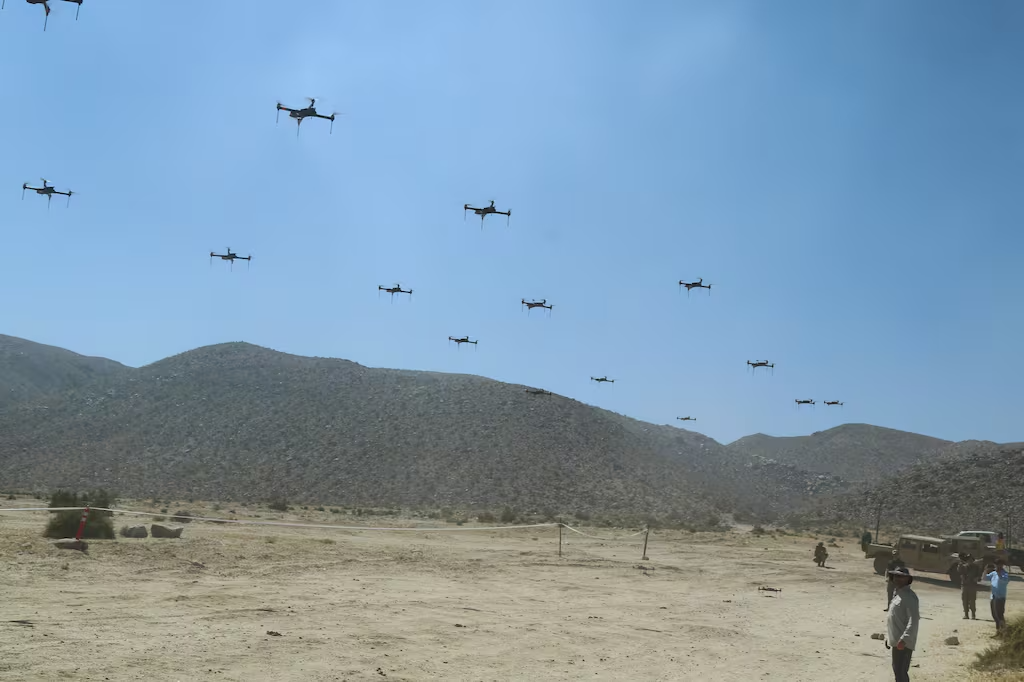
When a US F15 pilot was debriefed after ejecting over Iran in April, he described multiple drones interconnected and moving as one, with smaller drones hanging below like legs, in a formation that resembled a jellyfish. This swarm architecture was something western intelligence communities had not previously assessed Iran to possess, and the account set off a debate that has not been resolved; the pilot was concussed and it was his second time being shot down and US CENTCOM declined to comment.
The debate matters because it sits at the center of how drone swarms actually work. On one side is the possibility that Iran has developed one-to-many meshed networking, where drones coordinate in real-time, hold reserves, and adapt to what the first volley fails to destroy. On the other is the War Zone's more cautious read: a preprogrammed barrage balloon screen, drones sent on fixed routes with no cooperative capability, where the geometry comes from tactical planning rather than algorithmic coordination. The difference between those two interpretations is the difference between autonomy and amount as the decisive variable in swarm effectiveness. Ukraine is where that question is currently being tested at scale.
Ukrainian production has scaled from 5,000 drones in 2022 to over 4 million annually, and Russia launched 6,804 long-range drones and missiles in April alone. The data suggests that the amount layer operates on an unforgiving arithmetic that point defenses cannot easily overcome. During a June 5 barrage, Russia employed 216 mixed platforms and Ukraine achieved a 91.7% kill rate, yet 16 strike vehicles still reached 13 separate locations in Kyiv. A defender who neutralizes 95% of 600 Shaheds still absorbs 30 successful strikes, and raising that threshold requires proportionally more interceptors and command bandwidth while the aggressor simply adds platforms to restore the penetration count. One defense analysts have noted that once the kill rate exceeds 70%-80% percent, the cost-benefit logic of slow propeller variants likely collapses. That appears to be precisely why Russia deployed the jet-powered Geran-4: reseting the velocity threshold at which engagement becomes viable more than bypassing air defenses.
The adaptation reveals what autonomy actually adds to volume. A mass swarm without coordination forces the defender into a linear response: engage each platform in sequence as it arrives while a meshed network breaks that linearity. Units that survive the first wave could reassign to targets the first volley failed to destroy, compressing the decision window from minutes to seconds. The jellyfish formation, if genuine, suggests Iran may have already solved the coordination layer. The Yartura Dancer 4.5.0 addresses this directly: at 450 km per hour with automatic target reacquisition, it is designed to re-engage a reassigning platform before it reaches a secondary target. But that capability only holds if the defender produces Dancers faster than Russia produces Geran-4s. The contest returns to the production-exchange ratio.
This is the constraint the current counter-swarm procurement drive has not resolved. Systems claiming counter-swarm capabilities (like Israel's DroneLight laser, Lithuania's Black Wasp, and Rohde & Schwarz's THORIS) each reduce the marginal cost per kill, but they do so by adding another tier to a defensive architecture that already favors the aggressor on industrial tempo. A laser neutralizing 30 targets per minute is effective until the adversary launches 31.
The recent $124M UAE Slinger contract suggests Gulf states have absorbed the cost-exchange lesson from Ukraine. The deeper lesson, that a system spent in days and rebuilt in years carries little endurance in a war of attrition, has likely not produced a procurement posture to match it. Engaging a $50,000 Shahed with a $12 million Patriot round depletes stockpiles faster than any allied factory replenishes them.
Ultimately, the swarm frontier will likely be decided by which side sustains the highest manufacturing volume under attrition more-so than pure platform capability. AI-on-AI drone warfare is already a reality in Ukraine, with Russia's aviation output rising 117% year-on-year and Ukraine's Brave1 Dataroom opening millions of combat videos for AI training. The jellyfish formation appears to signal Iran's entry into this phase. But the unresolved intelligence debate around it suggests the US and NATO are still measuring a capability they do not yet understand. Doctrine and procurement cannot be calibrated against a threat whose architecture itself is always under iteration.
China Watch: Drone Tanks, Autonomous Manufacturing, and Export Controls
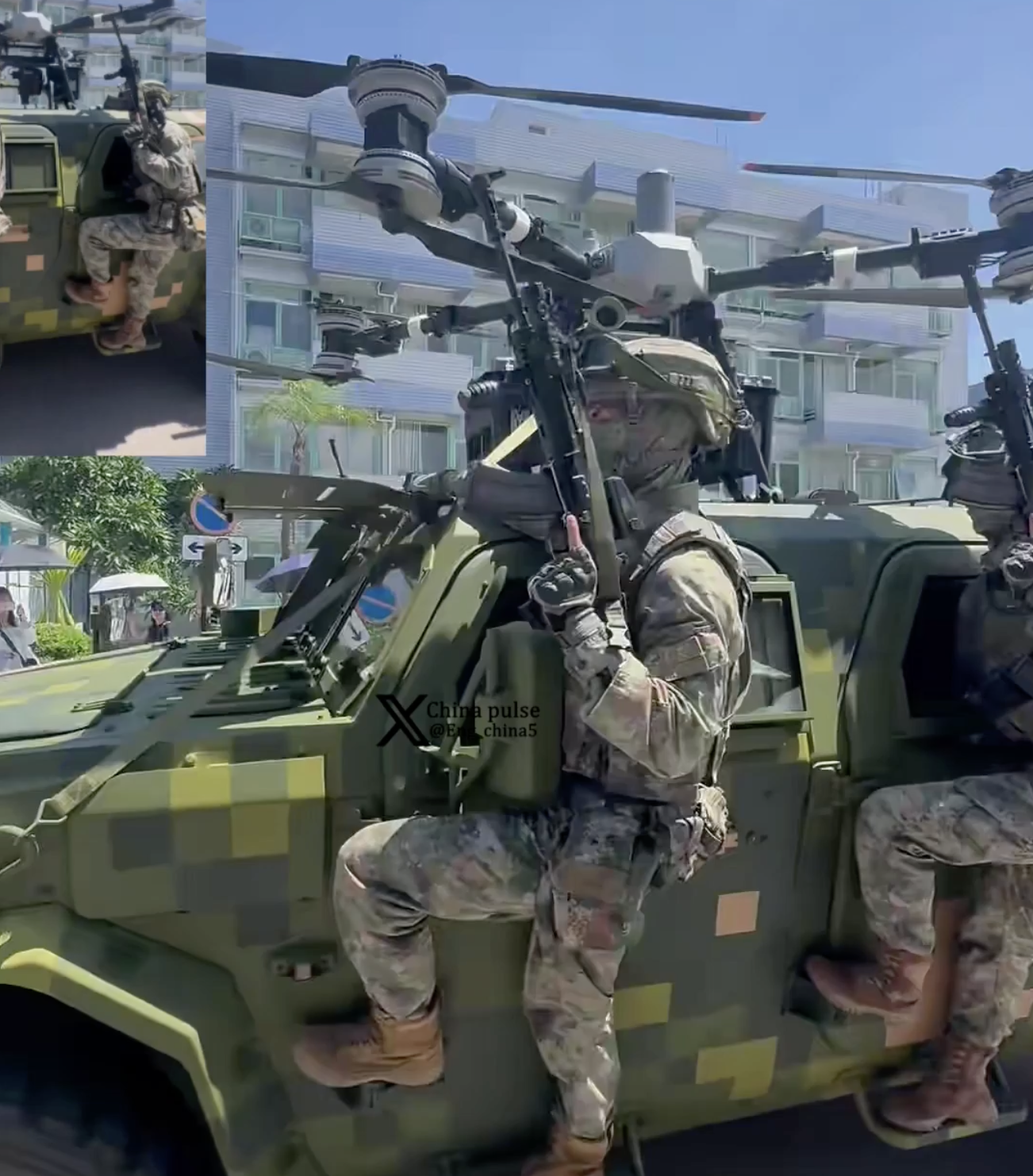
- Beijing is now equipping its CSK-181 armored vehicles of the People's Liberation Army (PLA) garrison in Hong Kong with the DJI FC1000. These DJI drones can carry payloads up to 85kg, and are designed primarily for logistics, emergency response and supply missions.
- The drones were mounted on the platforms’ roofs, most likely for route reconnaissance, improving local situational awareness by identifying obstacles beyond visual line–of-sight (LoS) in dense urban environments. The configuration also enables PLA to enhance readiness for rapid-response operations, and indicates that the PLA is testing how commercial drones can be integrated into routine mechanized operations.
- At Eurosatory 2026, China’s state-run North Industries Group Corporation (Norinco) displayed a miniaturized model of a full assembly line alongside several drones, signaling localized manufacturing capabilities are becoming part of its export offerings. This arrives as China seeks to expand its drone exports to countries targeting to build indigenous capabilities, particularly in the Middle East.
- The two new export regulations (announcements No. 77 & 78), tightening declaration requirements for exports of industrial machine tools and unmanned aerial systems (drones), including related parts and components, will take effect from 30 June 2026 onwards. The measures do not expand the list of controlled products but raise the bar for how exporters must report, describe, and justify shipments, requiring more detailed product information. The move should be viewed within the broader global drone race, where states are building drone arsenals to gain competitive leverage.
On Our Radar:

Ukraine Uses Balloon-Borne Drones for Deep Strikes Into Russia
Ukraine is deploying inexpensive stratospheric balloons to carry AI-guided drones and missiles deep into Russian territory, stacking the ranges of both platforms to reach targets neither could hit alone. The balloons ride prevailing west-to-east winds, bypassing air defenses and forcing Russia to expend million-dollar interceptors on $200 targets. This delivery pattern represents a structural geographic advantage for Kyiv, turning the wind itself into a mechanism for extending the reach of its autonomous strike campaign. (Defense News)
Hezbollah Manufactures Drones as Fiber Optics Appear in Lebanon in Mass
Israeli forces discovered a massive underground Hezbollah drone factory just six kilometers from the border, equipped with launch shafts and housing dozens of explosive UAVs. Simultaneously, Hezbollah has begun fielding tethered fiber-optic FPV drones that are entirely immune to conventional electronic warfare. The combination of an in-theater production facility and unjammable strike platforms means Israel's counter-UAS stack in southern Lebanon is now partially obsolete, as the supply chain is already entrenched inside the conflict zone. (NDTV, Defense News)
Drone Strikes Wreak Havoc on Crimean Supply Chains, Cause Fuel Shortages
Ukraine's Unmanned Systems Forces struck more than 60 military and logistics targets across Crimea in a single coordinated operation, severely damaging energy infrastructure and port facilities. The campaign has now moved beyond purely military targets to the civilian logistics layer, producing fuel rationing and total blackouts in major cities. This represents the drone equivalent of strategic bombing: Russia cannot suppress the second-order civilian infrastructure effects without solving the underlying targeting problem. (El Pais, FT)
The U.S. Military Is Losing Its Technological Edge to AI and Drone Adversaries
The era of American military technology dominance is ending, as the proliferation of cheap drones, autonomy, and AI levels the playing field between Washington and its adversaries. The recent conflict with Iran served as the first empirical validation that the U.S. technological edge has eroded in actual combat. Possess of technological advantage is now less relevant than speech of adoption, integration, and iteration. (Foreign Affairs)
Non-Traditional Companies Rush to Take Part in the Drone Spending Boom
The defense-industrial base is rapidly expanding beyond traditional prime contractors as non-traditional firms enter the drone market. The U.S. Air Force awarded Collaborative Combat Aircraft production contracts to Anduril, the first new company to win a fighter program since the 1970s, which is now negotiating to acquire a historic Nissan automotive plant in Japan for local UAV production. With telecom giants like Vodafone and legacy vehicle makers like AM General also entering the space, the security market is drawing in civilian industrial capacity at scale. (National Interest, RIA Novosti)
Autonomous Ground Systems Move Into Combat Engineering
The Spanish Army awarded Indra a 382 million euro contract to develop an automated wheeled bridge-laying vehicle, with a prototype expected by the end of 2026. The platform integrates advanced C4ISR technology, transforming a traditional engineering asset into a node within a digitized battlefield network. While in early development, more projects like this are being announced moving autonomous ground systems beyond strike and reconnaissance roles into heavy combat engineering and mobility support. (Infodefensa)
Hardware Innovations and Tactical Adaptations
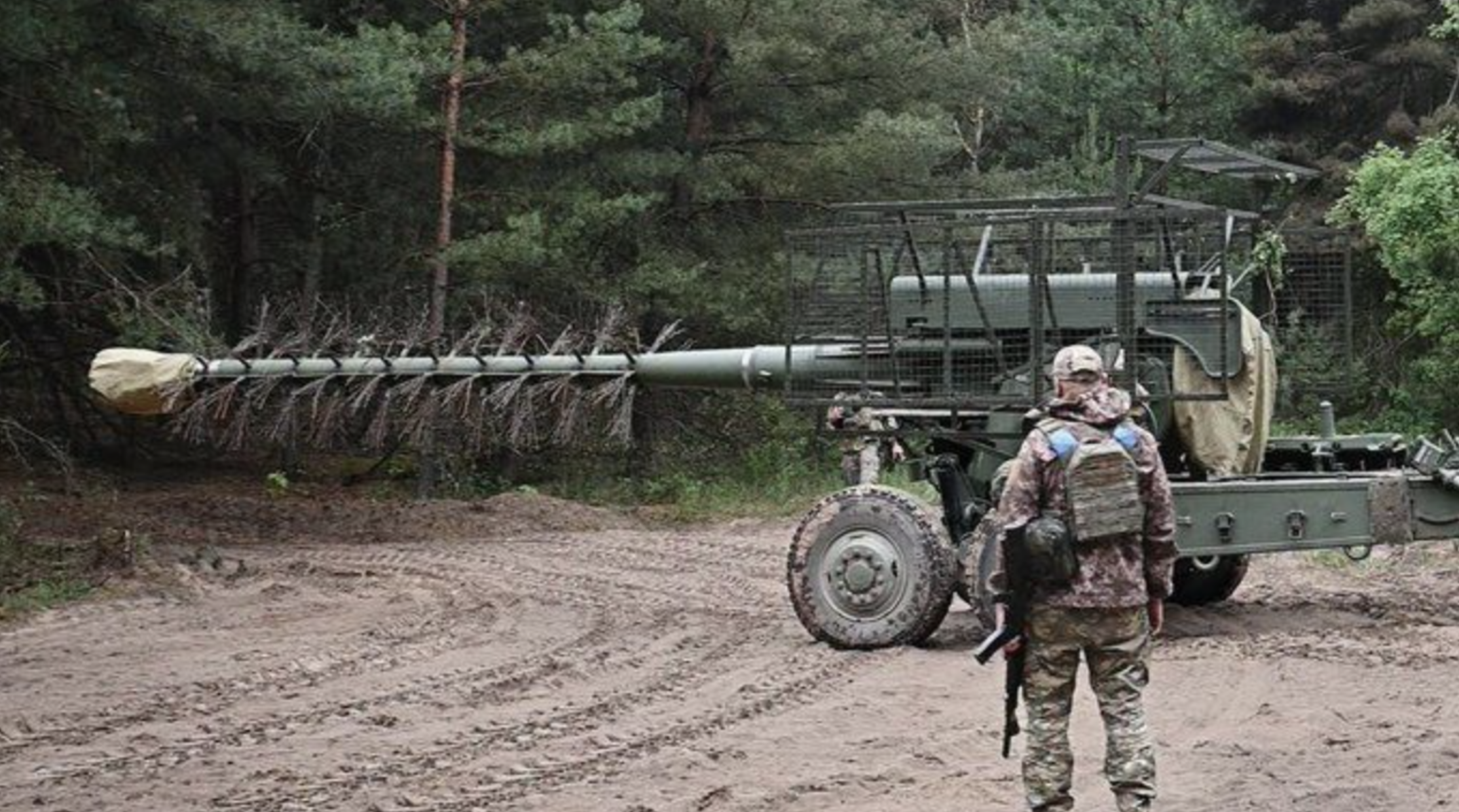
- Anti-Drone Barrel Shield: A Ukrainian 2P22 Bohdana 155 mm towed howitzer was reportedly equipped with an anti-FPV drone shield around its barrel. This improvised shield features a lightweight cylindrical cage/sleeve wrapped around the forward section of the gun barrel. It’s not attached directly to the barrel itself. But instead, appears to be supported by a series of evenly spaced radial struts or ribs that hold the outer mesh away from the barrel. The innovation likely functions as a ‘sacrificial barrier’ that keeps drones from making direct contact with the artillery system's critical surfaces.
- Drone as Bait: A Russian soldier was reportedly incentivized to retrieve a downed Ukrainian drone, likely to inspect its technology for reverse engineering. Instead, the drone, rigged with an explosive, detonated once it was carried away, illustrating how habits and behaviors themselves can be weaponized in full-scale warfare.
- USV as FPV Carriers: Russia has claimed that Ukraine is using USVs to launch FPV drones from the sea off occupied Crimea to hunt Russian mobile fire groups and air-defence teams on the coast. The innovation exploits a tactical gap: most Russian mobile fire groups are configured to counter larger Ukrainian attack drones rather than smaller, faster, and lower-signature FPV drones. Also, if USV-launched FPVs can suppress coastal fire groups or air-defence assets, they likely become part of the enabling layer for larger drone and missile attacks.
What We're Reading
- US Develops AI-Designed Aerial Vehicle for Nuclear Arsenal: The National Nuclear Security Administration's testing of Aires Tide, an AI-designed aerial vehicle, moves AI-generated hardware from commercial manufacturing into the nuclear weapons complex, the most tightly controlled procurement environment in the US government. (Kommersant)
- Ukraine's Demand for Tiny Drone Laser-Targeting Systems Spurs New Product Launches: Ukraine's battlefield requirement for miniaturized laser designators is pulling commercial optics manufacturers into defense production, compressing the development cycle that would normally take years into months. (Defense News)
- USMC Deploys Autonomous Systems to Okinawa: The Marine Corps is relying on autonomous NMESIS and MADIS systems to generate the mass required for distributed anti-access and area-denial operations in the Indo-Pacific, with the Okinawa deployment the most forward expression of that doctrine. (Yonhap)
- Israeli Defense Tech Seeks Local, Autonomous Solutions: Israeli defense firms are accelerating domestic production and autonomous software development to insulate their supply chains against potential US arms restrictions, a hedge that would have been unthinkable five years ago. (Mako)
- Israel Unveils Tube-Launched Drone Interceptor: Rafael and SpearUAV's Iron Wasp integrates an autonomous drone interceptor into existing combat vehicle launchers without platform modifications, removing the need for dedicated counter-UAS vehicles and distributing the interception capability across the entire armored force. (The Defense Post)
- GCC Seeks Autonomous Collective Defense with AI: Gulf states are developing autonomous collective defense architectures with integrated AI and real-time data sharing as US security guarantees become less reliable, building the technical infrastructure for a defense posture that does not depend on American response times. (Focus)
- China Integrates LOAC into Autonomous Weapons: Beijing's integration of Law of Armed Conflict requirements into autonomous weapon systems through military-civil fusion is not a concession to international norms – it is preparation for operating in environments where target discrimination and proportionality are programmed constraints that reduce legal exposure during and after conflict. (Lieber Institute)
- M83, Deblaat Develop Synthetic Data for Robot and Drone Training: The joint initiative to develop synthetic training data for robots and drones addresses the single largest bottleneck in autonomous systems development: the scarcity of labeled real-world data for edge cases that cannot be safely generated in live environments. (Newspim)
- Eric Schmidt Tests Autonomous Drones in Ukraine: Schmidt is reportedly using the Ukraine conflict to test his autonomous Hornet drone system outside US defense regulations, making Ukraine the permissive regulatory environment that allows capability development prohibited at home. (Izvestia)
- Ukraine's BARS RS UAV Strikes 1,000+ kilometers into Russia: The confirmed 1,000-kilometer strike range of the modified BARS RS platform places Ukraine's domestic defense industry at parity with Russian strategic strike capabilities, without foreign platform transfers. (Janes)


