


Welcome to this week’s Brief, our analysis of the most consequential developments in unmanned systems and drone warfare. Each week we track rapidly accelerating battlefield innovations, emerging doctrine, and the technologies reshaping how states and non-state actors deploy unmanned systems.
Have intelligence requirements, developments we should investigate, or perspectives to share? Contact us at info@dronesense.ai.

Deep Dive: Does Supply Chain or Technical Intelligence Drives the Edge in the Drone Race?
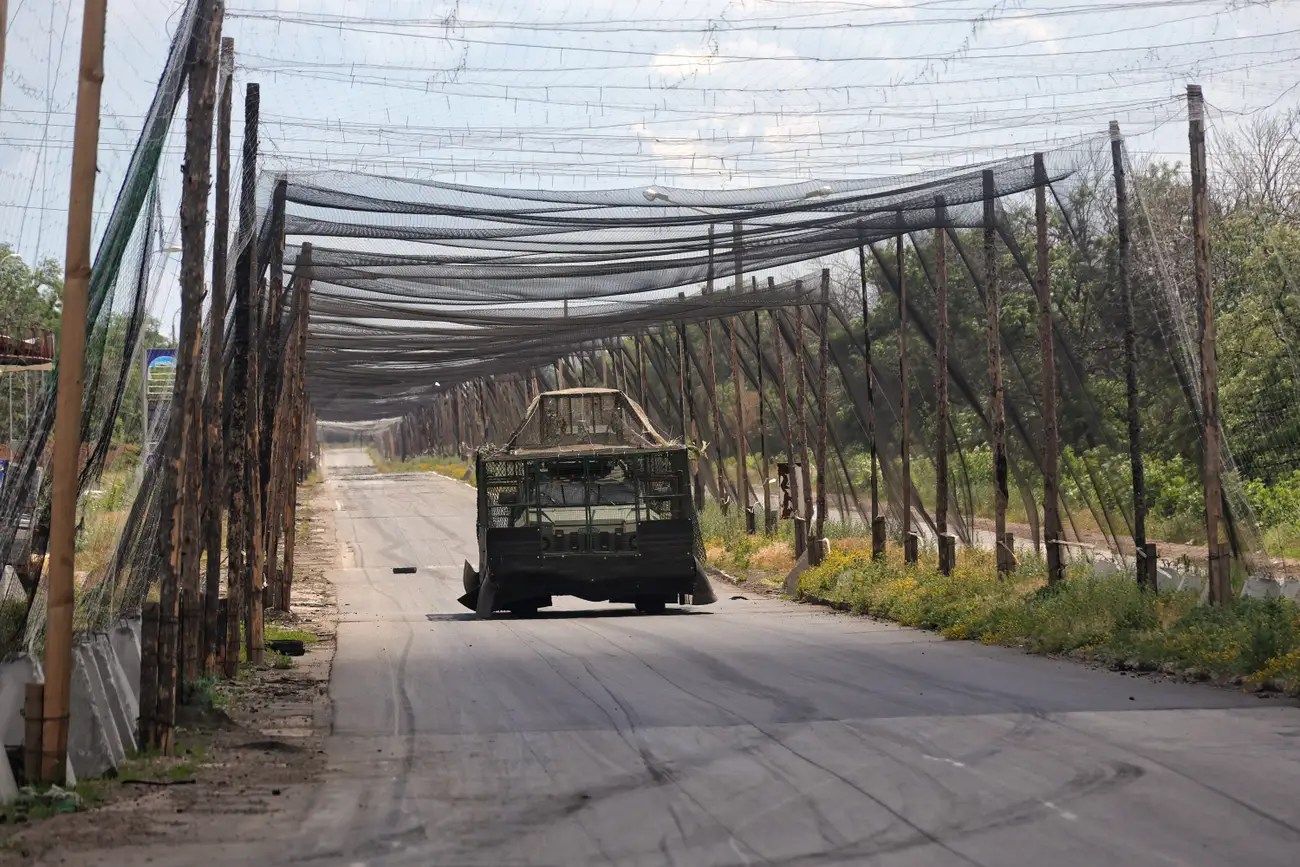
Where does a state begin if it wants to build a credible drone arsenal but has neither the technical intelligence nor the industrial capacity to do so? For most, building a sovereign supply chain from scratch would be far more difficult than acquiring the knowledge needed to use already available systems. The falling cost and simplicity of many drones has lowered the barrier to entry, allowing states to learn from foreign designs, train operators and begin building an unmanned capability without first developing an aerospace industry.
This gives technical intelligence a high initial marginal value. It allows a state to move beyond simply buying drones and begin adapting them to its own operational environment. Knowledge can also travel more easily than factories can. But there is a limit to how far this advantage can go. A country can know how to build better FPVs or loitering munitions and still be unable to produce enough of them to matter in a prolonged war. Why? Because the threshold for sustaining drone combat has not changed much.
Once drones become disposable enough, volume becomes a competitive advantage in its own right. Russia is a useful example to understand this. Moscow does not need to originate every useful innovation if it can identify what works, replicate it and manufacture it at scale. A relatively basic drone produced in the tens of thousands can pose a greater battlefield problem than a technically superior system that cannot be quickly replaced. At this point, the marginal value of another technical breakthrough may be lower than the marginal value of another production line.
But production creates another problem: what happens when the inputs are disrupted? A factory is of little use if it cannot replace the motors, batteries, or electronics needed to keep producing. This is where supply-chain resilience becomes more valuable than industrial capacity alone. China is perhaps the clearest example because its advantage lies in the depth and redundancy of the wider manufacturing ecosystem around it.
A state does not necessarily need to own every part of its supply chain. It needs enough access and alternatives that an adversary cannot easily switch its production off.
Though industrial capacity can produce large numbers of drones, but without technical learning those drones can eventually become easier to defeat. Ukraine has demonstrated the value of a short feedback loop between battlefield experience, engineering and production. A weakness is identified, the system is modified and the next version returns to the battlefield. Yet Ukraine also shows the limits of technical intelligence when the industrial capacity to turn it into mass depends heavily on external support. The knowledge may remain even if the ability to convert it into enough drones does not.
This is also why for China, which has already built enormous industrial depth, the marginal gain from simply adding more production capacity may be lower than the gain from acquiring battlefield knowledge that can improve what it already produces. Russia's experience in Ukraine, alongside Ukraine's own evolution, then becomes useful extremely useful.
Iran appears to disprove our hypothesis, but it actually operates under another model: distributed production and technical knowledge can create resilience without requiring China's level of industrial depth. The important point is that there is more than one way to build a drone enterprise, but every model eventually has to solve the same problem of turning knowledge into sustained production.
The relative competitive value of technical intelligence and supply chains likely changes as a state's drone capability matures. For a country starting from 0, technical intelligence could have the highest marginal value because it provides the cheapest route to building a useful capability. Once production begins, industrial capacity matters more because losses need to be replaced. At scale, supply-chain resilience becomes critical because production is meaningless if the inputs can be cut off. At the highest level, the sharper edge may come from how quickly a state can move between all three and feed battlefield experience back into the next production cycle.
The future may belong neither to the country with the best drone nor the biggest factory. It may actually belong to the country that can turn technical intelligence into production, production into mass deployment, and combat experience back into technical intelligence faster than its competitors.
China Watch: Sanctions, New Maritime Drone Capability, and Threat to Undersea Cables
- Beijing's Ministry of Commerce has announced a barrage of retaliatory measures against the US, subjecting all shipments of drones, their key components, and related technology to strict case-by-case review, with the new licensing requirements taking effect immediately. 6 US entities were added to a countermeasures list, banning Chinese individuals and companies from cooperating with them over allegations they assisted US sanctions targeting Xinjiang.
- The measures respond directly to the FCC's decision to ban the import and sale of new foreign-made robotic devices and power inverters, 2 sectors where China holds a dominant global position, citing cybersecurity and national security risks. The ban followed months of escalating FCC restrictions covering telecommunications, testing laboratories, drones, routers and submarine cables. The counter-restrictions likely build on the tactics Beijing used during its trade war with Washington last year, when it tightened export controls over rare earth minerals.
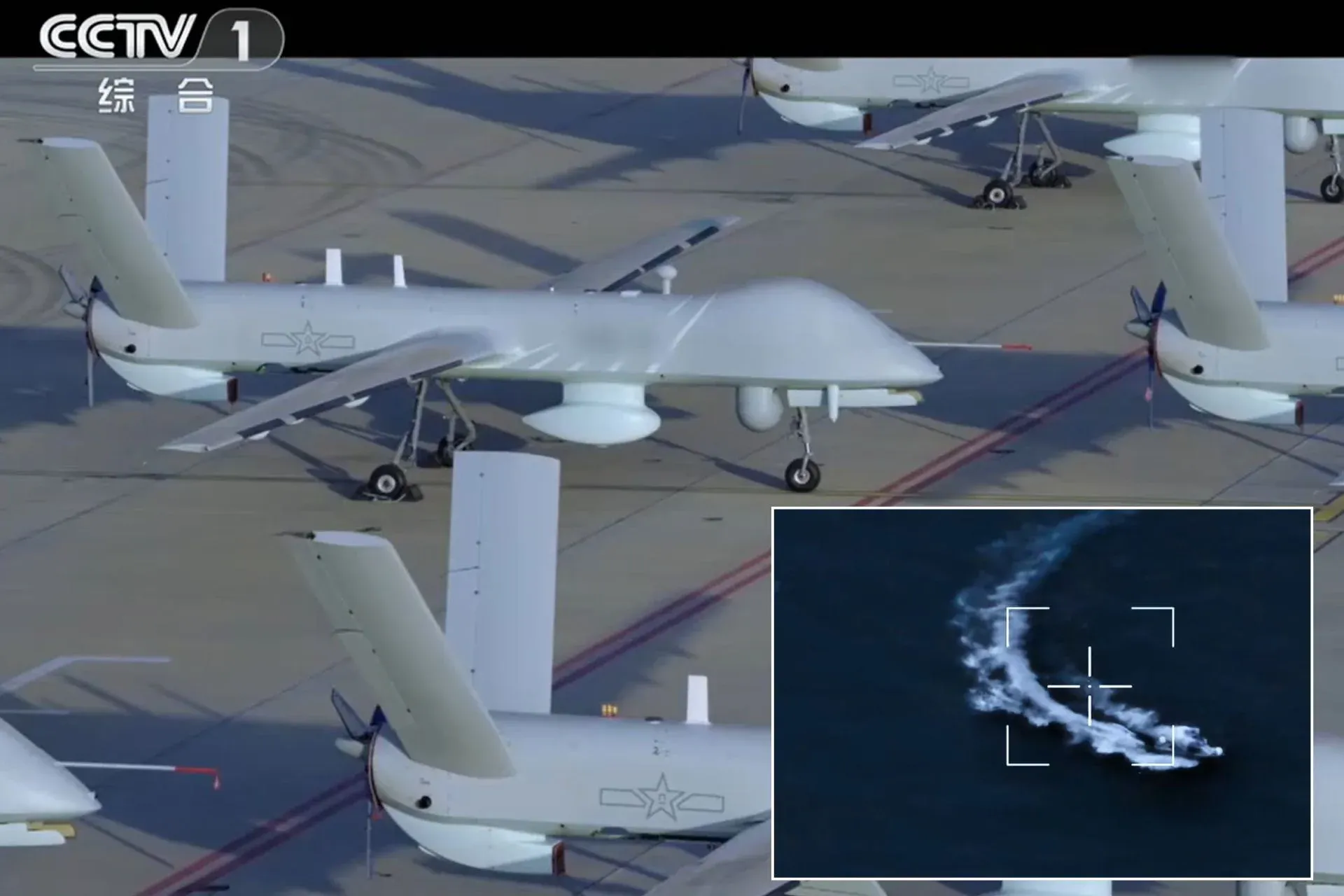
- China's People's Liberation Army Ground Force used a KVD002 armed reconnaissance drone to track and strike a moving unmanned surface vessel (USV) during a joint exercise off the country's southeastern coast. This was the first time Beijing demonstrated such maritime strike capability using a drone.
- The KVD002 drone used in the drill is designed for reconnaissance, target designation, and precision strikes against air defenses, armored vehicles, and fortified positions. It has a wingspan of 18 m, is powered by a 4-cylinder piston engine producing roughly 85 kW. It carries an electro-optical and infrared turret alongside VHF/UHF and satellite communications links.
On Our Radar:
Long-Range Drones to Deliver Aerial Intelligence on US Critical Infrastructure
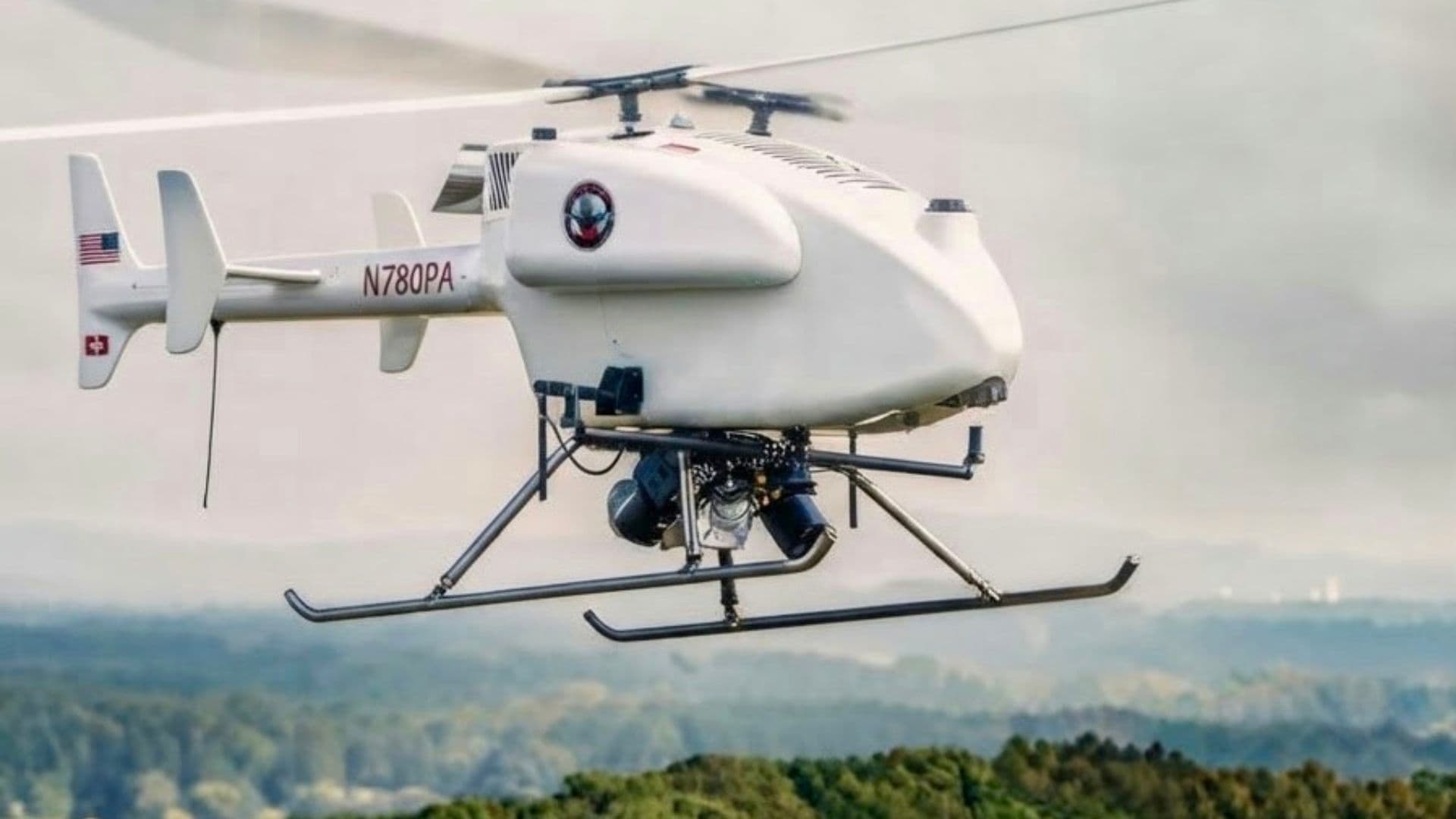
Long-range drones are being positioned to provide persistent aerial intelligence over US critical infrastructure, extending the commercial inspection logic used around power lines, pipelines and transport networks. A system designed to watch assets continuously can also map routines, identify blind spots and normalize a level of domestic aerial collection that once required crewed aviation. As infrastructure protection becomes dependent on unmanned surveillance, the same systems intended to secure a site broaden the attack surface defenders need to protect. (Interesting Engineering)
Explosive Drone at German Airport Forces a Tough Reassessment of Vulnerability
German police disarmed an explosive-laden drone close to Ukrainian cargo aircraft at Leipzig/Halle Airport, temporarily disrupting operations and forcing an acknowledgement of Germany’s drone-security vulnerabilities. The point is not merely that an airport was entered. Commercial aviation, military logistics and aid flows increasingly share the same infrastructure, allowing an inexpensive aerial device to create effects across all three. The incident pushes the airport-drone problem from nuisance and surveillance into a more difficult hybrid-threat category. (Ars Technica) (Yonhap) (El País)
Latin America Quietly Emerges as a Critical Node in Illicit Global Drone Development
Mexico’s arrest of Alfonso Fernandez Magallon, a cartel figure alleged to have used weaponized drones against Mexican military personal reflects broader adoption in an otherwise quiet region. While not as dominant in tactical innovations, Latin America is supplying people, experience and labor to the global drone ecosystem: roughly 40% of the document 16,000 foreign volunteers in Ukraine are from the region, with the cohort including Colombian narcos acquiring technical and tactical intel. Russia is also ramping up its recruitment of young women the regions to assemble drones. Knowledge from the Ukraine war is traveling through criminal networks and labor pipelines and raising the prospect that the region turns into a fourth hub of indigenous innovation in time. (Yonhap) (Militarnyi) (FT) (Le Monde)
Is There Anywhere Unmanned Systems Won’t End Up on the Battlefield?
Ukrainian companies are accelerating AI-powered combat robots for tasks from casualty evacuation to artillery targeting to carrying heavy weapons. With varying degrees of success and clarity, autonomous systems are penetrating the entire battlefield chain: bringing supplies forward, removing casualties, moving weapons, observing targets and eventually delivering effects. Compound autonomous platforms (which mix ground, sea, and air drones) may make dominion distinctions less useful than whether a mission can be separated from the person doing it. (Punchng) (Asia Pacific Defence Reporter)
Drone Companies Target Chile as Interest in Latin American Market Grows
Hanwha joined a growing list of western defense companies targeting the Chilean drone/anti-drone market last week. Chile is an obvious early market given its relatively mature armed forces, long coastline and infrastructure-security requirements. But suppliers are now treating Latin America as a market for the entire low-altitude security stack rather than a place to sell individual drones. Once Chilean procurement creates a reference case, neighboring states confronting organized crime, border surveillance and infrastructure risks will have an easier argument for following it. (Infodefensa)
Hardware Innovations and Tactical Adaptations
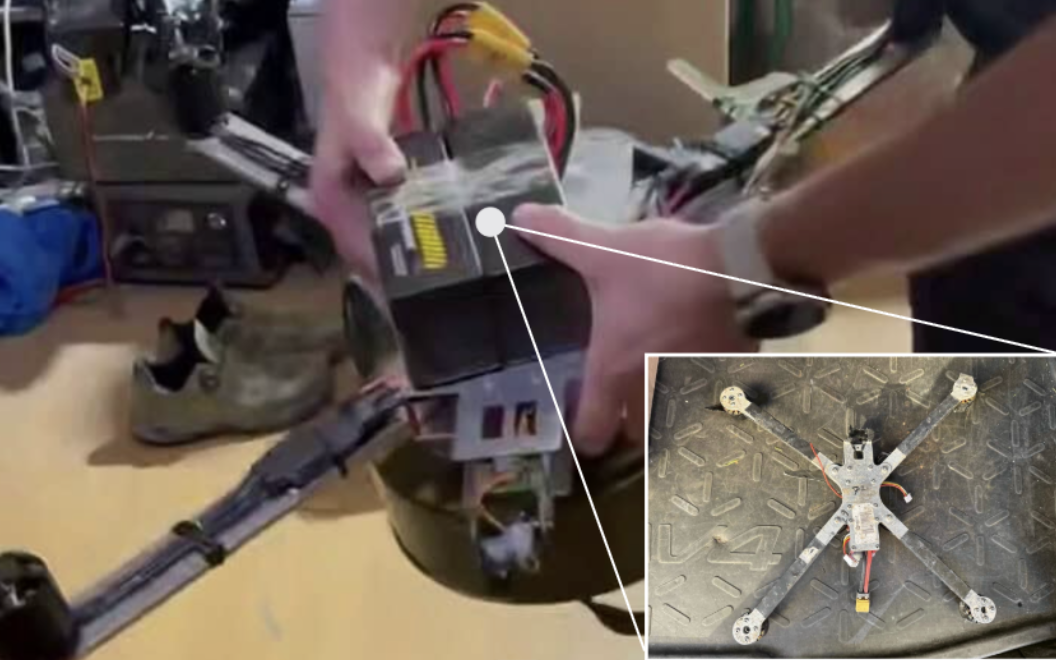
- 17-inch FPV Bomber: Russian forces have converted a new FPV drone into a 17-inch bomber UAV, VT-40-2, with a payload capacity of more than 10kg. The bomber drone has a rotating camera and a release system, enabling it to be used also as a munition carrier alongside as a strike platform. The released images show the drone equipped with TM-62M and TM-72 anti-tank mines fitted with special release mounts, likely for precision drop missions. The bomber has been used in combat in both fiber-optic and strike configurations, making it ideal for operations in EW-saturated zones near the frontline.
- Anti-Drone Floating Platforms: Russia is reportedly experimenting with a floating fire support platform, Plat-40, to defend naval bases and ports against Ukrainian aerial and maritime drones. Plat-40’s armament is a remotely controlled machine gun module. Although not confirmed, the installation most likely features advanced AI-enabled target classification to respond quickly upon detecting drones. While it is intended for extended missions at sea, particularly as an observation post, Plat-40 might be used as a logistical carrier in coming months. The platform is also produced completely locally in Russia’s Leningrad region.
- Tapes, Strips & Foil: Both Ukraine and Russia are reinforcing their drones with tape, metal strips, and foil to increase their radar cross-section (RCS) and improve visibility on friendly radars. This enables operators to easily guide the drones to the engagement point with the target. The modifications are usually done in areas where the airframe does not require additional structural reinforcement, fastening of fuselage elements, or external detonator wiring. Manufacturers are further installing radar-reflective elements (such as corner reflectors) at the factory to improve the visibility of interceptor drones.
What We're Reading
- Army opens ranges in US, Morocco to speed interceptor testing, development: The U.S. Army has opened four domestic ranges and one facility in Morocco for companies to test self-funded interceptor missiles. The model is designed to move testing from a procurement bottleneck to a continuous industry activity, which could shorten the path from counter-drone prototype to fieldable system. (Breaking Defense)
- Finland closes airspace, restricts maritime traffic near Russia over drone risk: Precautionary measures reflect growing anxiety over airspace incursions on NATO's eastern flank. The restrictions indicate that European states are now treating even unverified drone activity near critical infrastructure as a severe security threat requiring economic disruption. (Defense News)
- Ukraine Unveils Drone-Hunting UGV That Fires Nets in All Directions: A Ukrainian firm has developed the VORON UGV, which uses up to eight Pavuk net launchers to provide all-around protection against approaching FPV drones. (Defense Post)
- Thales Australia whips together armed UGV in just 6 weeks: Rapid prototyping demonstrates industry shift toward agile, attritable ground robotics. The compressed timeline suggests prime contractors are finally adopting the iterative, software-first development cycles previously dominated by smaller defense-tech startups. (Defense News)
- US Army wants a surface-to-air missile that can destroy small drones: Procurement shift acknowledges that existing interceptors are too expensive for mass drone threats. Developing a dedicated, low-cost kinetic interceptor is an admission that directed energy and electronic warfare alone cannot provide comprehensive point defense against swarming attacks. (Military Times)
- US Navy, Saildrone to use unmanned systems in expanded counternarcotics role: Autonomous surface vessels transition from ISR experiments to active interdiction operations. Using USVs for counternarcotics frees up crewed vessels for higher-end warfighting tasks, validating the Navy's strategy of deploying UAS for persistent, low-intensity missions. (Military Times)
- Russia drone company chief injured in car bombing: Attack on Vladimir Tkachuk is the latest targeting prominent figures in the Russian war effort. The assassination attempt underscores a growing trend where defense executives and supply-chain managers are treated as legitimate military targets in asymmetric warfare campaigns. (FT)
- Israel’s IAI unveils ‘Hypnosis’ system for confusing enemy drone swarms: Non-kinetic defense system aims to spoof navigation rather than physically intercepting incoming swarms. The development of advanced spoofing technologies reflects the operational necessity of finding cost-effective countermeasures that do not rely on depleting expensive kinetic interceptor stockpiles. (Defense News)
- Russia may use captured Ukrainian drones against Poland and Baltics, Warsaw warns: False-flag drone operations emerge as a new vector for hybrid warfare escalation. The potential use of captured systems for deniable strikes complicates attribution and raises the threshold for triggering collective defense responses under NATO Article 5. (Defence News)
- JIATF-401 awards CACI $500M for non-kinetic cUAS: Major contract signals the Pentagon's shift toward directed energy and electronic attack solutions. The massive investment in non-kinetic countermeasures highlights the urgency of fielding scalable defenses capable of defeating drone swarms without exhausting conventional air defense munitions. (Breaking Defense)
- Tigray Forces Deploy Newly Acquired FPV Drones Against Ethiopian Army in August Clashes: Footage and Tigrayan sources indicate that Tigray forces used newly acquired FPV drones against the Ethiopian army during clashes on August 1–2. The appearance of cheap first-person-view systems in another conflict shows how quickly drone tactics can spread once the basic equipment and operator knowledge become available. (EritreanPost)


