


Welcome to this week’s Brief, our analysis of the most consequential developments in unmanned systems and drone warfare. Each week we track rapidly accelerating battlefield innovations, emerging doctrine, and the technologies reshaping how states and non-state actors deploy unmanned systems.
Have intelligence requirements, developments we should investigate, or perspectives to share? Contact us at info@dronesense.ai.

Deep Dive: Startups, contractors, or industrials, whose experience will best transfer into drone production?

European car manufacturer Renault plans to build 1,000 Thales TOUTATIS loitering munitions a month from 2027. The munition is designed for a war in which jamming matters, payloads change, and the same aircraft may launch from a soldier, a vehicle, or another platform. Renault brings the plants and production engineers; Thales brings the munition and the military customer. It is an attractive arrangement for governments trying to turn a drone program into a factory program. But it may also be solving yesterday’s problem.
The awkward fact is that attritable drones are not settling into the sort of stable product that factories usually need (and industrial product categories usually follow). Ukrainian manufacturers are updating software and hardware three or four times a year while the country plans output above seven million drones in 2026. A new electronic-warfare countermeasure can change the radio, navigation, antenna, payload, or flight profile between production runs.
Industrial experience still matters enormously, though it works at a narrower layer than its advocates imply. Motor-G went from 181 motors in its first month to 200,000 a month after its founders bought Chinese production documents and applied HVAC manufacturing knowledge to winding, tooling, inspection, and supplier management. That is a stable foundation: a motor line, qualified inputs, process data, and a team that knows where a minor change turns into scrap. It is also why Ukrainian motors remain more expensive than Chinese equivalents and why a drone maker can have a good design while still depending on someone else’s supply chain.
Startups - specifically those that are trying to look like startups while being contractors - have a better claim on the changing edge. Auterion’s 33,000 Skynode strike-kit order gives the company a position in drones it does not manufacture. The autonomy layer can move across airframes, taking a new guidance method or counter-jamming fix with it. DIU’s Replicator awards point in the same direction: the Department is paying for collaborative autonomy and resilient C2 from a mixed group of new software firms, Anduril, L3Harris, and Viasat rather than assuming that one airframe maker will own the whole stack. A company that controls the integrations between software and hardware can keep selling upgrades as the hardware around it changes.
This puts traditional contractors in an uncomfortable position. Their strongest assets are exactly the things a ministry still values: secure links, weapons integration, export approvals, training, and support. Boeing’s transfer of Wisk, SkyGrid, and Insitu to Archer showed how valuable those assets remain, even as the company moved them into a faster production model. The difficulty is that contractors tend to own the complete system. Attritable procurement is starting to break that system apart. The radio can come from one supplier, the autonomy from another, the motor from a third, and the airframe from whichever factory can keep its rate.
The EU–Ukraine Drone Deal suggests governments have reached the same conclusion. It does not select a single European champion. It funds a group of Ukrainian and European companies, backs joint ventures, aligns standards, and uses the war’s feedback loop to guide a wider production base. That is less like a classic defense program than an attempt to build a production stack: Ukrainian units and developers change the edge; European suppliers, plants, and rules hold the core together. The practical contest will be over the standards and interfaces that allow one side to change without freezing the other.
For now, that favors startups and neo-primes more than conventional manufacturers. Not because a startup is inherently better at production, and not because it can build a factory faster than Renault. Instead, this gives product architect the power to decide which parts remain stable and which parts are replaced next month. Anduril’s $5 billion raise is an attempt to turn that architectural position into factories, suppliers, and delivery capacity before an industrial or prime consortium captures the same interface. The companies that hold that boundary can direct the production network around them.
The titular question has a different answer than it did even a year ago (and certainly could shift again). The brute economics of industrial experience will transfer best to the stable (and low margin) core of unmanned production. Yet the experience that is best suited to captures the market is a competence in changing the drone without repeatedly rebuilding its factory. That is a new hybrid and it is why neo-primes have the moment. The advantage disappears once designs, components, and interfaces settle. Until then, a factory is an important asset. It is not the center of the market.
China Watch: Spy Cameras, Helicopters as Airborne Control Nodes, City-wide Blanket Bans on Drones
- During a recent cyber vulnerability assessment, cameras fitted to the Royal Navy's K3 Scout uncrewed surface vessels were found sending "heartbeat" signals to an IP address in China. The K3 Scout is an 8.4m uncrewed vessel with a 1.93m beam, a 0.8-metre draft and a maximum displacement of 2,500kg. The sea drones are built by Kraken Technology Group under a 20-vessel contract worth $16.5 million as part of Project Beehive—an initiative to build a "Hybrid Navy" pairing large crewed warships like the Type 26 and Type 31 frigates with smaller, disaggregated autonomous vessels.
- The drone fleet entered service with the Royal Marines in March and was supporting preparatory work for potential future missions in the Strait of Hormuz. The case exposes a structural weakness that administrative compliance checklists cannot close on their own: a component can clear procurement assurance standards on paper while still carrying dependencies, firmware behavior and network calls that only a physical teardown or continuous traffic monitoring would catch.
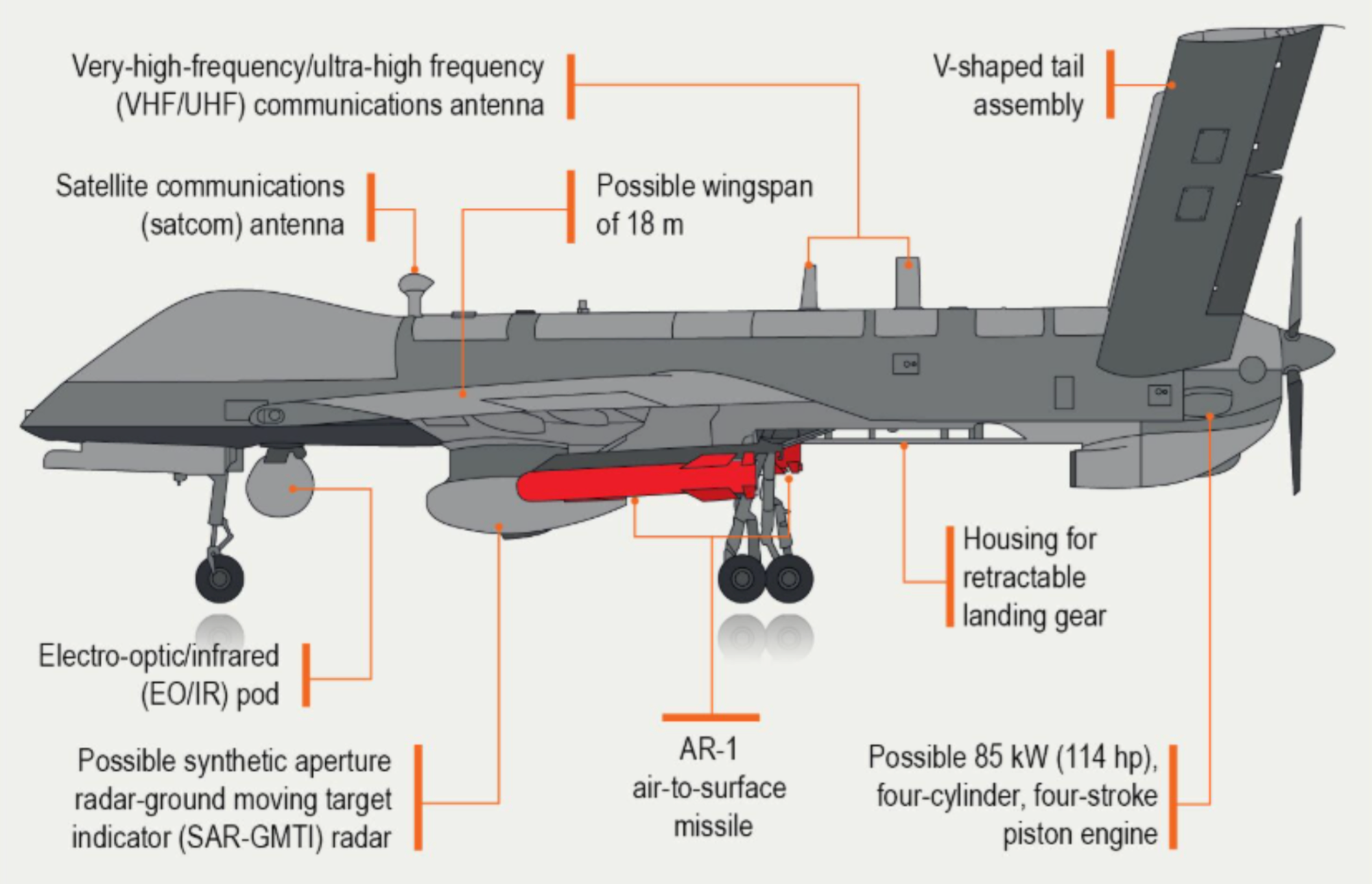
- PLA Army recently showed its Aviation Z-19 attack helicopter flying in close formation with reconnaissance-strike drones consistent with the KVD002 platform. The Z-19 is a light attack helicopter already in PLA service, and the KVD002 is a fixed-wing armed reconnaissance drone with an estimated 18m wingspan, an electro-optical and infrared turret, VHF/UHF and satellite communications links, and previously demonstrated striking a moving unmanned surface vessel during a coastal exercise.
On Our Radar:
Critical Infrastructure Begins Pricing In Drone Risk
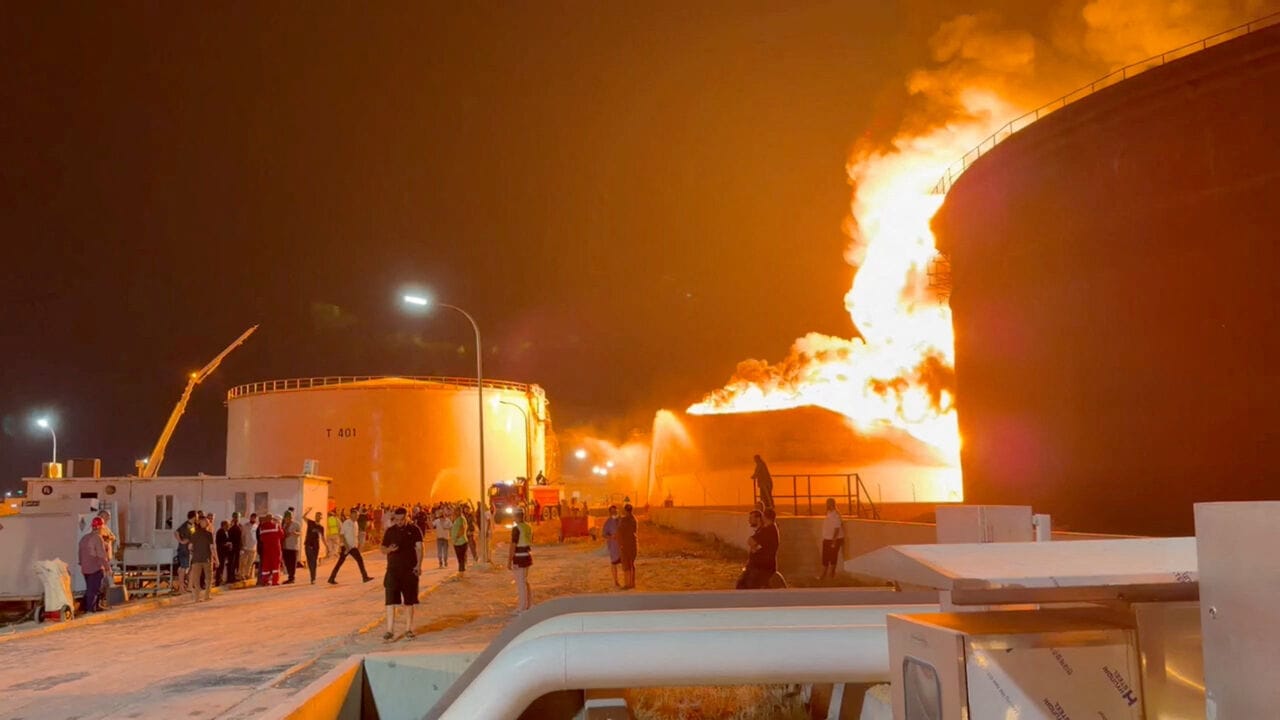
Drone attacks on Libya's 120,000-bpd Zawiya refinery have forced a partial shutdown and left the National Oil Corporation to warn it could invoke force majeure if strikes continue. With no actor claiming responsibility, the incident shows how cheap, deniable systems can impose outsized costs on an energy asset far outside an active war zone, creating a physical analogue to ransomware in which disruption and the prospect of recurrence drive the expense. In Germany, Uniper CEO Michael Lewis was outlining more than €2.5 billion in gas-power investment and accompanying protection against drone attacks which is now necessary, early evidence that asset owners may soon treat C-UAS as a baseline operating requirement alongside physical and cyber security. (RIA Novosti) (Reuters) (Süddeutsche Zeitung)
UGVs Spread Into Suicide Attacks and Squad-Level Mass Production
Ground robots are becoming a response to two forms of manpower scarcity: troops who cannot be exposed to move supplies under fire and armies that cannot recruit enough people to fill a squad. Ukraine's 3rd Separate Assault Brigade is using them for logistics and one-way attacks against Russian positions, while South Korea's decision to mass-produce Hanwha's Arion-SMET follows a reduction in its standing military from roughly 560,000 personnel in 2019 to 450,000 in 2025. The two programs bookend a ground-robot market that is moving from a niche logistics tool to a solution for labor that is either too vulnerable or too scarce to supply in sufficient numbers. (El Mundo) (Asia Pacific Defence Reporter)
Turkey and Iran Run National Competitions to Grow Drone Talent
Turkey and Iran are turning technology competitions into public talent pipelines for autonomy, making drone, AI, robotics, and cybersecurity expertise a visible form of national achievement before participants enter the defense-industrial labor market. TEKNOFEST's drone championship in Şırnak combines the country’s flagship aviation festival with a regional competition, while Iran's Technology Olympics has drawn 4,700 registrants, including 200 participants from 14 countries, across six technology disciplines. Iran has also added a job expo and interview station to the event, making the link between competition, recruitment, and strategic technology development explicit. One wonders how long it takes these events to become targets for collections at best, targeting at worse (Anadolu Agency) (Tehran Times)
Ukrainian Drones Defeat a US Armored Brigade in German Exercises
During Exercise Combined Resolve in Germany, Ukrainian drone operators repeatedly simulated the destruction of U.S. tanks and Bradley fighting vehicles from the 3rd Armored Brigade Combat Team, forcing controllers to respawn vehicles so the scenario could continue. The exercise gave American troops a direct encounter with the drone kill zone that has made large armored maneuver increasingly untenable in Ukraine, where vehicles must now disperse, conceal themselves, and use electronic warfare simply to reach the fight. Ukrainian teams produced a similar result in a Swedish-led NATO exercise in May, suggesting the most consequential export from the war may be a new operating model for the Alliance’s armored forces. (Ars Technica) (The Wall Street Journal)
Countries Put AI Simulators Into Pilot Training as Costs Fall
Russia's Air Force is using AI and augmented-reality simulators built around Ukraine war scenarios to rehearse refueling, emergencies, formation flying, and combat missions, moving operational lessons into the training pipeline without consuming scarce flight hours or airframe life. Separately, Argentina is pairing advanced simulation technologies with its F-16 transition, building the training and logistics architecture needed to absorb a more complex Western fighter fleet before all aircraft arrive. As air forces face rising flying costs and rapid drone-driven mission shifts, simulation is becoming the main venue for repeated tactical practice, while live flight becomes the final validation stage. (TASS) (Infodefensa)
Hardware Innovations and Tactical Adaptations

- Microphone on ‘Waiter’ drones: Russia is equipping its small FPV ambush drones with a microphone that can detect traffic for more timely attacks. It remains undisclosed whether the sound captured by the microphone triggers the drone to pursue the target or simply alerts the operator. But regardless, such a capability would likely enable Russian soldiers to position these waiter drones in more concealed positions, where a direct line-of-sight is also necessary after an acoustic cue has been established.
- Shaheds with Video-Intercepting Jammers: Ukraine has obtained first hardware evidence of Russian EW antennas on Shaheds, specifically targeting the FPV video channel of Ukrainian interceptor drones. The antennas are likely operating around 5.8 GHz. Many interceptor drones are still manually flown toward the Shahed using an FPV video feed. If a jammer is placed on the target, the Shahed’s interference can overwhelm the interceptor’s video link as it closes in, particularly because the interceptor’s transmitter is much farther from the ground-based receiver.
- Mirrored Panels on Vehicles: Russian forces reportedly fitted a UAZ-452 ‘Bukhanka’ vehicle with mirrored panels to likely protect it from drones using machine vision guidance for strikes. The mirrors in this specific physical ‘adversarial camouflage’ setup would have helped break up the vehicle’s appearance, create changing reflections, and make it harder for an algorithm to recognize or track the target. But without testing against the actual tracker used by an attacking drone, “anti-AI protection” remains a claim rather than a demonstrated capability.
What We're Reading
- Houthi Rebels Use Fiber-Optic FPV Drones: Houthi forces' reported first combat use of fiber-optic FPVs introduces an electronic-warfare-resistant threat to Yemen, demonstrating how commercial components available through Alibaba are rapidly migrating from Ukraine's drone war into other conflicts. (Yonhap)
- Autonomous AI Agents Attack Taiwan Systems: Autonomous AI agents mapped 21 Taiwanese government systems, compromised 85 accounts, and extracted 2,500 personnel records in four days, showing how agentic tools can now coordinate reconnaissance, credential attacks, and lateral movement at a scale that sharply reduces the cost of competent cyber operations. (CNN)
- CIA Covertly Attacked Ecuadorian Vessels with Drones: Reports that the CIA used explosive quadcopters against Ecuadorian fishing vessels near the Galapagos would give covert action a deniable offshore form, with civilian crews left to establish what happened after the strike. (Yonhap)
- Mali Deploys Shahed-136 Drones with Russian Support: Mali's verified use of Shahed-136-type loitering munitions, likely supplied through Russia's African support network, puts a long-range, low-cost strike system on an African battlefield for the first time. (Military Africa)
- Army Seeks Autonomous Missile Robot Truck: The Army's CAML program seeks an optionally crewed launcher able to carry Tomahawk, Patriot, AIM-9X, or MLRS munitions, betting that one robotic chassis can replace several specialized missile fleets. (Defence Blog)
- Marines Train to Counter Drones with Standard Weapons: New Marine Corps counter-UAS training turns rifles, shotguns, grenade launchers, and AI-enabled machine guns into a layered squad-level defense, accepting that drone defeat begins with every Marine rather than a specialist unit. (Military Times)
- Everyone Is Learning the Wrong Lessons from Ukraine's Drone War: Ukraine's advantage comes less from any individual drone than from an innovation cycle that pushes battlefield feedback into production and tactics quickly, a system Western militaries cannot buy by purchasing platforms alone. (Breaking Defense)
- Unitree Dominates Humanoid Robot Market: Unitree's lead in humanoid robots, helped by scale, low costs, and investment in foundation-model development, echoes DJI's rise as China builds industrial standards in a category the West still treats as a venture bet. (Asia Economy)
- US Faces Hurdles in Humanoid Robotics Industry: America's humanoid robotics push remains bounded by China-linked components and manufacturing, leaving U.S. firms to compete in a market where Unitree can already sell machines at prices domestic rivals cannot match. (The New York Times)
- Trump Imposes Tariffs up to 100% on Drones: Trump's up-to-100% tariffs on drones and components are intended to secure the U.S. drone supply chain, but their effect depends on whether the policy lasts long enough to credibly drive American and allied production to substitute for less expensive Chinese inputs. (Yonhap)
- Russia Develops Hundred Drone Modifications: Russia's development of more than 100 UAV modifications shows that drone advantage is being produced through constant, low-cost iteration at unit level, allowing systems to substitute for heavier equipment faster than formal procurement cycles permit. (RIA Novosti)


