


Welcome to this week’s Brief, our analysis of the most consequential developments in unmanned systems and drone warfare. Each week we track rapidly accelerating battlefield innovations, emerging doctrine, and the technologies reshaping how states and non-state actors deploy unmanned systems.
Have intelligence requirements, developments we should investigate, or perspectives to share? Contact us at info@dronesense.ai.

Deep Dive: The Obscene Limits of Drone Warfare Economics Come Into Focus
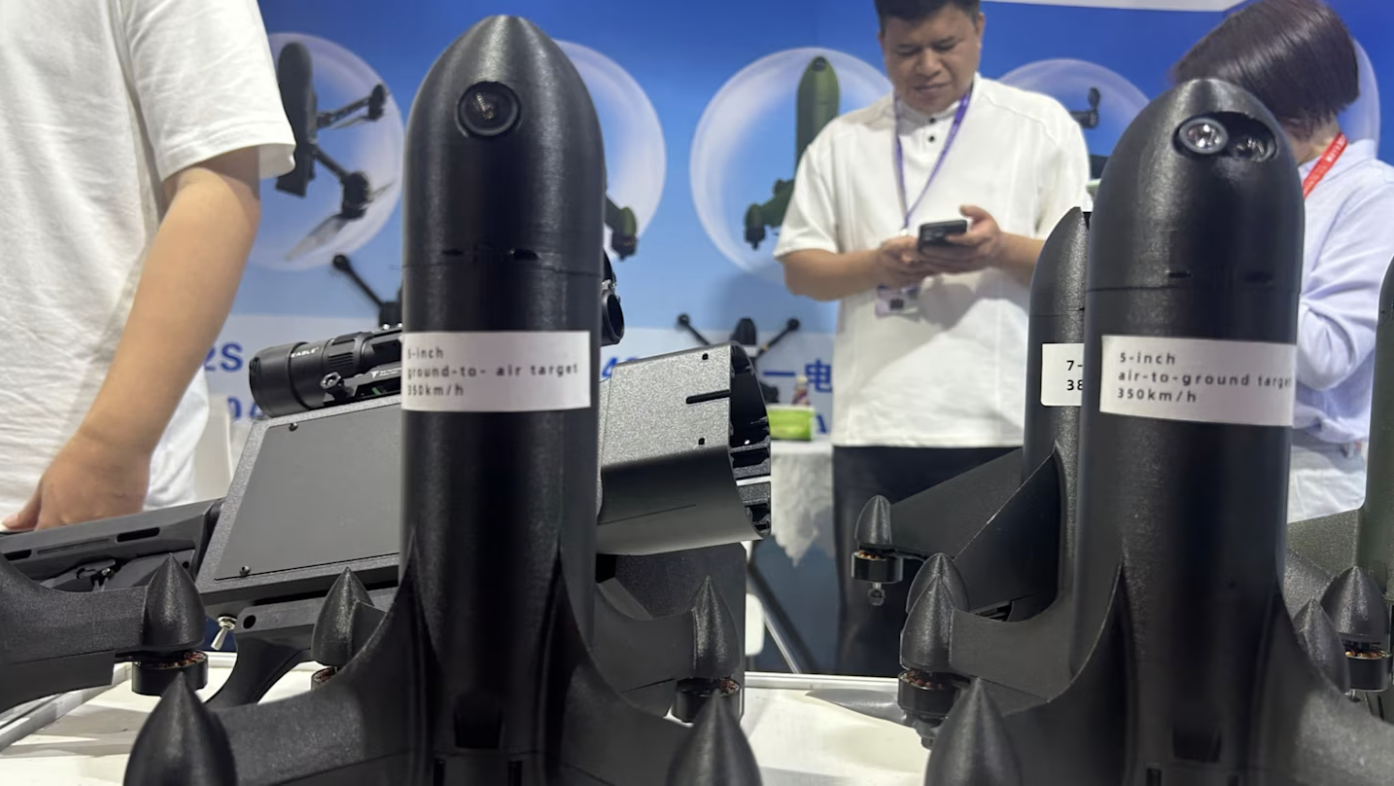
The drone revolution's surface level promise of cheap warfare hides an uncomfortable and increasingly clear implication that war is being turned into a pure volume game. If, as we are seeing, a drone can be designed, printed, altered, and fielded with the rhythm of a consumer product, the decisive advantage may come from the side that can add one more unit to the line, make one more loss acceptable, and repeat the process tomorrow.
This week's buzz of stories around 3D-printed interceptors appears to answer the cost problem created by cheap attack drones. Yet the low cost manufacturing stack looks likely be the technology that makes the cost contest harder to escape.
Japan's Acquisition, Technology, and Logistics Agency selected Terra Drone's 3D-printed Terra B1 interceptor after a three-month tender and is preparing it for mass production. The company plans to use distributed print farms to reduce tooling costs, alter a design more quickly, and retain output if a particular factory goes down. Chinese companies are pursuing the same proposition as an export business, offering low-cost 3D-printed interceptors to customers who need a more affordable response to Shahed-type threats than expending conventional missiles. While the US military has explored with en-theatre 3d printing in Philippine exercises, these mark what we expect to be the first of a surge of standing 3d printing production investments.
The logic is compelling. Despite press releases making dronetech feel cutting edge, interceptors aren't marvels of aerospace. They need to see the threat, reach it, and be reliable enough to defeat it at a cost that allows the defender to keep using it. Once a platform crosses that threshold, a marginal improvement in airframe design may matter less than the ability to produce a large number of acceptable systems and replace them after they are used. Printing promises to move that threshold closer to the economics of the threat itself.
But in classic escalatory fashion, offensive parties are adopting the same manufacturing model (swarm drones require someone to go make all of those). A new drone body, mounting arrangement, antenna position, or payload configuration can now be altered quickly on both sides. So while the low-cost interceptor may absorb more attack drones, cheaper attack drones may then be sent in greater numbers or revised more often. Each iteration adds pressure to the other side's production line. The contest already has started to look less like a search for a singular technical breakthrough and more like an industrialized exchange of losses, revisions, and replenishment.
Once systems become cheap enough to be treated as expendable, a defense budget can start behaving like a rate rather than an investment.
This changes the meaning of volume. Volume is often described as a simple factory question, as if the winner is the side with the larger line. Yet a production line can only make what its surrounding system permits. Drones need motors, battery cells, processors, radios, sensors, optical payloads, and people able to turn field feedback into a revised design and test it before the next batch leaves the factory. A recent Chinese simulation found that even the country's industry could meet only 60% of wartime drone demand, despite including civilian conversion, inventories, supplier networks, and existing capacity in the model. The printer lowers one barrier. It makes the remaining barriers more visible.
The most important constraint may therefore be difficult to name in advance. It might be an imported microcontroller, a shortage of qualified battery cells, a test facility, a trained workforce, a software integration problem, a certification rule, or the time required to discover that an inexpensive revision fails in rain, cold, jamming, or high-speed flight. These are less visible than a drone's unit price, yet they determine whether a country can turn a digital design into thousands of systems that work when it matters. The point is not that 3D printing is insignificant, instead that its success pushes competition toward constraints that are harder to see and slower to solve.
The same ambiguity reaches the defender. A printed interceptor may be inexpensive. The system required to use it at scale isn't. Detection, tracking, command links, software, operators, launchers, spare parts, maintenance, and stores of effectors all become recurring requirements. A state defending fixed assets or population centers may have to keep paying for readiness after the immediate crisis has passed. It has to decide how much coverage is enough, which gaps are politically tolerable, and whether the expense belongs with the military, a private operator, an insurer, or the public.
This is where a volume game becomes a political problem. There may be no natural ceiling once both attacker and defender can raise their rate at relatively low cost (issues of defense political economy around drone-related job creation notwithstanding). A government can allocate another dollar to production and its opponent can do the same. The airframe is cheaper, which makes an increase in quantity easier to justify, while the sensor network, inventory, and human system around it still demand investment. Spending can rise precisely because each additional drone or interceptor is cheap enough to seem sensible. The cumulative commitment can still become enormous as we're already seeing with defense commitments globally.
The commercial logic is equally unsettled. A business that makes a printable airframe may face rapid commoditization as designs diffuse and customers demand lower prices. A company that controls a reliable component supply, validates designs quickly, integrates software with hardware, or guarantees recurring output could occupy a more durable position. Yet even these advantages are conditional. They depend on the customer continuing to finance rate, and on the threat continuing to change quickly enough that replenishment and adaptation remain more valuable than a settled inventory of platforms.
The likely limits aren't therefore a single equation between an attack drone and an interceptor. They are the boundaries of a system that could become easier to start and harder to stop. Additive manufacturing may lower the cost of entry, accelerate adaptation, and spread production capacity across more places. It can also turn a war of discrete platforms into a continuous contest over the next marginal dollar, the next production run, and the next constraint that neither side knew it had.
The drone and interceptors are measured in thousands (and maybe hundreds in the future). The game it makes possible is already being measured in percentage of GDP.
China Watch: FPV Drone Training, 3D Interceptor Surge, and UAV Rescue Ops

- Chinese researchers have developed a lithium-metal pouch cell with a specific energy of 602.5 Wh/kg, potentially opening a path toward much longer endurance for drones and eVTOL aircraft. The team from Tianmushan Laboratory and Tsinghua University used an additive-coordinated electrolyte structure to stabilize the interfaces around the lithium-metal anode and high-voltage cathode.
- The higher energy density could allow drone designers to either extend flight endurance or reduce battery mass while maintaining the same mission profile, with the latter potentially creating additional room for payload or propulsion requirements.
- A 10Ah pouch cell paired with a lithium-rich manganese-based cathode reached 602.5 Wh/kg and retained 80% capacity for 60 cycles. But the 602.5 Wh/kg figure remains a laboratory result with only 60 cycles demonstrated under the reported test conditions, and the researchers have not yet demonstrated commercial-scale production.
- China is incorporating FPV drones into frontline-style military training, with PLA troops in Xinjiang practicing navigation through complex terrain, obstacle courses and precision strikes against armored targets. Operators wearing VR goggles are being trained across both physical and virtual environments, indicating that China is treating FPV operation as a repeatable military skill that can be developed through a combination of live and simulated training.
On Our Radar:
China Is Turning Disaster Relief Into a Drone Sales Strategy
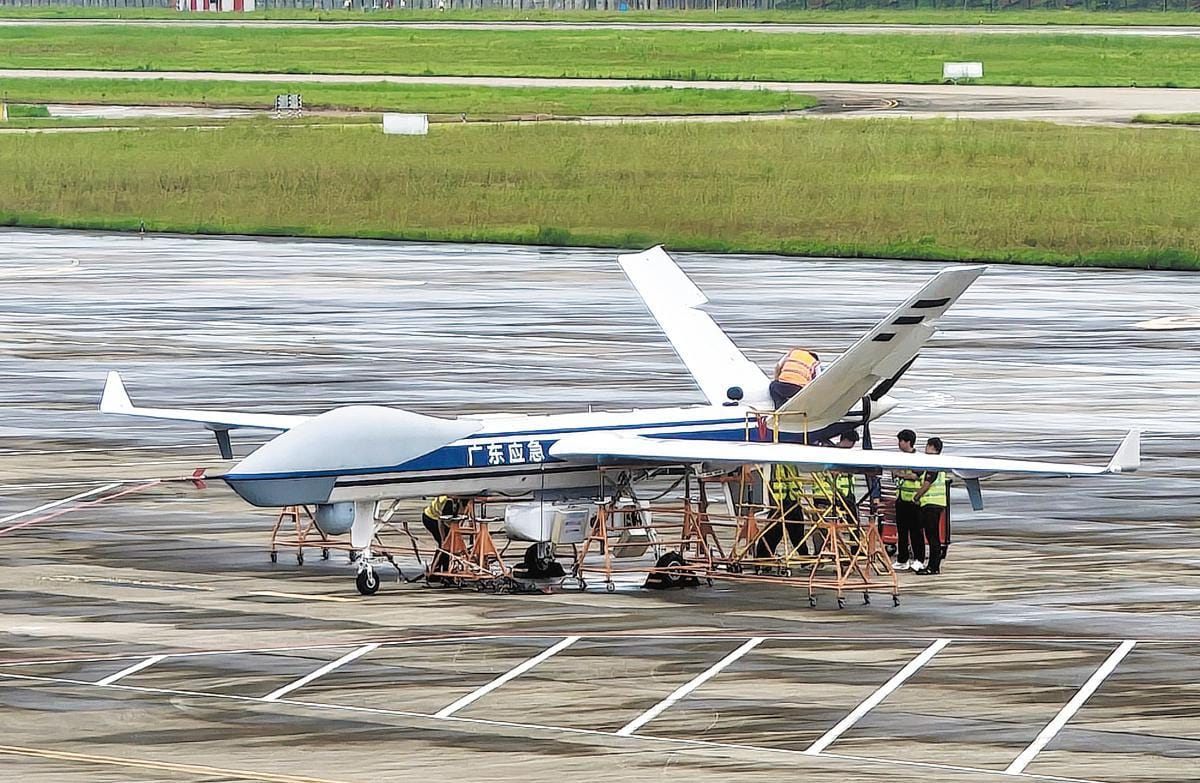
China's Wing Loong 2 aircraft flew nearly 70 hours over four days after floods in Guangxi, restoring communications for more than 90,000 residents and rescue personnel. That response did more than demonstrate an aircraft's endurance. It showcased the full operating ecosystem around a large Chinese UAV: payload integration, communications relays, command infrastructure, and crews able to sustain missions after roads, power, and mobile networks fail. Humanitarian assistance can package compassion, proof of concept, and market entry in a single operation. The more regional governments see Chinese systems manage a real crisis, the easier it becomes to sell the same ecosystem afterward for logistics, infrastructure inspection, border security, or public safety. (China Daily)
Autonomous Civilian Kills Cross a Line, With No Credible Path to Push Back
A Russian Molniya drone, equipped with an Nvidia Jetson Orin computer, reportedly killed three civilians at a Zaporizhzhia gas station after selecting its final target without human confirmation. Ukrainian investigators found no control antenna and an onboard system used to identify propane tanks, placing the event beyond the familiar category of terminal guidance. Despite the UN claiming that such attacks had crossed a line, a measure to restrict autonomy in warfare failed with the US vetoing a resolution to constrain autonomous kill chains. (The New York Times)
West Has a Growing Sovereign Autonomy Gap
Iran says it has achieved broad self-sufficiency in drones, missiles, and other defense systems despite decades of sanctions. Turkey is moving into that next layer, with Baykar and the T3 Foundation developing an embedded platform that combines onboard computing with an AI accelerator for unmanned systems expected by 2027. Hanwha Aerospace, by contrast, is targeting a fully autonomous mission-capable unmanned ground platform by 2035, after first establishing a common UGV architecture by 2030. With some countries claiming a sovereign production base today, targeting anything for 2035 at a platform level is already structurally overtaken by events. (Herald Business)
Drones Move Into the Fight Against Illicit Mining and Trafficking
Ghana's governing party has proposed using drones against illegal mining, while Costa Rica is exploring Ukrainian drone technology to strengthen its response to drug trafficking and organized crime. Both efforts begin with a common requirement: routine visibility over territory that patrols cannot cover economically, where illicit actors can exploit terrain and weak state presence. The resulting demand profile differs from conventional military procurement. Useful platforms require endurance, usable sensors, low operating cost, and an institutional model connecting observation to police or regulatory action. This is part of a larger shift in adoption. Drones are becoming an everyday tool for governments confronting dispersed illicit activity, creating security markets shaped by trafficking, mining, terrain, and shortages of personnel. (Reuters) (The Tico Times)
Counter-Drone Systems Get to the Field Before the Rules
Thales and Visionary Machines are developing a passive optical system that detects, tracks, and identifies drones without transmitting an electronic signature. Sparely, Germany's Vanea Defence is marketing ATOMZA, an optical system designed to disable a drone's sensors with directed light. Both are efforts to remove the operational drawbacks of traditional counter-drone tools and bring a usable capability to airports, energy sites, public events, and urban areas. The harder question remains: who may employ these systems, under what authority, and with what liability when a civilian site faces a real threat. Companies are solving for detection and defeat first. Governments still need to define the authority under which private operators move from observation to action. (The Defense Post) (EQS News)
Hardware Innovations and Tactical Adaptations
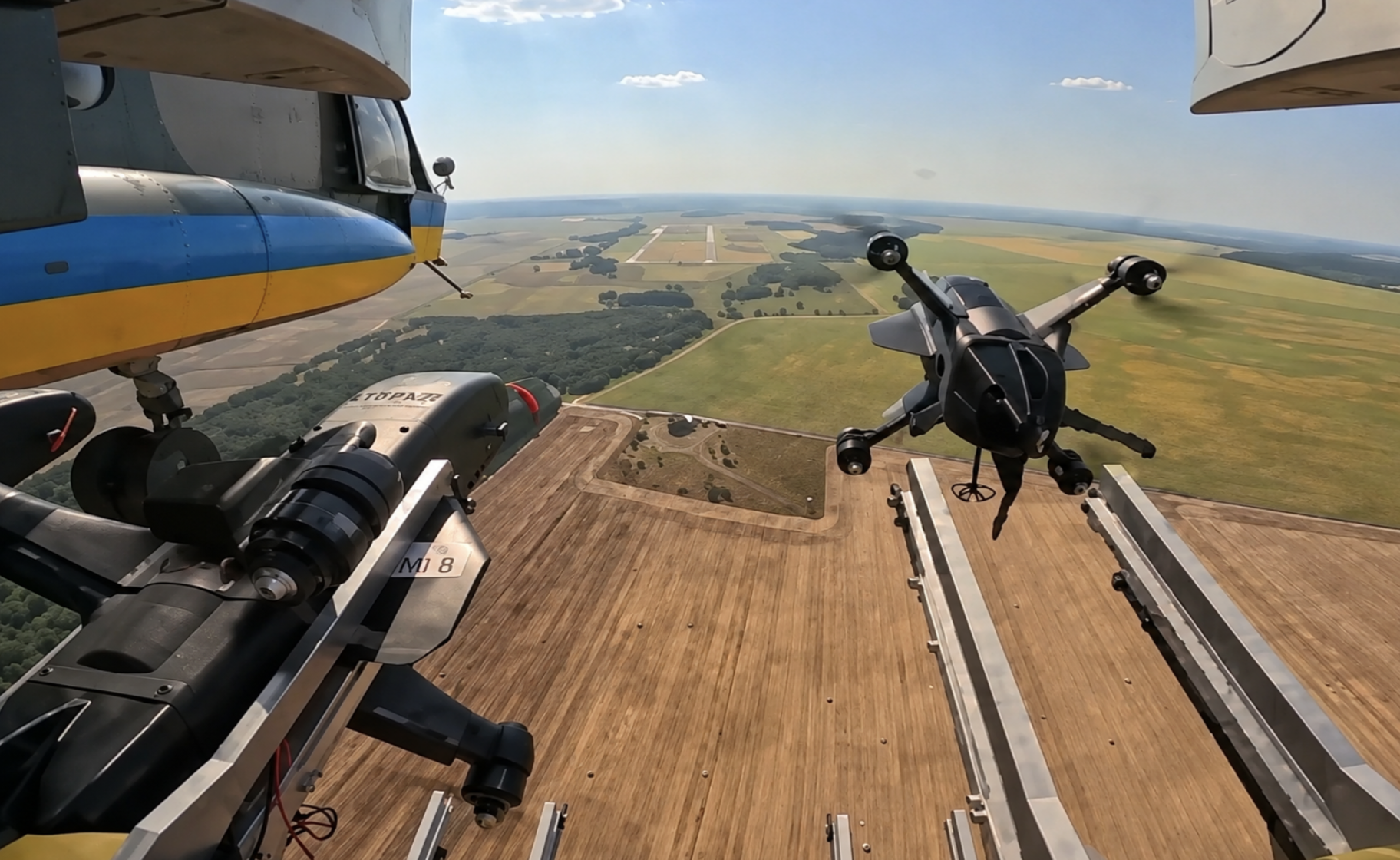
- Drone Launch Rails: Ukraine has reportedly begun fitting Mi-8 helicopters with launch rails for interceptor drones. A recent configuration showed three launch positions on each side, giving the crew a six-interceptor loadout. (Janes) Small effectors remove the requirement for a combat helicopter to stay within direct-fire range against Shahed-type UAVs. The helicopter can launch the interceptor toward the engagement area, allow it to conduct the terminal chase, and remain at standoff range in a defensive posture.
- Double Tapping: Russia is increasing strikes on Ukraine in a double-tap rhythm, launching smaller groups of five to six jet-powered drones every 60 to 90 minutes. (Drone Warfare International Magazine) The tactic likely aims to increase danger around recovery operations, slow repair, and sustain pressure on ordinary activity in targeted areas. It can also impose cognitive fatigue on security forces, creating exploitable gaps and diverting scarce resources from the front line to cities.
- External Navigation Layer: Ukraine is building autonomous radio beacons along its southern coast to help interceptor drones operate over the Black Sea despite GPS jamming. (Militarnyi) The system provides a position picture when visual references, navigation, or communications become unreliable. The approach moves part of the resilient positioning problem from the drone into shared infrastructure, allowing smaller interceptors to navigate and recover farther from shore while extending the engagement envelope against Russian reconnaissance UAVs.
What We're Reading
- Philippines Expands Military Drone Fleet as South China Sea Tensions Rise: Manila's plan to combine drones, naval assets, AI, and secure communications shows that a meaningful maritime drone force is a network, not an aircraft inventory. (South China Morning Post)
- Drone Companies Meet White House Officials at First Drone Dominance Session: The meeting brings industry into the center of the administration's Drone Dominance initiative as Washington attempts to turn political urgency into production and procurement. (Breaking Defense)
- Taiwan's Drone Strategy Becomes a Budget Fight: Taiwan's rival drone plans have become part of its legislative battle over defense spending, showing that an asymmetric strategy can still be delayed by domestic politics. (Nikkei Asia)
- Turkey's Armed Drones Become a Regional Default: Turkish armed drones have spread across the Arab world because Ankara sells platforms alongside training, maintenance, and political alignment, making the drone an instrument of sustained regional influence. (Forbes)
- Construction's DJI Dependence Exposes a Civilian Supply-Chain Risk: A survey of U.S. construction firms shows how deeply DJI drones are embedded in site inspection and mapping, suggesting restrictions could impose immediate costs on civilian industries with few substitute platforms. (DroneLife)
- India Raises Alert After Suspected Pakistani Drone Sighting: A suspected sighting over the Line of Control shows how a single unconfirmed drone can generate an outsized security response in a border region where attribution and escalation are tightly linked. (WION)
- Airbound Raises $37 Million for Rocket-Like Cargo Drones: The Indian startup's funding round reflects investor confidence that high-speed cargo UAVs can compete with trucks on selected routes, even though airspace integration and operating economics remain the commercial test. (TechCrunch)
- Japan Accelerates Interceptor Procurement for Swarm Threats: Japan's three-month Terra B1 competition responds to a threat evolving faster than traditional acquisition cycles, using 3D printing to make rapid iteration part of the requirement. (Defense News)
- Pentagon Plans a Directed-Energy Shoot-Off: The counter-drone task force's planned competition for laser and microwave prototypes will test which systems can become deployable defenses against inexpensive threats. (Breaking Defense)
- Nvidia Chips Continue to Appear in Russian Autonomous Drones: The recovery of Nvidia Jetson Orin modules from Russian strike drones shows that commercial edge-computing hardware can accelerate autonomy even when the manufacturer does not sell directly into the conflict. (The New York Times)
- China's Drone Production Model Has Its Own Mobilization Limits: A study finding that China could meet only 60% of wartime drone demand illustrates that even the world's deepest drone supply chain can struggle to absorb a sudden surge in military requirements. (South China Morning Post)
- Low-Cost Interceptor Production Is Moving Closer to the Threat: Powerus's Guardian program in the UAE signals growing demand for counter-drone effectors cheap enough to be produced and expended at scale. (The New York Times)


