


Welcome to this week’s Brief, our analysis of the most consequential developments in unmanned systems and drone warfare. Each week we track rapidly accelerating battlefield innovations, emerging doctrine, and the technologies reshaping how states and non-state actors deploy unmanned systems.
Have intelligence requirements, developments we should investigate, or perspectives to share? Contact us at info@dronesense.ai.

Deep Dive: "Shortened" Combat Cycles Aren't Enough to Meet Battlefield Innovation Needs
It took Ukrainian operators 10 days to develop a UGV and the mechanism for dropping it from a heavy bomber drone, a concept the US had chased for 30 years (10,950 days) without once fielding it.
The levels to which combat cycles are being compressed in Ukraine and Russia are truly unprecedented and hard to conceptualize. The period between identifying a battlefield requirement and testing a solution against the enemy has collapsed to literal months or sometimes days. But militaries are facing another problem: invention is moving faster than their ability to manufacture, distribute and absorb the resulting capability across all the units that actually need it.
That mismatch is glaring in the UGV-UAV case. Because even if Ukrainian operators worked out and combat-tested the new configuration within 10 days, BRAVE1 still needs to connect the specific unit with a manufacturer that can take it beyond small-batch production.
Serial production also only solves part of the problem because wider adoption in reality requires enough systems to reach relevant units, alongside training, spare parts, maintenance procedures and tactics for using them.
Ukraine has already introduced targeted measures to reduce ‘after-innovation’ delays. The formal process for codifying new weapons has been reduced from months to days. Once equipment is present, DOT-Chain Defence lets combat units select what they need, while the procurement agency handles contracting, payments and logistics, with in-stock equipment taking around 9 days on average to reach units through the marketplace.
These measures essentially try to stop procurement and distribution from eroding the time gained during development.
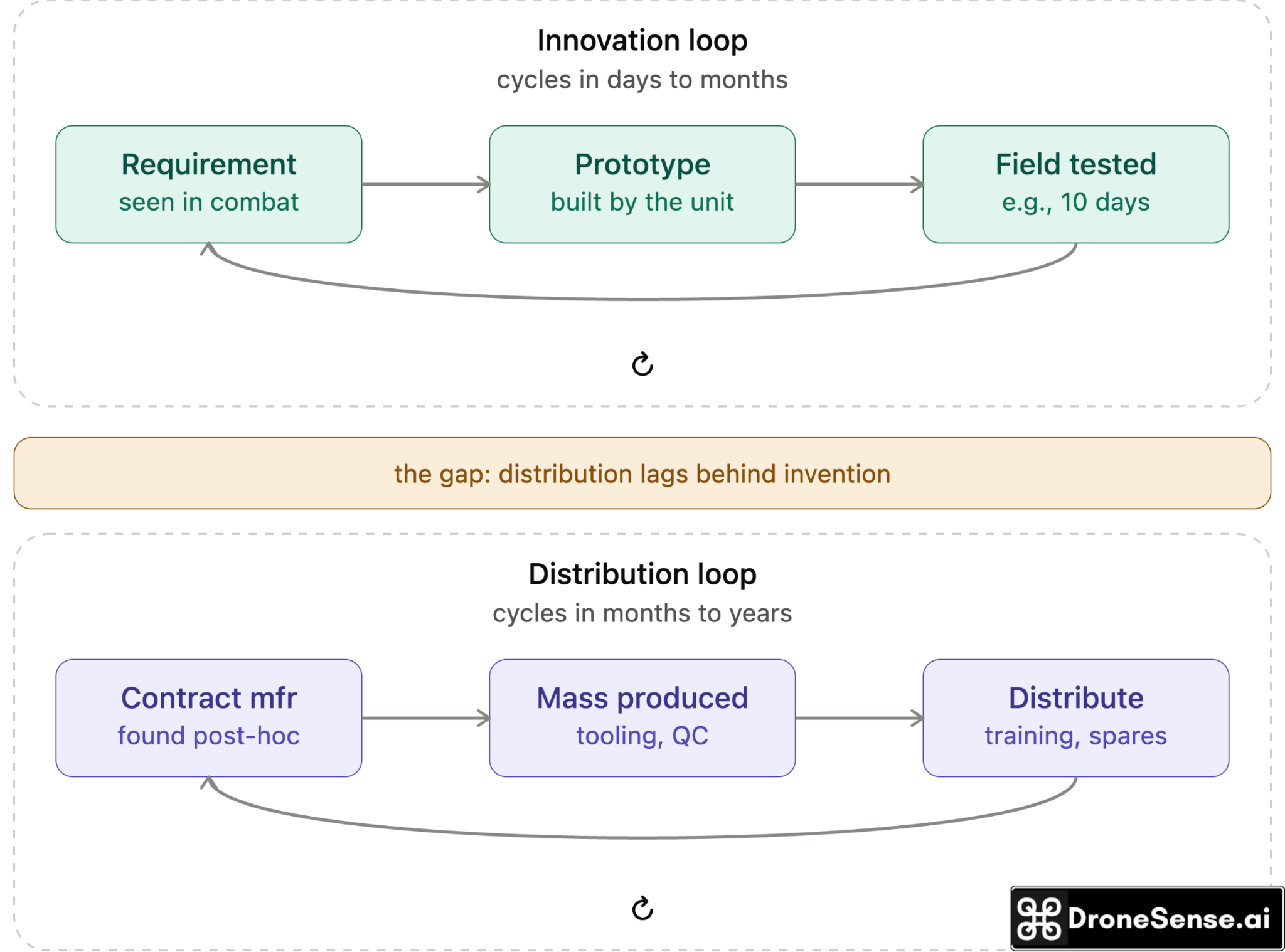
The development process itself is also becoming easier to compress because the people experiencing a battlefield problem are often much closer to those changing the technology. The UGV-UAV combination was developed inside the combat unit that would use it, allowing combat experience to feed directly into another iteration.
Many adaptations also do not require a completely new weapon. Changing software, frequencies, guidance modules, or payloads can alter what an existing drone does much faster than designing an entirely new model.
This creates a reinforcing relationship between invention and integration. Russian changes to jammers, drone configurations or tactics can reduce the useful life of a Ukrainian response, creating pressure to shorten approval and deployment.
Faster routes into combat then make further modification more worthwhile because developers know successful changes have a realistic path to users before the underlying battlefield problem disappears.
But sometimes compressing this process too far starts working against scaling itself. If units and developers produce new configurations every few weeks, the version selected for serial production may already be changing while factories are tooling up to manufacture it.
This is one reason why simply building an innovation pipeline does not guarantee the same outcome. A military can fund prototypes, establish accelerators and shorten testing while still losing time if production, procurement, training and distribution cannot absorb changes at a similar rate.
The bottleneck simply moves further down the process. NATO's latest reforms suggest militaries are beginning to recognize this. Its 2026 Scale-Up Package specifically connects successful experimentation with contracting and manufacturing pathways.
From this lens, the useful length of a combat cycle depends less on whether development can be reduced to days and more on whether enough capability can reach the battlefield before the enemy changes the problem again. A countermeasure developed in 30 days could still arrive in time if the opposing system remains unchanged for 6 months. The same 30 days becomes slow if software, frequencies or tactics are changing every 2 weeks.
China Watch: Identifying UAV emitters, Municipal drone integration, Anti-drone lasers on combat aircraft

- Researchers at the Army Engineering University and PLA Unit 95826 have developed an algorithm that combines signal detection, data enhancement and intelligent recognition under low signal-to-noise conditions, interference and non-line-of-sight propagation. The approach uses time-frequency scanning and an improved ResNet structure to strengthen recognition when signals are distorted by terrain, buildings or competing radio traffic.
- The research aims to address the layer between detection and engagement, because knowing that an aircraft is present is less useful when several tracks appear at once. In such scenarios, operators also need to establish which signals or radar tracks belong to the same platform or group.
- Such studies strongly indicate that for China, persistent classification is likely to become more valuable as UAV formations and autonomous aircraft become more common.
- In parallel, Chinese cities are racing to turn drone delivery into a multi-node urban service, giving commercial UAV operators a practical environment for testing fleet management, automated infrastructure, and repeatable routes.
- Route reliability, weather constraints, failed deliveries and maintenance cycles are expected to feed directly into future system design, many of which will be exported.
On Our Radar:
Russia’s Economy and Society Re-Orient Around Drones
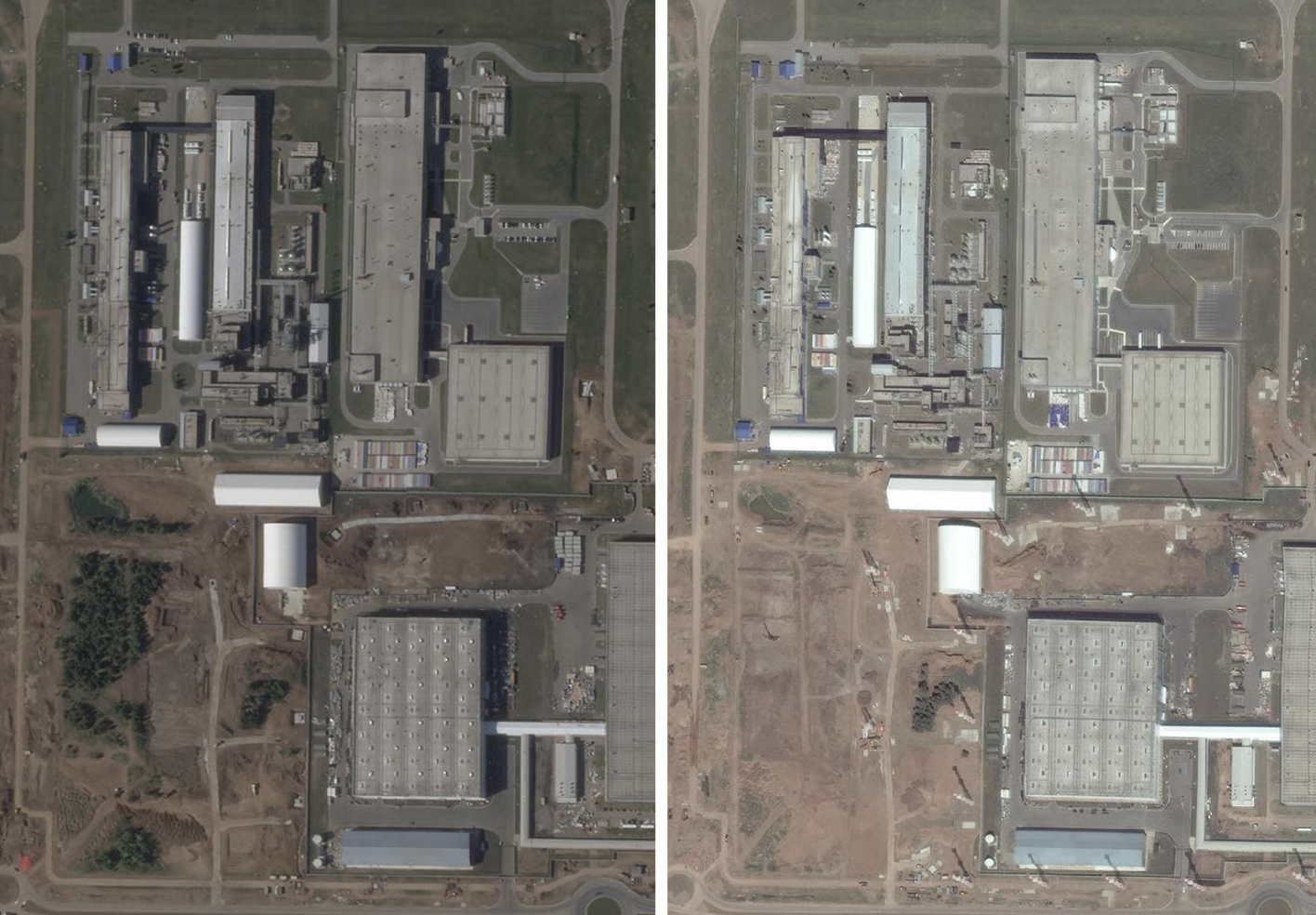
Rosatom has approved an expansion at its Alabuga-Volokno plant that would lift carbon-fiber output to 500 tons a year by 2029, material an outside weapons expert estimates could support 28,000 additional Geran airframes annually. The project sits inside a broader state reallocation: the Finance Ministry’s 2027-29 proposal puts 135.7 billion rubles into machine tools and 103.3 billion into unmanned aviation, while converted Soviet-era factories feed smaller developers linked to frontline feedback and the incoming Duma prepares a committee for unmanned systems and artificial intelligence. Russia’s Defense Ministry says it is also striking Ukrainian sites making UAV components and ground robots, bringing carbon fiber, production machinery, factory conversion, battlefield iteration, state finance, parliamentary oversight, and the opponent’s supply base into a single production contest. (POLITICO) (An-Nahar) (RIA Novosti) (Lenta.ru) (MK.ru)
Cartel Counter-Innovation Set to Surge Demand and Investment in the Western Hemisphere
A U.S. assessment says Mexican cartels are recruiting Colombians returning from Ukraine, sending affiliates to Ukraine, and studying jamming-evasion techniques such as changing radio frequencies as they pursue longer-endurance, heavier-payload drones. At the U.S.-Mexico border, Joint Task Force Southern Border says cartels alter their drone maneuvers and tactics frequently, using aircraft for surveillance, route finding, and possible package transport. The adaptation loop creates a recurring requirement for sensors, jammers, and directed-energy systems that can keep pace with aircraft and operator techniques criminals can change far faster than a border program can replace a fixed system. (The Washington Post) (DefenseScoop)
Korean Prime Establishes National Defense Ecosystem to Improve Market Competitiveness
Hanwha Aerospace has signed memorandums with 43 South Korean companies covering airframes, components, materials, and mission equipment, positioning itself as the systems integrator for a K-UAV ecosystem aimed at overseas sales. Its large-aircraft test case is the Mojave STOL, developed with General Atomics, for which Hanwha plans a South Korean production line with more than 70% domestic content when mass production begins; smaller platforms would be offered with K9 howitzers and Chunmoo rocket launchers. The strategy gives domestic suppliers a route into series production and export packages, though its commercial value depends on converting the agreements into orders and volume. (Yonhap News TV) (Yonhap News Agency)
Acoustic Detection Shows Key Role in the C-UAS Detection Ecosystem
Researchers at Poland’s Łódź University of Technology have built a passive microphone array that isolates motor and propeller noise, calculates a drone’s location from multiple sensors, and can follow a low-altitude flight path. Russia’s proposed Spider network uses the same layer in a distributed form: its developers say acoustic sensors can classify UAV types, detect FPV drones at up to 200 metres, and detect larger gasoline-powered aircraft beyond one kilometre, though those performance claims are unverified. Both designs turn a drone’s own sound into an inexpensive tripwire that can cue the scarce radar, optical, and interceptor resources needed to confirm and defeat a track, with weather, terrain, and engine type determining how much warning it provides. (RMF24) (Izvestia)
Domestic Drone Production Helps Intensify Yemen Civil War
As fighting renewed across six provinces, Yemeni government forces reported using drones against Houthi positions, vehicles, weapons, and ammunition in Jawf and Marib, while the Houthis claimed to have downed a Saudi Wing Loong 2 near Mokha. At a public event in Amran, Houthi officials said Yemen has progressed from making basic military supplies to producing advanced drones and hypersonic missiles, without offering production figures or technical evidence. UAVs are now routine tools on both sides of a civil war that had been relatively quiet for four years, while claims of domestic production have become part of the Houthi case for strategic self-reliance. (Al Jazeera) (SABA)
Hardware Innovations and Tactical Adaptations
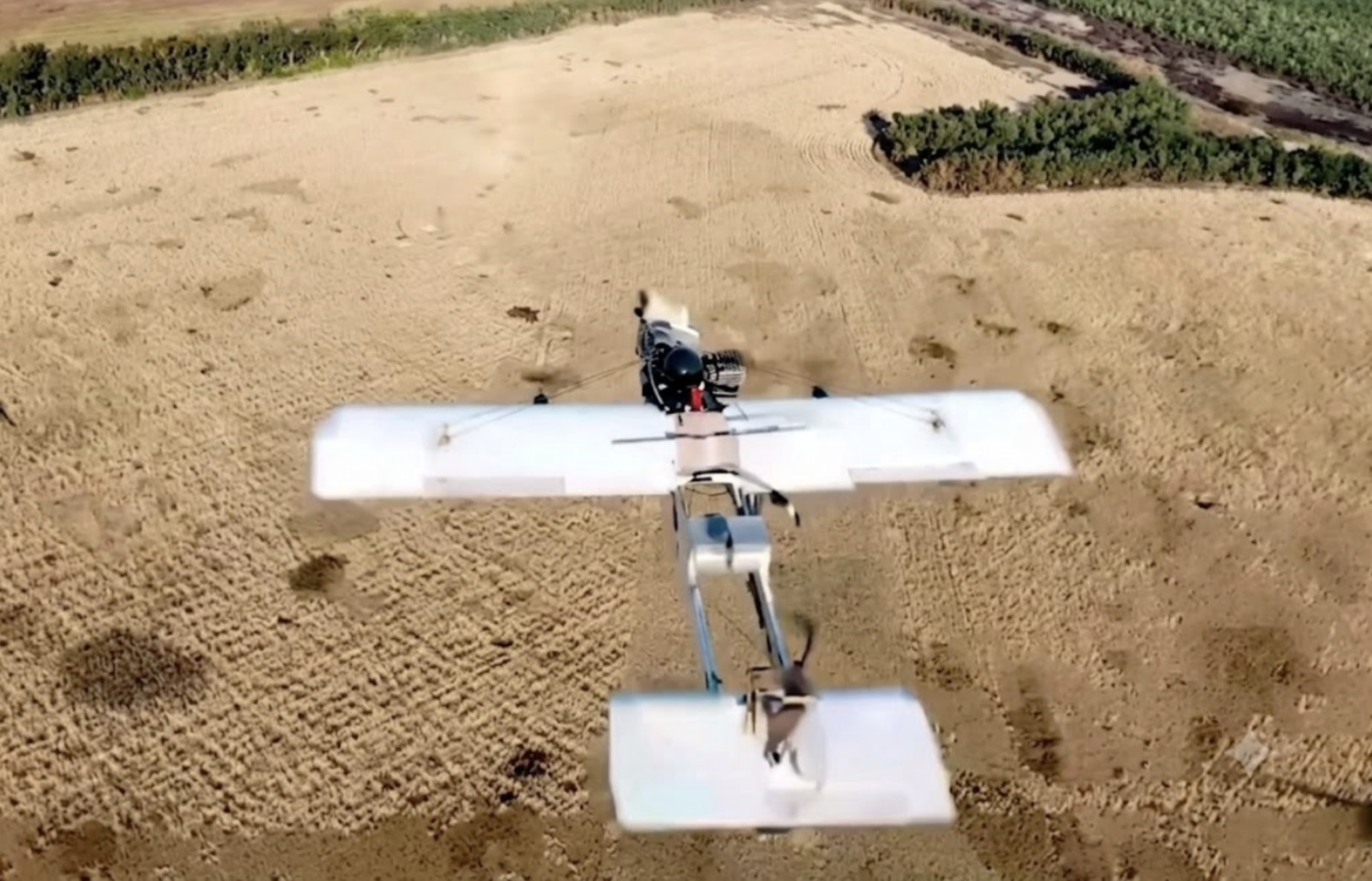
- Molniya with a Rifle: A Russian fixed-wing Molniya UAV with a rifle strapped to its airframe was recently intercepted by the Ukrainian drone operators from the 82nd Air Assault Brigade. Unlike previous configurations, where strapped rifles served as an add-on kinetic layer to the drone, this time the rifle was part of a package to be delivered to Russian soldiers in forward positions. This suggests Russia could likely be testing its existing drone stack for frontline logistics instead of immediately adding newer platforms, which would require training to operate. It also shows how modularity in Russian expendable drone designs reinforces mission flexibility and range.
- FPV with Radio Horizon: Ukraine is equipping FPV drones with radio horizons to create an airborne communication relay as Russian EW measures intensify. 2-3 large antenna panels are put on the drone to build multiple communication channels between the operator and platform, such as operator to airborne relay, and then relay to FPV. This elevated node could potentially clear obstacles, improve line of sight and push the practical radio horizon farther away without requiring the operator to move forward with it. But it does not make the drone jamming-free.
- Drone ‘Watch Towers’: In light of Ukraine’s long-range drone strikes, Russia has reportedly created elevated and dedicated work platforms for its MANPADS teams (usually a team of 2-4) around Moscow. Given, a shoulder-fired air-defense missile is mostly useful if the operator can see, acquire and track the target in time, these stations likely aim to remove the visual barrier present in dense urban terrain. This can let operators spot low-flying drones early, preserving the engagement windows.
What We're Reading
- Pentagon Pushes Open Systems Into the Field: The Pentagon’s new Modular Open Systems Approach cadre and NAVAIR’s search for a Marine controller reflect an effort to replace platform-specific ground stations with field-swappable hardware and software. (Military Embedded Systems) (Military Embedded Systems)
- The Army Tests Balloons as a High-Altitude Drone Launch Layer: The Army’s balloon-carried APOLLO-R launch in Japan, following tests in Guam and Morocco, explores a low-cost way to put sensors, communications relays, and effects over dispersed theaters. (The Defence Blog) (U.S. Army Japan)
- Microsoft’s Gulf AI Buildout Rests on Regional Resilience: Microsoft’s planned $10 billion Gulf investment in cloud, AI, and telecommunications makes digital resilience and data protection central to an infrastructure buildout continuing through wartime. (Reuters)
- Ho Chi Minh City Gives Drone Delivery a Real-World Sandbox: Ho Chi Minh City has begun autonomous UAV deliveries under a Defense Ministry flight permit, turning an urban logistics sandbox into short-range trials in real airspace. (VnExpress)
- Rheinmetall Tests an Unmanned Port-Security Network: Rheinmetall used REPMUS26 to test a mobile German Navy command centre linking different unmanned systems, treating interoperability as the central port-security problem. (Rheinmetall)
- Shipboard 3D Printing Gets a Naval Logistics Trial: Firestorm says crews aboard USS Essex printed more than 1,000 unique parts and 12 FPV drones, testing at-sea manufacturing as a faster replacement pipeline. (National Defense Magazine)
- Manpower Pressure Pushes AI Deeper Into Drone Warfare: A shrinking pool of soldiers is pushing Russia and Ukraine toward automation, with reported AI-assisted Gerans giving autonomy a more direct place in the strike chain. (O Globo) (El Confidencial)
- China’s BG-5 Brings Biomimicry Into Coastal Reconnaissance: China’s fin-propelled BG-5 robotic fish can reach five metres without propeller noise, bringing a lower acoustic profile to shallow-water reconnaissance. (Yonhap News Agency)
- Ukraine Deploys Bomber Drones to Insert Strike Robots: Ukraine’s 3rd Army Corps says heavy bomber drones air-dropped kamikaze ground robots more than 10 kilometres behind Russian lines, extending unmanned ground operations beyond the immediate front. (Ukrainska Pravda)
- Drone Attacks Push Turkish Sailors Into the War’s Risk Zone: The unclaimed drone strike on the Turkish-flagged Duru 67 off Crimea severely injured crew, one episode in 226 reported Black Sea attacks on civilian and commercial vessels. (Arab News)
- Pakistan Uses Drone-Incursion Claim to Widen Afghan Strikes: Pakistan says it struck 10 Afghan drone sites after intercepting aircraft from across the border, while Kabul says the strikes killed four civilians and denies launching the drones. (Reuters)


